Wednesday, February 18, 2026
Medicare Part D Pharmacy Networks in 2026: Supermarkets Dominate as Drugstores Stall and Independents Walk Away
The Centers for Medicare & Medicaid Services (CMS) has just released its initial 2026 data on enrollment in Medicare Part D prescription drug plans (PDPs).
DCI’s exclusive analysis shows that 83% of seniors remain enrolled in PDPs with preferred pharmacy networks—essentially unchanged from 82% in 2025, but sharply lower than the 99% peak in 2023. Meanwhile, the number of major Part D plans offering preferred networks has fallen to a record-low eight.
The new enrollment data reveal a clear shift in competitive positioning: Albertsons and Publix are now preferred in every major plan. Walgreens is holding strong. Walmart—the company that invented the Part D preferred network model—has slipped to the middle of the preferred pack.
Meanwhile, smaller pharmacies have fully abandoned PDPs’ preferred networks in 2026.
At the same time, the IRA’s expansion of the Low-Income Subsidy (LIS) means a growing share of beneficiaries have little financial incentive to use a preferred pharmacy at all. Add in the PBM reforms in the Consolidated Appropriations Act of 2026, and the preferred network model will gradually lose relevance.
Thursday, November 13, 2025
Medicare Part D 2026: Preferred Networks Vanish as the PDP Market Collapses
DCI’s exclusive analysis of Center for Medicare & Medicaid Services’ (CMS) data reveals:
- The number of PDPs has plummeted by 55% since the IRA’s passage, to a record low of 360 plans for 2026.
- Preferred cost-sharing pharmacy networks are disappearing, with their share falling to the lowest level since 2014. That’s a post-IRA net loss of 505 plans with these networks.
- Just five companies—Aetna, Health Care Service Corporation, Humana, UnitedHealthcare, Wellcare—will account for 94% of all PDPs in 2026. In recent years, four major plan sponsors—Cigna, Clear Spring Health, Elevance Health, and Mutual of Omaha—have exited the PDP market.
Even with the demonstration program handouts, the Part D market is increasingly fragile: fewer choices, greater concentration, and massive disruption for beneficiaries.
Thanks, IRA! 🙃
What else should you expect for 2026? Find out during my upcoming live video webinar, Drug Channels Outlook 2026, on December 12, 2025, from 12:00 p.m. to 1:30 p.m. ET. Click here to learn more and sign up. As always, we are offering special discounts if you want to bring your whole team.
Wednesday, April 23, 2025
Smaller Pharmacies, Bigger Impact: Inside Manufacturers’ Specialty Networks in 2025
Today, we dive deeper. Drawing from DCI’s new 2025 Economic Report on U.S. Pharmacies and Pharmacy Benefit Managers, we explore how pharmaceutical manufacturers structure their specialty pharmacy networks—and how smaller, independent pharmacies have emerged as dominant players in exclusive networks.
In DCI’s latest analysis, we find specialty pharmacies affiliated with the largest PBMs still play an outsized role in limited networks. But like a certain striped-hatted cat, smaller pharmacies unaffiliated with PBMs show up where few expect them. They dominate exclusive networks and maybe even cleaning up any messes left by Things 1, 2, and 3.
Read on for DCI’s updated profile of specialty networks—and consider why smaller players are showing the good tricks that they know.
Tuesday, February 18, 2025
Vanishing Act: Why Small Pharmacies Exited Medicare Part D Networks for 2025
A few months ago , DCI highlighted how the largest pharmacy chains are participating as preferred cost sharing pharmacies in the 2025 stand-alone prescription drug plan (PDP) networks. Today, we update our exclusive analysis of how smaller pharmacies are participating via their pharmacy services administrative organizations (PSAOs).
As you will see below, the largest PSAOs have almost fully abandoned PDPs’ preferred networks in 2025. Plans from Humana, WellCare, and UnitedHealthcare will again not have any independent pharmacies participating via PSAOs as preferred pharmacies.
Thanks to the Inflation Reduction Act (IRA), the PDP market is vanishing. Looks like the presence of smaller pharmacies in preferred networks will not be far behind.
Tuesday, November 19, 2024
Large Chains’ Position in 2025’s Part D Pharmacy Networks: Supermarkets Take the Lead in a Shrinking PDP Market
Today, we examine the seven largest retail chains’ participation in the 12 major 2025 Part D networks that the five largest plan sponsors will offer. As always, we provide you with a handy table for tallying each chain’s participation and changes from 2024 to 2025.
As you’ll see, Albertsons and Publix are the only major retail chains that will be participating in all of the major PDP’s preferred and open pharmacy networks. Walmart and Walgreens will maintain strong participation, while CVS will pull back. Low-income subsidy (LIS) beneficiaries, whose ranks expanded due to the IRA, will continue to have no financial advantage for using a preferred pharmacy.
In a future post, we’ll delve into how smaller pharmacies will participate in the 2025 Part D plans, by examining the pharmacy services administrative organizations (PSAOs).
Speaking of 2025, please join Adam J. Fein, Ph.D., for his upcoming live video webinar, Drug Channels Outlook 2025, on December 13, 2024, from 12:00 p.m. to 1:30 p.m. ET. Click here to learn more and sign up.
Wednesday, November 13, 2024
Medicare Part D in 2025: Preferred Pharmacy Networks Fade in a Collapsing PDP Market
For 2025, DCI’s exclusive analysis of Center for Medicare & Medicaid Services’ (CMS) data reveals that the number of PDPs will drop to a historic low. What’s more, the share of plans with a preferred cost sharing pharmacy network will fall to its lowest rate in more than 10 years. Check out the distressing charts below and our review of the remaining national players (Aetna, Cigna, Humana, UnitedHealthcare, and WellCare).
The destruction of the Part D market marks yet another unintended consequence of the Inflation Reduction Act of 2022 (IRA). The IRA makes PDPs less economically viable and will drive even more seniors into Medicare Advantage Prescription Drug (MA-PD) plans—despite the challenges facing those plans. The 2025 decline will occur even after CMS gifted $7 billion to PDPs to prevent a complete collapse of the 2025 market.
Legislate in haste. Repent in leisure.
What else should you expect for 2025? Find out during my upcoming live video webinar, Drug Channels Outlook 2025, on December 13, 2024, from 12:00 p.m. to 1:30 p.m. ET. Click here to learn more and sign up. As always, we are offering special discounts if you want to bring your whole team.
Tuesday, June 18, 2024
The Top 15 Specialty Pharmacies of 2023: Market Shares and Revenues at the Biggest PBMs, Health Plans, and Independents (rerun)
One important update to the figures below: We (and many others) had significantly underestimated Walgreens' revenues and market share. As we discuss below, its market share is closer to 10%, compared with the 3% that we originally reported.
Click here to see the original post from April 2024.
Drug Channels Institute’s (DCI’s) latest analysis finds that participants in the specialty pharmacy market continue to get more diverse—although revenues remain highly concentrated.
We have identified nearly 1,800 dispensing sites with specialty pharmacy accreditation—about 40% of which are owned by hospitals, physician practices, and other healthcare providers.
Alas, specialty pharmacies owned by the three largest pharmacy benefit managers (PBMs) have the most brass in their pocket, as they accounted for two-thirds of prescription revenues from pharmacy-dispensed specialty drugs.
Read on for DCI’s latest overview of the 2023 marketplace and revenues of the biggest market participants, along with key specialty pharmacy trends.
Tuesday, April 16, 2024
The Top 15 Specialty Pharmacies of 2023: Market Shares and Revenues at the Biggest PBMs, Health Plans, and Independents
We have identified nearly 1,800 dispensing sites with specialty pharmacy accreditation—about 40% of which are owned by hospitals, physician practices, and other healthcare providers.
Alas, specialty pharmacies owned by the three largest pharmacy benefit managers (PBMs) have the most brass in their pocket, as they accounted for two-thirds of prescription revenues from pharmacy-dispensed specialty drugs.
Read on for DCI’s latest overview of the 2023 marketplace and revenues of the biggest market participants, along with key specialty pharmacy trends.
Thursday, April 04, 2024
Vertical Integration Lessons: The Economics and Strategies of Hospital-Owned Specialty Pharmacies (rerun)
For updated data on hospital-owned specialty pharmacies, see Chapter 3 of DCI's new 2024 Economic Report on U.S. Pharmacies and Pharmacy Benefit Managers.
Click here to see the original post from November 2023.
As many of you know, hospitals and health systems have emerged as significant participants in the specialty pharmacy industry. A new American Society of Hospital Pharmacists (ASHP) survey provides fresh insights into these specialty pharmacies.
Below, I review key findings on the economics and operations of these specialty pharmacies. I then highlight how hospitals steer prescriptions to their internal specialty pharmacies.
As you’ll see, hospitals use network strategies that would make any pharmacy benefit manager (PBM) proud—especially when combined with the prescribing activities of hospital-employed physicians.
Vertical integration among insurers, PBMs, specialty pharmacies, and providers within U.S. drug channels gets most of the attention. But a parallel vertical integration has been occurring among hospitals, specialty pharmacies, and physicians. Manufacturers and payers must adapt to the growing power and market tactics of hospital-owned specialty pharmacies.
Tuesday, January 23, 2024
Medicare Part D in 2024: Smaller Pharmacies Abandon Preferred Pharmacy Networks
Today, I update DCI's exclusive analysis of how smaller pharmacies will participate as preferred cost sharing pharmacies via the pharmacy services administrative organizations (PSAOs) that represent them in negotiations with plans.
As you will see below, the largest PSAOs have effectively abandoned PDP’s preferred networks in 2024. Plans from Aetna, Humana, WellCare, and UnitedHealthcare will not have any independent pharmacies participating via PSAOs as preferred pharmacies.
Smaller pharmacies' ability to navigate away provides more bad news for stand-alone Part D market—and another unexpected consequence of the Inflation Reduction Act of 2022. Look out below!
Wednesday, November 15, 2023
Medicare Part D in 2024: Mapping Large Chains' Position in 2024’s Preferred Pharmacy Networks
Today, I examine the seven largest retail chains’ participation in the 20 major 2024 Part D networks that the eight largest plan sponsors will offer. As always, I offer you a handy table for scoring each chain’s participation and changes from 2023 to 2024.
As you’ll see, these companies all maintained strong positions in the major PDP’s preferred networks. Walmart has the highest participation, while Rite Aid has the lowest. In an upcoming post, I’ll delve into how smaller pharmacies will participate in the 2024 Part D plans, by examining the pharmacy services administrative organizations (PSAOs).
Speaking of 2024, please join me for my upcoming live video webinar, Drug Channels Outlook 2024, on December 15, 2023, from 12:00 p.m. to 1:30 p.m. ET. Click here to learn more and sign up.
Tuesday, November 07, 2023
Vertical Integration Lessons: The Economics and Strategies of Hospital-Owned Specialty Pharmacies
Below, I review key findings on the economics and operations of these specialty pharmacies. I then highlight how hospitals steer prescriptions to their internal specialty pharmacies.
As you’ll see, hospitals use network strategies that would make any pharmacy benefit manager (PBM) proud—especially when combined with the prescribing activities of hospital-employed physicians.
Vertical integration among insurers, PBMs, specialty pharmacies, and providers within U.S. drug channels gets most of the attention. But a parallel vertical integration has been occurring among hospitals, specialty pharmacies, and physicians. Manufacturers and payers must adapt to the growing power and market tactics of hospital-owned specialty pharmacies.
Tuesday, October 24, 2023
Medicare Part D in 2024: The Seven Largest Companies' Preferred Pharmacy Networks and the Coming Collapse of the PDP Market
For 2024:
- 94% of stand-alone Medicare Part D prescription drug plans (PDP) will have a preferred network.
- 51% of Medicare Advantage prescription drug (MA-PD) plans will have a preferred network.
The 2024 data provide early evidence of a shrinking PDP market. Chalk it up to yet another unintended consequence of the Inflation Reduction Act of 2022 (IRA), which will make PDPs less economically viable and drive even more seniors into Medicare Advantage plans.
Wednesday, March 29, 2023
CVS, Walgreens, and Walmart Keep Position in 2023 Part D Preferred Networks—While Kroger Bails Over its Express Scripts Blowup (rerun)
One follow-up to this rerun: Kroger’s participation as a preferred pharmacy declined significantly due to its Express Scripts relationship. Based on early 2023 enrollment data, Kroger is preferred in plans that enrolled only 11.8 million people—a decline of 33% from the 2022 figure. See Exhibit 154 of our new 2023 Economic Report on U.S. Pharmacies and Pharmacy Benefit Managers.
Click here to see the original post and comments from December 2022.
In Preferred Pharmacy Networks in 2023’s Medicare Part D Plans: Cigna, CVS Health, Humana, UnitedHealthcare, WellCare, and More, I highlighted how those networks have taken over the world of stand-alone Medicare Part D prescription drug plans (PDP) and become a major presence in Medicare Advantage prescription drug (MA-PD) plans.
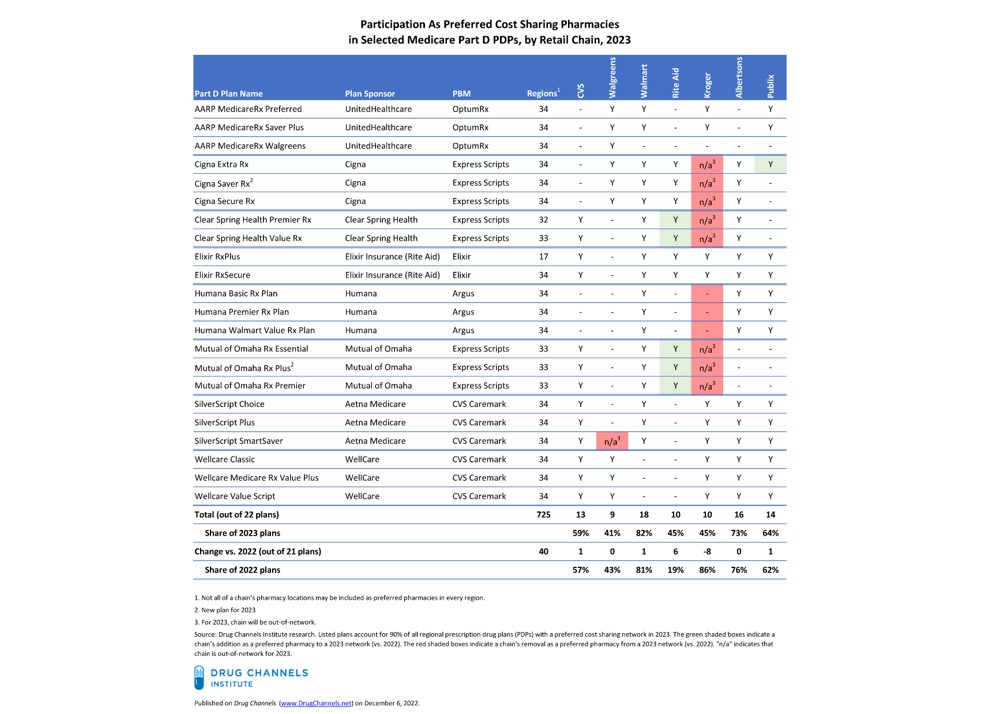
Today, I examine the seven largest retail chains’ 2023 participation in the 22 major 2023 Part D preferred networks that the eight largest plan sponsors will offer. As always, I offer you a handy table for scoring each chain’s participation and changes from 2022 to 2023.
As you’ll see, Kroger’s decision to exit Express Scripts commercial pharmacy networks has had negative ramifications for its Part D position. Kroger will be out-of-network—not just non-preferred—in the major Part D networks for which Express Scripts acts as the PBM. That will be a key factor behind its $1+ billion revenue hit.
Tuesday, February 14, 2023
Exclusive: Profiling Manufacturers’ Limited and Exclusive Pharmacy Networks for Specialty Drugs
Below, we rely on a unique database to provide you with some never-before-published benchmarking data on manufacturer-defined networks for 290 specialty drugs.
As you’ll see, a typical network contains only five specialty pharmacies. However, this average disguises substantial variability in network size. More than one in four specialty products have an exclusive network, while some have as many as 25 participants.
Manufacturers almost always say “be mine” to pharmacy benefit manager (PBM) affiliated partners, but they also swipe right with unaffiliated specialty pharmacies. Alas, PBM and plan strategies can still make smaller pharmacies feel lonesome.
Wednesday, December 07, 2022
Small Pharmacies Walk Away from Medicare Part D’s 2023 Preferred Networks
Today, I update our annual analyses of how smaller pharmacies will participate as preferred cost sharing pharmacies via the pharmacy services administrative organizations (PSAOs) that represent them in negotiations with plans.
As you will see below, the largest PSAOs will move further away from preferred networks in 2023. What's more, plans from Aetna, Humana, WellCare, and UnitedHealthcare will not have any independent pharmacies participating via PSAOs as preferred pharmacies.
Below we provide details about the PSAOs owned by the three major wholesalers—AmerisourceBergen, Cardinal Health, and McKesson—along with information about AlignRx, the largest independent PSAO. There are some differences in strategy, as you will see from our handy scorecard below. However, smaller pharmacies’ near-total rejection of preferred networks shows that the more the PBMs talk, the less independents can take.
What else is ahead for 2023? Find out during my upcoming live video webinar, Drug Channels Outlook 2023, on December 16, 2022, from 12:00 p.m. to 1:30 p.m. ET. Click here to learn more and sign up.
Tuesday, December 06, 2022
CVS, Walgreens, and Walmart Keep Position in 2023 Part D Preferred Networks—While Kroger Bails Over its Express Scripts Blowup
Today, I examine the seven largest retail chains’ 2023 participation in the 22 major 2023 Part D preferred networks that the eight largest plan sponsors will offer. As always, I offer you a handy table for scoring each chain’s participation and changes from 2022 to 2023.
As you’ll see, Kroger’s decision to exit Express Scripts commercial pharmacy networks has had negative ramifications for its Part D position. Kroger will be out-of-network—not just non-preferred—in the major Part D networks for which Express Scripts acts as the PBM. That will be a key factor behind its $1+ billion revenue hit.
Speaking of 2023, please join me for my upcoming live video webinar, Drug Channels Outlook 2023, on December 16, 2022, from 12:00 p.m. to 1:30 p.m. ET. Click here to learn more and sign up.
Tuesday, November 01, 2022
Preferred Pharmacy Networks in 2023’s Medicare Part D Plans: Cigna, CVS Health, Humana, UnitedHealthcare, WellCare, and More
For 2023:
- 98% of stand-alone Medicare Part D prescription drug plans (PDP) will have a preferred network.
- 52% of Medicare Advantage prescription drug (MA-PD) plans will have a preferred network.
The largest companies made only minor changes to their 2023 stand-alone plans, after streamlining their 2022 plans. I also update our analysis of the prevalence of preferred networks in three different types of MA-PD plans.
In upcoming articles, I’ll investigate what we can deduce from chain and independent pharmacies’ participation in the major 2023 preferred networks.
Tuesday, March 01, 2022
Supermarkets Again Dash Past CVS and Walgreens in 2022’s Part D Pharmacy Networks
Below, we use the new enrollment data to examine the major pharmacy chains’ position within the 27 major Part D plans that have preferred networks. For the second year, the big supermarket chains—Albertsons, Kroger, and Publix—outpaced the big three drugstore chains and Walmart.
Supermarket pharmacies gained overall prescription market share in 2021, as we discuss in our forthcoming 2022 Economic Report on U.S. Pharmacies and Pharmacy Benefit Managers. Expect supermarkets to run even faster in 2022. What a strange world we live in!
Wednesday, December 01, 2021
CVS Pharmacy Downsizes: 10 Industry Trends Driving the Retail Shakeout
This long-overdue move highlights the retail industry’s fundamental economic headwinds. The pharmacy shakeout is accelerating, as smaller competitors exit and larger companies reduce store count.
To help you make sense of CVS’s move, below I outline 10 crucial forces of change reshaping the retail pharmacy industry.
For more on pharmacy’s future, please register for Drug Channels Outlook 2022, my live video webinar that will air on December 17, 2021.