

P.S. Join my 70,000+ LinkedIn followers for links to interesting industry news, along with unfiltered commentary from the DCI community.
340B in 2026: Market Shifts, Policy Battles, and What They Mean for Stakeholders.
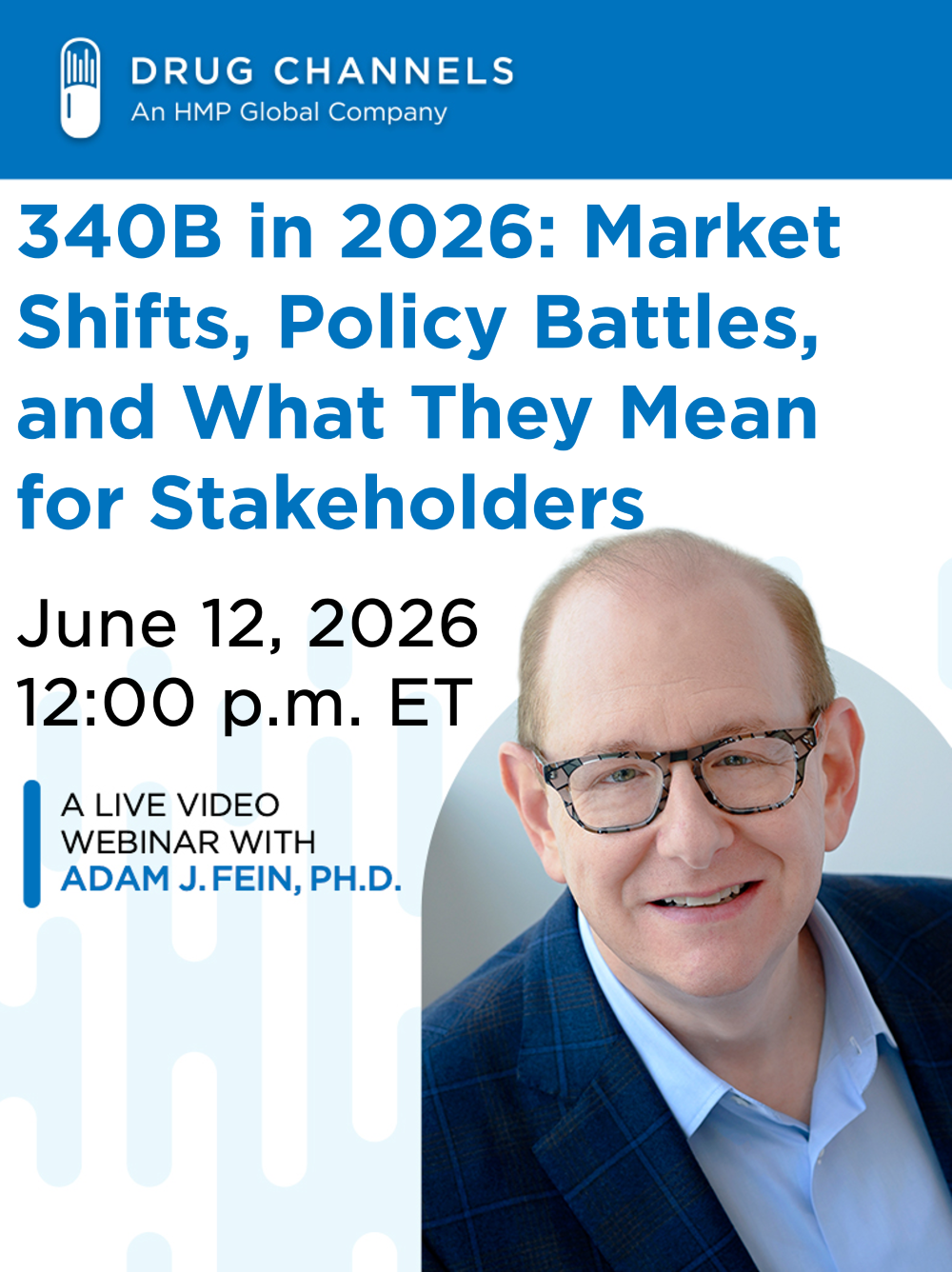
Don't miss DCI’s upcoming webinar on Friday, June 12, 2026, from 12:00 p.m. to 1:30 p.m. ET. Adam J. Fein and Tyler Novotny will unpack the good, the bad, and the ugly of the 340B program—and what it means for you. Click here to learn more and sign up.
Optum Rx Introduces Industry’s First Transparent Pharmacy Care Model, Business Wire
One consequence of the Net Pricing Drug Channel is that intermediaries—pharmacies, wholesalers, and PBMs—will move to decouple their compensation from list prices.
The latest example comes from Optum Rx. From the company’s announcement:
Optum Rx is acknowledging what the NPDC makes increasingly unavoidable:
P.S. Click here to read the lively debate on this announcement among the Drug Channels community.
The latest example comes from Optum Rx. From the company’s announcement:
“Under the new approach, Optum Rx clients will be offered a pricing structure with monthly, clearly defined fees per member that are independent of manufacturers’ list prices or prescription volume, eliminating spread pricing and similar practices. Every client will have transparency into Optum Rx fees — including those associated with its group purchasing organization (GPO) — with clear disclosure of payments received from pharmaceutical manufacturers. By the end of 2027, group purchasing will fully transition to flat service fees.”Translation: Optum Rx claims to be shifting away from spread pricing, rebate opacity, and list-price-linked economics.
Optum Rx is acknowledging what the NPDC makes increasingly unavoidable:
- Simpler, fee-based pricing models will win
- Rebate-heavy strategies will become less sustainable
- Gross-to-net arbitrage will be harder to sustain
- Transparent money flows will force intermediaries to redefine their value
P.S. Click here to read the lively debate on this announcement among the Drug Channels community.
Stretching Scarce Authorizing Legislation as Far as Possible: A Legislative History of the 340B Drug Pricing Program , The Milbank Quarterly
If you care about 340B policy, read this outstanding new paper.
Sayeh Nikpay and her colleagues went back to the early 1990's to reconstruct the program's origins. Their research draws on interviews with 18 key participants and 175 primary source documents spanning 1990–1992.
Their conclusion is difficult to ignore.
340B was originally designed as a narrow policy solution to address an unintended consequence of Medicaid’s best-price provision while supporting core safety-net providers.
But the paper makes a compelling case that today’s program extends far beyond Congress’s original intent.
Whether you support or oppose the current structure of 340B, this paper is essential reading for anyone who wants to understand how we got here.
One especially fascinating detail: The disproportionate share hospital (DSH) eligibility threshold of 11.75% was chosen specifically to qualify two specific hospitals and secure bipartisan support from Senator Hatch and Representative Bliley.
In other words, the threshold was not grounded in any broader scientific or policy rationale.
Amazing.
Sayeh Nikpay and her colleagues went back to the early 1990's to reconstruct the program's origins. Their research draws on interviews with 18 key participants and 175 primary source documents spanning 1990–1992.
Their conclusion is difficult to ignore.
340B was originally designed as a narrow policy solution to address an unintended consequence of Medicaid’s best-price provision while supporting core safety-net providers.
But the paper makes a compelling case that today’s program extends far beyond Congress’s original intent.
Whether you support or oppose the current structure of 340B, this paper is essential reading for anyone who wants to understand how we got here.
One especially fascinating detail: The disproportionate share hospital (DSH) eligibility threshold of 11.75% was chosen specifically to qualify two specific hospitals and secure bipartisan support from Senator Hatch and Representative Bliley.
In other words, the threshold was not grounded in any broader scientific or policy rationale.
Amazing.
Inside Blue Shield of California’s $500M PBM experiment, Modern Healthcare
In 2024, Blue Shield of California promised "$500 million in medication savings” with its widely praised attempt to unbundle the traditional PBM model across nine different vendors. At the time, I was a bit skeptical. (See A Reality Check on That Blue Shield of California Announcement.)
So, how’s it going?
Not so well.
According to this Modern Healthcare interview with Paul Markovich: "Progress toward major savings is proving more gradual than the company anticipated."
Blue Shield reports $100 million in savings through "lower administrative costs." But last year, Mr. Markovich revealed that the company had already “spent nearly $100 million getting our pharmacy model set up and working.”
So, despite the glowing press coverage in 2024, there's still little evidence of meaningful net savings. That’s why I remain skeptical that Blue Shield has stumbled upon a viable and scalable alternative to the traditional PBM model.
If anything, the company's misadventures reinforce a lesson often emphasized by Mark Cuban: Complexity is the enemy of low costs and efficiency.
So, how’s it going?
Not so well.
According to this Modern Healthcare interview with Paul Markovich: "Progress toward major savings is proving more gradual than the company anticipated."
Blue Shield reports $100 million in savings through "lower administrative costs." But last year, Mr. Markovich revealed that the company had already “spent nearly $100 million getting our pharmacy model set up and working.”
So, despite the glowing press coverage in 2024, there's still little evidence of meaningful net savings. That’s why I remain skeptical that Blue Shield has stumbled upon a viable and scalable alternative to the traditional PBM model.
If anything, the company's misadventures reinforce a lesson often emphasized by Mark Cuban: Complexity is the enemy of low costs and efficiency.
Prior Authorization and Associated Delays and Denials of Branded Medication Dispensation , JAMA Health Forum
This JAMA Health Forum article analyzed roughly 206,000 brand-name drug prescriptions with initial prior authorization (PA) rejections.
Some shocking stats from the study:

Bottom line: For many patients, an initial PA rejection means delayed (or no) treatment.
Some shocking stats from the study:
- Only 35% were resolved the same day
- 65% experienced delays (median = 6 days)
- Nearly half (46%) were never approved
- Refills and complex cases were less likely to move quickly
- Medicaid patients and people with multiple conditions had lower approval rates
- Approval rates varied substantially across therapies, highlighting uneven patient access, as you can see below
[Click to Enlarge]

Bottom line: For many patients, an initial PA rejection means delayed (or no) treatment.
Asembia’s AXS26, LinkedIn
The DCI team had a great time at Asembia’s AXS26 in Las Vegas. It’s always good to reconnect with old friends and make a few new ones along the way.
Events like this are a great reminder of how fun this industry can be, despite the breathtaking pace of change.

And special thanks to Marie Caldwell for the amazing stickers featuring fan-favorite Drug Channels sayings!

Events like this are a great reminder of how fun this industry can be, despite the breathtaking pace of change.
[Click to Enlarge]

And special thanks to Marie Caldwell for the amazing stickers featuring fan-favorite Drug Channels sayings!
[Click to Enlarge]

No comments:
Post a Comment