Drug Channels delivers timely analysis and provocative opinions from Adam J. Fein, Ph.D., the country's foremost expert on pharmaceutical economics and the drug distribution system. Drug Channels reaches an engaged, loyal and growing audience of more than 100,000 subscribers and followers. Learn more...
Showing posts with label Health Care Policy. Show all posts

Wednesday, July 15, 2026

The 340B Program Hit $100 Billion in 2025: Has It Become Too Big to Reform?

By Adam J. Fein, Ph.D.

The 340B Drug Pricing Program continues to redefine the meaning of "skyrocketing."
  • For 2025, discounted purchases under the 340B program reached an astounding $100 billion—23% higher than in 2024.
  • The gross-to-net difference between list prices and discounted 340B purchases—a proxy for funds available to covered entities—also grew, to $79.5 billion (+$12.0 billion).
  • Hospitals again accounted for 87% of 340B purchases.
  • 340B purchases are now more than 70% larger than Medicaid’s net prescription drug spending. The program now accounts for nearly one-fifth of the total U.S. gross-to-net bubble.

During DCI’s June webinar, I predicted that the 340B program would move from an era of expansion and opacity to one of transparency and accountability.

But given the latest growth figures, I worry that reform of this undermanaged, out-of-control program may never happen. Has the program become too big to reform?

Read on for our full analysis—and consider whether 340B will ever face its true day of reckoning.

Click here to share your thoughts on the latest 340B data with the Drug Channels community on LinkedIn.

Tuesday, March 31, 2026

Drug Channels News Roundup, March 2026: Cigna’s 340B Workaround, Merck’s ARPA Surprise, Walgreens’ Automation Bet, Why Rebates Hurt Patients, and a DCI Team Photo

By Adam J. Fein, Ph.D.

Spring is here in always-sunny Philadelphia. The vernal equinox has brought us an unexpected bounty of noteworthy news: Plus: A bonus photo from the Drug Channels Leadership Forum

P.S. Join my nearly 69,000 LinkedIn followers for links to neat stuff, along with unfiltered commentary from the DCI community.
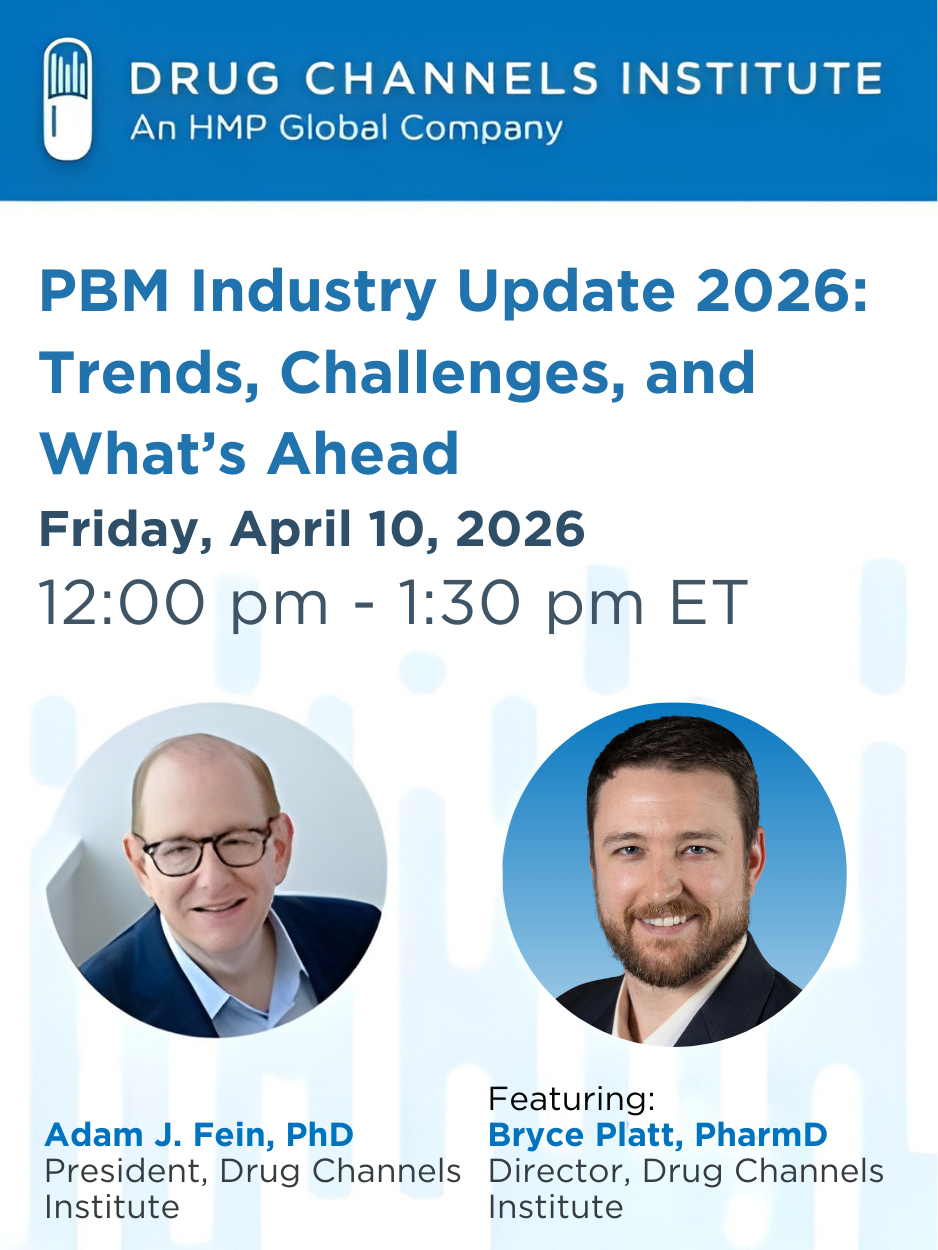
PBM Industry Update 2026: Trends, Challenges, and What's Ahead.

Don't forget to register for DCI’s next webinar on Friday, April 10, 2026, from 12:00 p.m. to 1:30 p.m. ET. Adam J. Fein and Bryce Platt will unpack the good, the bad, and the ugly of the PBM industry—and explore what it means for you. Click here to learn more and sign up.

Tuesday, December 09, 2025

Follow the 340B Dollar: Senator Cassidy Exposes How CVS Health and Walgreens Profit as 340B Contract Pharmacies (rerun)

This week, I’m rerunning some popular posts while I prepare for Friday’s live video webinar: Drug Channels Outlook 2026.

Today's rerun provides background for the webinar, when I will discuss the consequences of the Inflation Reduction Act for the 340B program and contract pharmacies. Click here to see the original post from May 2025.


Two weeks ago, Senator Bill Cassidy—now chair of the Senate Committee on Health, Education, Labor, and Pensions (HELP)—dropped a must-read, eyebrow-raising report on the out-of-control 340B Drug Pricing Program. (Link below.)

The report reveals previously confidential information showing how billions are funneled to health systems and pharmacies—with manufacturers unable to follow the flow.

Below, we use these new disclosures to illustrate the 340B program’s hidden prescription economics for 340B contract specialty pharmacies operated by CVS Health and Walgreens Boots Alliance.

As you can see, the program’s participants earn substantial margins, while plans and third-party payers foot the bill.

What do you think? Click here to share your thoughts with the Drug Channels LinkedIn community.  

Friday, June 20, 2025

Transparency vs. Reality: Troubling Lessons from PBM Disclosure Laws (rerun)

This week, I’m rerunning some popular posts while I prepare for today’s live video webinar: What’s Next for Retail Pharmacy: Data, Debate, and Disruption. I’ll be joined by special guest Antonio Ciaccia, CEO of 46brooklyn Research, and President of 3 Axis Advisors.

Click here to see the original post from March 2025.


Last week, President Trump signed yet another executive order, this time promising to make healthcare pricing more transparent.

While this marks another federal push for disclosure, states have already been quite active in this space. Since 2017, 24 states have passed 38 laws targeting healthcare transparency, with a strong focus on unraveling the complex economics of pharmacy benefit managers (PBMs).

But has all this legislation actually provided clarity—or just more red tape?

Below, I analyze four state reports on manufacturers’ rebate and fee payments to PBMs. The findings are dispiriting: mandated disclosures have yielded little actionable, reliable data. Lawmakers got to pat themselves on the back for “transparency,” but the data tell a different story. Federal efforts haven’t been much better.

Should we continue down the path of government-mandated reporting, or should plan sponsors be left to negotiate their own deals? 

Wednesday, May 28, 2025

Drug Channels News Roundup, May 2025: MFN Controversy, Plan Sponsors ♥️ Rebates, PBM Profits, and Fun in Congress

Summer unofficially began over the weekend. To mark the occasion, here are a few hot items, freshly seared on the Drug Channels grill: Plus: A special moment for DCI on Capitol Hill.

P.S. Join my 63,000+ LinkedIn followers for daily links to neat stuff, along with sharp and thoughtful commentary from the DCI community.
What’s Next for Retail Pharmacy: Data, Debate, and Disruption.

Don’t miss DCI’s June 20, 2025, webinar, featuring Dr. Adam J. Fein and Antonio Ciaccia. We’ll unpack the good, the bad, and the ugly of the pharmacy industry—and explore what it means for you. This dynamic session will blend expert insights and real-time debate. Join us!

Tuesday, May 06, 2025

Follow the 340B Dollar: Senator Cassidy Exposes How CVS Health and Walgreens Profit as 340B Contract Pharmacies

Two weeks ago, Senator Bill Cassidy—now chair of the Senate Committee on Health, Education, Labor, and Pensions (HELP)—dropped a must-read, eyebrow-raising report on the out-of-control 340B Drug Pricing Program. (Link below.)

The report reveals previously confidential information showing how billions are funneled to health systems and pharmacies—with manufacturers unable to follow the flow.

Below, we use these new disclosures to illustrate the 340B program’s hidden prescription economics for 340B contract specialty pharmacies operated by CVS Health and Walgreens Boots Alliance.

As you can see, the program’s participants earn substantial margins, while plans and third-party payers foot the bill.

What do you think? Click here to share your thoughts with the Drug Channels LinkedIn community.  

Monday, April 28, 2025

Drug Channels News Roundup, April 2025: Amazon Rx Update, Express Scripts’ Spend Trends, Gold Cards, and CMS Acronym Absurdity

Spring has officially arrived at Drug Channels' worldwide headquarters in beautiful downtown Philadelphia. (Photo proof at right.) So, scurry over to this month’s curated crop of noteworthy news: Plus, MPPP or not MPPP? That is the question.

P.S. Join nearly 63,000 of your peers who follow me on LinkedIn for daily insights, links to neat stuff, and sharp commentary from the ever-engaged DCI community.

Live from Asembia’s AXS25 Summit: The DCI team is on-site! Swing by booth #1601 at 4 p.m. today for our “Ask Adam Anything” (#AAA) session.

Wednesday, April 02, 2025

Four Revelations from Minnesota’s First 340B Transparency Report (rerun)

This week, I’m rerunning some popular posts while I prepare for Friday’s live video webinar: PBM Industry Update: Trends, Challenges, and What’s Ahead.

Click here to see the original post from December 2024.


It’s time to pay attention to the money behind the 340B curtain.

Minnesota just released the industry‘s first ever mandated financial report on the 340B Drug Pricing Program. Below, I do a wicked deep dive into the data and highlight crucial implications about spending, profits, pharmacies, plans, patients, program integrity, and more.

There are important limitations to these data. But Minnesota’s report marks a valuable first step on the yellow brick road to the wonderful world of transparency. I suspect similar reports are gonna be popular.

Wednesday, March 05, 2025

Transparency vs. Reality: Troubling Lessons from PBM Disclosure Laws

Last week, President Trump signed yet another executive order, this time promising to make healthcare pricing more transparent.

While this marks another federal push for disclosure, states have already been quite active in this space. Since 2017, 24 states have passed 38 laws targeting healthcare transparency, with a strong focus on unraveling the complex economics of pharmacy benefit managers (PBMs).

But has all this legislation actually provided clarity—or just more red tape?

Below, I analyze four state reports on manufacturers’ rebate and fee payments to PBMs. The findings are dispiriting: mandated disclosures have yielded little actionable, reliable data. Lawmakers got to pat themselves on the back for “transparency,” but the data tell a different story. Federal efforts haven’t been much better.

Should we continue down the path of government-mandated reporting, or should plan sponsors be left to negotiate their own deals? I’ll explore these questions and more during DCI’s upcoming live video webinar, PBM Industry Update: Trends, Challenges, and What's Ahead on April 4, 2025. Click here to learn more and sign up.

Tuesday, January 28, 2025

Drug Channels News Roundup, January 2025: Mark Cuban Fixes Healthcare, Payers’ G2N Bubble, Pharmacists Rejoice, 340B Shenanigans, and 46Brooklyn vs. Mushrooms

Get ready to climb a Crisco-covered light pole! DCI’s hometown Philadelphia Eagles are going to Super Bowl LIX! Go E-L-G-S-E-S! (No, that's not a typo.)

Before you overturn any cars, please enjoy this month’s playbook of articles, intercepted for you from the Drug Channels gridiron:
  • Touchdown! How Mark Cuban would quarterback the U.S. healthcare system 
  • Trick Play: Patients and plans get sacked by a gross spending-to-net bubble
  • Defensive line: A comeback for pharmacy students
Plus, Super Antonio runs downfield in the Mushroom Kingdom.

P.S. I recently passed 60,000 LinkedIn followers. If you haven’t done so already, follow along for my daily links to neat stuff along with thoughtful and provocative commentary from the DCI community.

Tuesday, January 14, 2025

Why 340B Reform Could Happen in 2025 (video)

During my recent Drug Channels Outlook 2025 video webinar, I tackled a wide range of crucial topics—including the controversial 340B Drug Pricing Program. As I explain in this video excerpt, we may finally see reform of this rapidly expanding program.

What’s more, implementing the Inflation Reduction Act will disrupt the current operations of the 340B program—and could shift program oversight from Health Resources and Services Administration to the Centers for Medicare & Medicaid Services.

Click here if you can’t see the video below.


Here are some Drug Channels articles with relevant background for the video:

Friday, December 13, 2024

Who Will Pay for Prescription Drugs in 2032: Four Takeaways from the New Government Forecasts (rerun)

This week, I’m rerunning some popular posts while I prepare for today’s Drug Channels Outlook 2025 live video webinar. (If you sign up before 12 p.m. ET, you can attend the live event.) Click here to see the original post.

The econowonks at the Centers for Medicare & Medicaid Services (CMS) recently released the latest projections for U.S. spending on healthcare. (See links below.) These data provide the latest official look at how the Inflation Reduction Act (IRA) will affect U.S. healthcare spending.

As you will see below, CMS projects that outpatient prescription drugs dispensed by retail and mail pharmacies will remain a small share of total U.S. healthcare spending. The Inflation Reduction Act’s changes to the Medicare Part D program, along with coming demographic shifts, will have a significant impact on future spending by government programs and consumers.

Nonetheless, taxpayers—primarily via Medicare and Medicaid—will continue to dominate the employer-sponsored insurance market. Like it or not, vertically integrated insurers, PBMs, specialty pharmacies, and providers will continue to prosper.

Tuesday, December 03, 2024

Four Revelations from Minnesota’s First 340B Transparency Report

It’s time to pay attention to the money behind the 340B curtain.

Minnesota just released the industry‘s first ever mandated financial report on the 340B Drug Pricing Program. Below, I do a wicked deep dive into the data and highlight crucial implications about spending, profits, pharmacies, plans, patients, program integrity, and more.

There are important limitations to these data. But Minnesota’s report marks a valuable first step on the yellow brick road to the wonderful world of transparency. I suspect similar reports are gonna be popular.

And don't forget to put on your ruby slippers and hear from Doctor of Thinkology Adam J. Fein. During next week’s Drug Channels Outlook 2025 live video webinar, he'll tell you what's ahead for the program that continues to defy gravity.

Tuesday, July 09, 2024

Who Will Pay for Prescription Drugs in 2032: Four Takeaways from the New Government Forecasts

The econowonks at the Centers for Medicare & Medicaid Services (CMS) recently released the latest projections for U.S. spending on healthcare. (See links below.) These data provide the latest official look at how the Inflation Reduction Act (IRA) will affect U.S. healthcare spending.

As you will see below, CMS projects that outpatient prescription drugs dispensed by retail and mail pharmacies will remain a small share of total U.S. healthcare spending. The Inflation Reduction Act’s changes to the Medicare Part D program, along with coming demographic shifts, will have a significant impact on future spending by government programs and consumers.

Nonetheless, taxpayers—primarily via Medicare and Medicaid—will continue to dominate the employer-sponsored insurance market. Like it or not, vertically integrated insurers, PBMs, specialty pharmacies, and providers will continue to prosper.

Wednesday, February 21, 2024

Surprise! Thanks to the IRA, Part D Plans Will Prefer High-List, High-Rebate Drugs

Like many of you, I have believed that the Inflation Reduction Act of 2022 (IRA) will encourage Medicare Part D plans to adopt low-list-price products over their high-list/high-rebate counterparts, thereby popping the gross-to-net bubble.

Actually, maybe not.

Below, I explain why the IRA will encourage Part D plans to prefer high-list, high-rebate specialty drugs, even as the government and manufacturers will prefer a low-list-price version. Just another IRA-inflicted hit for biosimilars?

The warped incentives don't stop there. Even more weirdly, both products with a negotiated maximum fair price (MFP) and low-list-price products will raise total costs for the healthcare system and increase beneficiary premiums.

Did I get this latest unintended consequence right? Or have I been spending too much time underwater in Bikini Bottom? Read on and see what you think. As always, I encourage you to share your own thoughts with the Drug Channels community on social media.

P.S. Want to learn more? Join me on April 5 for DCI's next live webinar: Drug Channel Implications of the Inflation Reduction Act. Official announcement coming soon!

Wednesday, December 20, 2023

Drug Channels News Roundup, December 2023: CVS’s New GPO, Medicaid vs. PBMs, 340B in Part D, and a Rockin’ Ex-CEO

Happy New Year, everyone! It has been another wild year for our ever-evolving healthcare system.

Thank you, dear readers, for welcoming Drug Channels into your inboxes, browsers, and apps. I’m proud of the diverse and thoughtful audience who follows and comments on our unique content. The Drug Channels community now encompasses 50,000+ LinkedIn followers, 25,000+ email subscribers, and 17,000+ Twitter/X followers.

We’ve had a blast bringing you our perspectives and curated links in 2023 and hope that you had fun engaging with it. Stay tuned for some exciting announcements in 2024!

Wishing you and your family health and happiness,
Adam and the Drug Channels team


In this issue:
  • Say hello to AVERON, CVS Health’s latest group purchasing organization
  • States continue to carve PBMs out of Medicaid programs
  • Seniors and taxpayers fund a growing share of 340B profits
Plus, George Barrett, former CEO of Cardinal Health and current cool dude, re-launches his music career.

Friday, December 15, 2023

EXCLUSIVE: The 340B Program Reached $54 Billion in 2022—Up 22% vs. 2021 (rerun)

This week, I’m rerunning some popular posts while I prepare for today’s Drug Channels Outlook 2024 live video webinar. My topic #9 for 2024: The Battle Over 340B Gets Even Messier.

Click here to see the original post from September 2023.


Drug Channels has just obtained new details on the size of the 340B Drug Pricing Program. I couldn’t wait to share the news, hence this special Sunday post.

For 2022, discounted purchases under the 340B program reached a record $53.7 billion—an astonishing $9.8 billion (+22.3%) higher than its 2021 counterpart. The difference between list prices and discounted 340B purchases also grew, to $52.3 billion (+$2.6 billion). 

Hospitals accounted for 87% of 340B purchases for 2022. Every 340B covered entity type experienced double-digit growth, despite drug prices that grew more slowly than overall inflation.

Another surprise: HRSA estimated that manufacturers' contract pharmacy restrictions reduced 340B purchases by only $470 million—or less than 1% of 2022's total purchases. That's far below the figure quoted by 340B lobbyists.

Once again, the data demonstrate that 340B advocates are wrong when they claim that manufacturers are “stripping critical resources from the nation’s health care safety net.” As I noted last year, only in the U.S. healthcare system can billions more in payments and spreads be considered a cut.

Read on for full details and analysis, including the opportunity to download your own copy of the raw data from HRSA.