

P.S. Join my nearly 69,000 LinkedIn followers for links to neat stuff, along with unfiltered commentary from the DCI community.
PBM Industry Update 2026: Trends, Challenges, and What's Ahead.
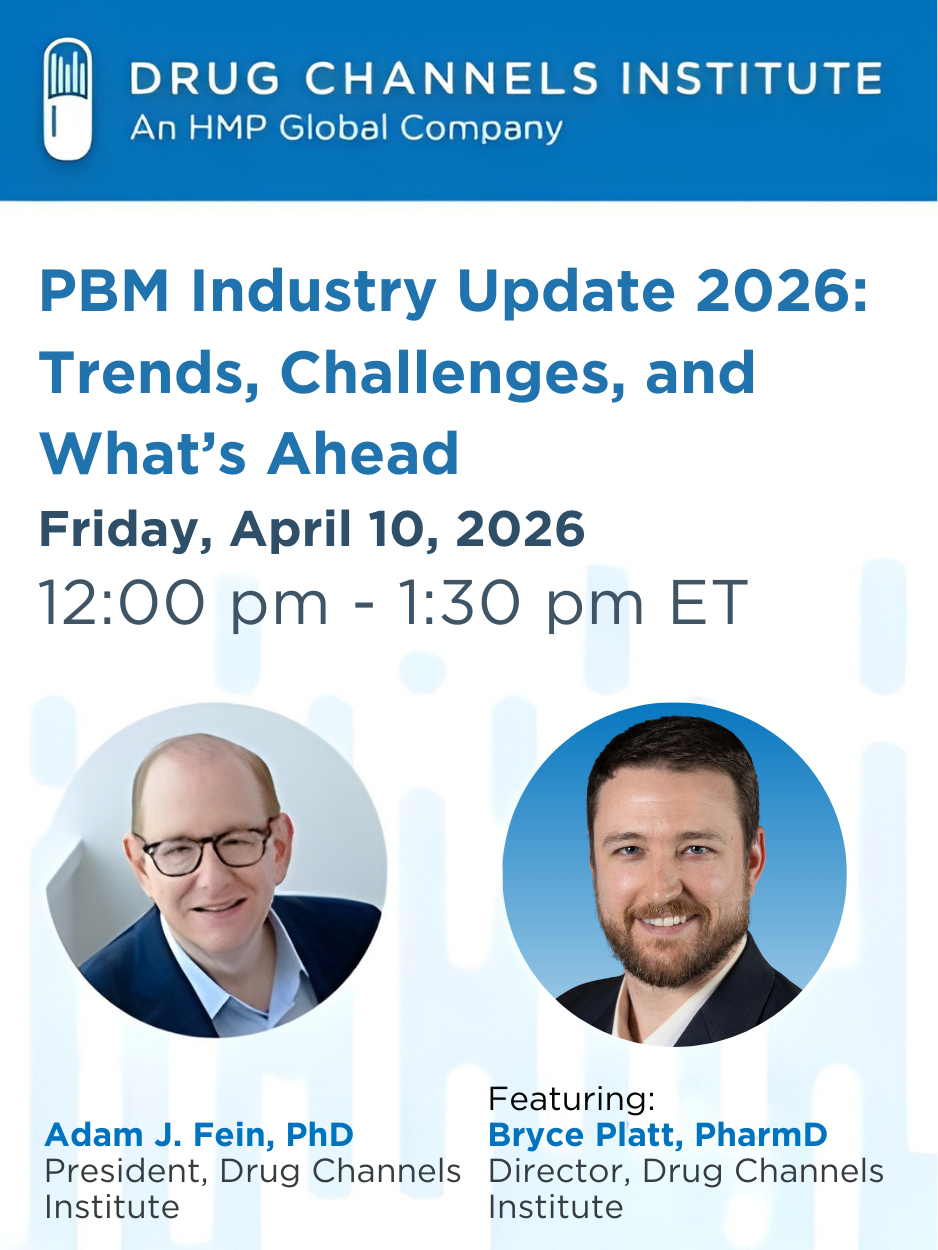
Don't forget to register for DCI’s next webinar on Friday, April 10, 2026, from 12:00 p.m. to 1:30 p.m. ET. Adam J. Fein and Bryce Platt will unpack the good, the bad, and the ugly of the PBM industry—and explore what it means for you. Click here to learn more and sign up.
Cigna, extending reach into prescription drugs, acquires major pharmacy used by hospitals, STAT
Bob Herman at STAT reports that The Cigna Group’s Evernorth Health Services now owns 100% of CarepathRx, a company that helps hospitals and health systems build and operate in-house specialty pharmacies.
By expanding deeper into hospital-owned specialty pharmacies, Cigna is executing a clever vertical integration play that helps preserve access to 340B-driven profits through a different channel.
In 2023, Cigna’s Evernorth Health Services acquired a 49% ownership interest in CarepathRx Health System Solutions, which assists hospitals and health systems with specialty pharmacy operations. In 2025, it acquired the remaining 51% of CarepathRx, giving it full ownership.
Recall that in 2025, Evernorth also invested $3.5 billion for an undisclosed stake in Shields Health Solutions, the former Walgreens Boots Alliance subsidiary with a similar hospital-focused specialty pharmacy model.
As we document in Section 3.3.5 of our new 2026 Economic Report on U.S. Pharmacies and Pharmacy Benefit Managers, health systems and hospitals have emerged as the fastest-growing direct participants in the specialty pharmacy market by operating internal pharmacies. Changes in manufacturers’ 340B contract pharmacy policies have accelerated hospitals’ investments in in-house specialty pharmacy operations.
Meanwhile, manufacturers’ limits on 340B contract pharmacies have pressured Express Scripts’ 340B profits. See The 340B Contract Pharmacy Market in 2025: Big Chains and PBMs Tighten Their Grip.
You can see how CarepathRx fits into the drug channel in our updated vertical integration graphic, which appears as Exhibit 267 in our new pharmacy/PBM report.
By expanding deeper into hospital-owned specialty pharmacies, Cigna is executing a clever vertical integration play that helps preserve access to 340B-driven profits through a different channel.
In 2023, Cigna’s Evernorth Health Services acquired a 49% ownership interest in CarepathRx Health System Solutions, which assists hospitals and health systems with specialty pharmacy operations. In 2025, it acquired the remaining 51% of CarepathRx, giving it full ownership.
Recall that in 2025, Evernorth also invested $3.5 billion for an undisclosed stake in Shields Health Solutions, the former Walgreens Boots Alliance subsidiary with a similar hospital-focused specialty pharmacy model.
As we document in Section 3.3.5 of our new 2026 Economic Report on U.S. Pharmacies and Pharmacy Benefit Managers, health systems and hospitals have emerged as the fastest-growing direct participants in the specialty pharmacy market by operating internal pharmacies. Changes in manufacturers’ 340B contract pharmacy policies have accelerated hospitals’ investments in in-house specialty pharmacy operations.
Meanwhile, manufacturers’ limits on 340B contract pharmacies have pressured Express Scripts’ 340B profits. See The 340B Contract Pharmacy Market in 2025: Big Chains and PBMs Tighten Their Grip.
You can see how CarepathRx fits into the drug channel in our updated vertical integration graphic, which appears as Exhibit 267 in our new pharmacy/PBM report.
2025 Annual Report (10-K), Merck
The law of unintended consequences remains undefeated.
The American Rescue Plan Act of 2021 (ARPA) eliminated the 100% Medicaid rebate cap beginning in 2024. Manufacturers of high-list/high-rebate products can now owe Medicaid more than 100% of a product's sales, i.e., negative net prices.
The Congressional Budget Office (CBO) projected that removing the cap would reduce the federal deficit by $17.3 billion. But as usual, CBO scoring ignored behavioral adaptation to the new incentives.
When rebates can exceed 100%, the conventional high-list/high-rebate model becomes economically unsustainable. ARPA is therefore one of the forces accelerating the emergence of the Net Pricing Drug Channel (#NPDC) and the deflation of the gross-to-net bubble.
Ironically, lowering the list price for a highly rebated drug can actually increase the net price after rebates and discounts.
Why? Because the Medicaid rebates and 340B ceiling prices are both linked to changes in a drug’s list price relative to inflation. When the inflation penalty pushes rebates above 100%, cutting the list price shrinks the penalty. Hence, net prices rise.
Merck just highlighted this dynamic on page 59 of its 2025 10-K filing:
P.S. On LinkedIn, my colleague Bryce Platt highlighted how this dynamic played out for GSK’s Flovent.
The American Rescue Plan Act of 2021 (ARPA) eliminated the 100% Medicaid rebate cap beginning in 2024. Manufacturers of high-list/high-rebate products can now owe Medicaid more than 100% of a product's sales, i.e., negative net prices.
The Congressional Budget Office (CBO) projected that removing the cap would reduce the federal deficit by $17.3 billion. But as usual, CBO scoring ignored behavioral adaptation to the new incentives.
When rebates can exceed 100%, the conventional high-list/high-rebate model becomes economically unsustainable. ARPA is therefore one of the forces accelerating the emergence of the Net Pricing Drug Channel (#NPDC) and the deflation of the gross-to-net bubble.
Ironically, lowering the list price for a highly rebated drug can actually increase the net price after rebates and discounts.
Why? Because the Medicaid rebates and 340B ceiling prices are both linked to changes in a drug’s list price relative to inflation. When the inflation penalty pushes rebates above 100%, cutting the list price shrinks the penalty. Hence, net prices rise.
Merck just highlighted this dynamic on page 59 of its 2025 10-K filing:
“In early 2025, Merck lowered the list price of the Januvia family of products to more closely align them with net prices. The lower list price has reduced the rebate amount Merck pays to Medicaid, resulting in higher realized net pricing.”In other words, a law designed to extract more than 100% of a drug's revenue from manufacturers in Medicaid has backfired, leading Medicaid and 340B covered entities to pay higher net prices.
P.S. On LinkedIn, my colleague Bryce Platt highlighted how this dynamic played out for GSK’s Flovent.
Walgreens Saved $500 Million Using Robots. Now Comes the Hard Part., AIM
This article contains a deep dive on how Walgreens has invested in centralized fulfillment and AI-driven inventory management.
The highlights:
Alas, the technology didn’t save Walgreens from having gross margins below its peers. Is this the future operating model of pharmacy—or are they just running faster to stay in place?
The highlights:
- 12 robotic micro-fulfillment centers
- $500M in savings
- 16M scripts/month centralized (~25% of total Rx)
- 40% more vaccines in automated stores
- Forecast error cut from 15% to ~1%
Alas, the technology didn’t save Walgreens from having gross margins below its peers. Is this the future operating model of pharmacy—or are they just running faster to stay in place?
The Cost of Rebates to Patients, Bryce Platt on LinkedIn
Here’s a sobering reminder of the warped incentives behind plan sponsors’ formulary decisions for high-list/high-rebate drugs.
In the example below, Drug A represents a high-list/high-rebate product, while Drug B shows a low-list/no-rebate product. Both products have the same net cost to the plan sponsor.

But as you can see, patients end up paying a much greater share of a drug’s net price than is apparent from their coinsurance amount. For Drug A in the example below, the patient’s 20% coinsurance equates to 53% (= $960 ÷ $1,800) of the drug’s post-rebate net cost.
Drug A also highlights how plans shift out-of-pocket costs to patients with conditions who rely on highly rebated prescriptions. This phenomenon is known as reverse insurance and “money from sick people.”
The message and the math echo my example from How Health Plans Profit—and Patients Lose—From Highly Rebated Brand-Name Drugs, one of Drug Channels’ most popular posts from the archives.
If plan sponsors adopt something like the “standard model” outlined in the Express Scripts-FTC settlement, then these warped incentives will be greatly diminished. That’s why patients could benefit from a Net Pricing Drug Channel.
In the example below, Drug A represents a high-list/high-rebate product, while Drug B shows a low-list/no-rebate product. Both products have the same net cost to the plan sponsor.
[Click to Enlarge]

But as you can see, patients end up paying a much greater share of a drug’s net price than is apparent from their coinsurance amount. For Drug A in the example below, the patient’s 20% coinsurance equates to 53% (= $960 ÷ $1,800) of the drug’s post-rebate net cost.
Drug A also highlights how plans shift out-of-pocket costs to patients with conditions who rely on highly rebated prescriptions. This phenomenon is known as reverse insurance and “money from sick people.”
The message and the math echo my example from How Health Plans Profit—and Patients Lose—From Highly Rebated Brand-Name Drugs, one of Drug Channels’ most popular posts from the archives.
If plan sponsors adopt something like the “standard model” outlined in the Express Scripts-FTC settlement, then these warped incentives will be greatly diminished. That’s why patients could benefit from a Net Pricing Drug Channel.
A Bonus Photo From The Drug Channels Leadership Forum
In Reflections and Photos from the Drug Channels Leadership Forum 2026, I shared some highlights from the second annual Drug Channels Leadership Forum.
Here’s a fun team photo of some members of the Drug Channels Institute team along with a few colleagues from HMP Global.

Here’s a fun team photo of some members of the Drug Channels Institute team along with a few colleagues from HMP Global.

No comments:
Post a Comment