Drug Channels delivers timely analysis and provocative opinions on pharmaceutical economics and the drug distribution system. Drug Channels reaches an engaged, loyal and growing audience of more than 100,000 subscribers and followers. Learn more...
Showing posts with label Alternative Funding Programs (AFPs). Show all posts

Tuesday, November 18, 2025

Drug Channels News Roundup, November 2025: PBM Revolution, Cuban’s Stelara Challenge, Express Scripts’ Price Games, U.S. Drug Spending Reality, and the AFP Reckoning

By Adam J. Fein, Ph.D.

Happy Thanksgiving, everyone! Before you stretch your stomach, stretch your mind with some fresh food for thought from across the drug channel. In this issue: Plus: Has the day of reckoning arrived for shady alternative funding vendors?

P.S. Join my more than 66,000 LinkedIn followers for daily links to neat stuff, along with sharp and thoughtful commentary from the DCI community.

What else should you expect for 2026? Find out during my upcoming live video webinar, Drug Channels Outlook 2026, on December 12, 2025, from 12:00 p.m. to 1:30 p.m. ET. Click here to learn more and sign up. As always, we are offering special discounts if you want to bring your whole team.

Wednesday, December 18, 2024

Drug Channels News Roundup, December 2024: Crazy Medicare Reimbursements, Independents Grow (Really!), AFP Risks, Pharmacy History, GLP-1 Jokes, and Two Cool Dudes

Happy New Year, everyone! It’s been a huge year for Drug Channels Institute (DCI).

In January, HMP Global acquired DCI. Thanks to our new friends at HMP, we will hold the Drug Channels Leadership Forum. This landmark event will take place in March 2025 in Miami. (If you haven’t done so yet, click here to request an invitation.)

Once again, I thank you, dear readers, for welcoming Drug Channels into your inboxes, browsers, and apps. I’m proud of the diverse and thoughtful audience who follows and comments on our unique content. The DCI community now includes more than 100,000 subscribers and followers from all parts of the industry. To stay in touch, you can sign up for an email subscription or follow me on LinkedIn.

We’ve enjoyed bringing you our perspectives and curated links in 2024. We hope that you had fun engaging with us and the DCI community.

Wishing you and your family health and happiness,
Adam and the DCI team


In this issue:
  • Unexplainable pharmacy reimbursements in Medicare Part D
  • Plan risks from shady alternative funding programs
  • A brief but enlightening history of pharmacy from 1385 to today
  • Jim Gaffigan jokes about GLP-1s
Plus, a fun photo of two cool (but familiar) dudes.

Did you miss the Drug Channels Outlook 2025 video webinar? No worries! Just sign up to watch the replay and download the full slide deck.

Wednesday, May 29, 2024

Drug Channels News Roundup, May 2024: CVS & Cordavis & Humira, 340Boom, AFP Slowdown, Asembia Wrap-Up, and GLP-1 Humor

Summer unofficially began over the weekend. Let’s turn up the heat with these sizzling news bites, seared to perfection on the Drug Channels grill:
  • CVS Health’s Cordavis business seems to want quasi-regulatory oversight of Humira biosimilars
  • 340B’s skyrocketing growth continues, but the market is changing
  • Plans sponsors' fading interest in alternative funding programs
  • A post-Asembia review from DCI’s trip to Las Vegas
Plus, South Park goes after insurance companies and PBMs over GLP-1 coverage.

P.S. Join my nearly 56,000 LinkedIn followers for daily links to neat stuff.

Register now for The 340B Drug Pricing Program: Trends, Controversies, and Outlook, a new live video webinar with Adam J. Fein, PhD. Click here to learn more and reserve your spot at the June 21 event.

Tuesday, March 26, 2024

Drug Channels News Roundup, March 2024: My $0.02 of CarelonRx/Kroger & CVS, Provider-Owned Pharmacies, Shady AFPs, 340B Deception, and Lilly’s GLP-1 Ad

It’s finally spring in Philadelphia, home of Drug Channels. Along with sunshine and fine weather, the vernal equinox has ushered in a crop of new and noteworthy stories:
  • What the CarelonRx/Kroger specialty pharmacy deal means for CVS Health
  • Provider-owned specialty pharmacies expand in Medicare
  • Payers are not keen on shady alternative funding programs (AFP)
  • Hospitals’ association spreads 340B misinformation
Plus, Lilly trolls our nation’s celebrities.

P.S. Join my nearly 54,000 LinkedIn followers for daily links to neat stuff.

What’s ahead for the drug channel? Find out during Drug Channel Implications of the Inflation Reduction Act, a new live video webinar with Adam J. Fein, PhD. Click here to learn more and reserve your spot at our April 5 webinar.

Thursday, October 05, 2023

The Economics of Copay Accumulators, Maximizers, and Alternative Funding Programs (Video) (rerun)

This week, I’m rerunning some popular posts while I put the finishing touches on DCI's new 2023-24 Economic Report on Pharmaceutical Wholesalers and Specialty Distributors.

One important update on copay accumulators since my original post from August 2023: U.S. District Court, District of Columbia struck down U.S. Department of Health and Human Services rule allowing non-grandfathered individual and group plans to exclude manufacturers' copay assistance from deductibles. (Details and industry reactions here.) IMHO, this was a huge win for patients thanks to the HIV + Hepatitis Policy Institute, the Diabetes Patient Advocacy Coalition, and the Diabetes Leadership Council.


In my most recent video webinar, I explored how plans and PBMs are turning to novel—and highly controversial—benefit design tools that access manufacturers’ patient support spending: copay accumulators, maximizers, and alternative funding programs.

In the video excerpt below, I describe these new approaches that plans offset specialty drug expenses. I then follow the dollar to show how they impact plan, patient, and manufacturer costs when compared with traditional approaches to copay support.

During the full 90-minute webinar, I discussed seven crucial risks that could disrupt this market along with many other aspects of this emerging market. If this clip whets your appetite for more, you can purchase the 90-minute webinar replay and full slide deck here: PBMs and the Battle Over Patient Support Funds: Accumulators, Maximizers, and Alternative Funding.

Click here if you can’t see the video below.


Two recent Drug Channels article on these topics:
Errata: The formulary rebate in the mathematical example that begins at 4:40 should be shown as 16.7%, not 20%. We apologize for the error.

Tuesday, August 01, 2023

The Economics of Copay Accumulators, Maximizers, and Alternative Funding Programs (Video)

In my most recent video webinar, I explored how plans and PBMs are turning to novel—and highly controversial—benefit design tools that access manufacturers’ patient support spending: copay accumulators, maximizers, and alternative funding programs.

In the video excerpt below, I describe these new approaches that plans offset specialty drug expenses. I then follow the dollar to show how they impact plan, patient, and manufacturer costs when compared with traditional approaches to copay support.

During the full 90-minute webinar, I discussed seven crucial risks that could disrupt this market along with many other aspects of this emerging market. If this clip whets your appetite for more, you can purchase the 90-minute webinar replay and full slide deck here: PBMs and the Battle Over Patient Support Funds: Accumulators, Maximizers, and Alternative Funding.

Click here if you can’t see the video below.


Two recent Drug Channels article on these topics:
Errata: The formulary rebate in the mathematical example that begins at 4:40 should be shown as 16.7%, not 20%. We apologize for the error.

Monday, June 19, 2023

Copay Accumulator and Maximizer Update: Adoption Plateaus as Insurers Battle Patients Over Copay Support (rerun)

I want to wish everyone a happy Juneteenth! This week, I’m rerunning some popular posts while I prepare for this Friday’s live video webinar: PBMs and the Battle Over Patient Support Funds: Accumulators, Maximizers, and Alternative Funding.

Click here to see the original post from February 2023.


Is the gold rush in copay accumulators and maximizers slowing down?

Our latest update finds that for 2022, about 40% of commercial lives have adopted these benefit designs. Accumulator adoption has plateaued, while maximizer use has overtaken accumulators. Patients who take a single-source, brand-name specialty drug for autoimmune conditions, multiple sclerosis, and oncology increasingly face these benefit designs. Check out the plan and patient data below.

Patients are caught in the middle of a complex battle among insurers, PBMs, and drugmakers. They are rightfully unhappy that their plans are grabbing the copay support funds. That’s why legislation, lawsuits, and patient advocacy are growing. Manufacturers are also pushing back on plans’ copay games.

These reactions will slow the financial windfall for plans and PBMs—and raise the risk that plans will push the ethical boundaries even farther.

Monday, May 22, 2023

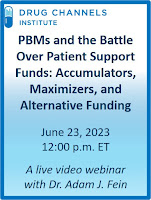
PBMs and the Battle Over Patient Support Funds:
Accumulators, Maximizers, and Alternative Funding (NEW Live Video Webinar)

Dr. Adam J. Fein, CEO of Drug Channels Institute (DCI) and the author of Drug Channels, invites you to join him for a new video webinar:

PBMs and the Battle Over Patient Support Funds:
Accumulators, Maximizers, and Alternative Funding

This event will be broadcast live on
Friday, June 23, 2023, from 12:00 p.m. to 1:30 p.m. ET.

This page describes the event and explains how to purchase a registration. The webinar will be broadcast from the Drug Channels studio in beautiful downtown Philadelphia.

This event is part of The Drug Channels 2023 Video Webinar Series.

WHAT YOU WILL LEARN

As expensive specialty therapies come to dominate drug spending, pharmaceutical manufacturers are paying a growing share of patents’ out-of-pocket costs for these prescriptions. At the same time, plans and PBMs are turning to novel—and often controversial—benefit design tools that access manufacturers’ patient support spending.

Join Dr. Fein as he helps you and your team deepen your understanding of this complex subject and its crucial implications for drugmakers, payers, PBMs, and patients. During the event, Dr. Fein will cover a wide range of topics, including:
  • What’s driving patients’ out-of-pocket obligations
  • Trends in the value of manufacturers’ financial assistance
  • Copayment offset programs vs. patient assistance programs (PAPs)
  • Conventional pharmacy benefit management tactics
  • The new tools that offset specialty drug costs: copay accumulators, maximizers, and alternative funding programs
  • The latest market data on adoption of the new spending drug management tools
  • Prescription economics of copay accumulators, maximizers, and alternative funding programs
  • How PBMs profit from—and are challenged by—the new tools
  • Plan sponsor perspectives
  • State and federal legislation over pharmacy benefits
  • Major lawsuits between manufacturers and vendors
  • Outlook for specialty drug spending management
  • Controversies and unresolved questions
  • And more!
PLUS: During the webinar, Dr. Fein will give participants an opportunity to unmute themselves and ask live questions. The webinar will last 90 minutes to accommodate audience questions.

As always, Dr. Fein will clearly distinguish his opinions and interpretations from the objective facts and data. He will draw from exclusive information found in DCI's 2023 Economic Report on U.S. Pharmacies and Pharmacy Benefit Managers.

Read on for full details on pricing and registration.

PRICING OPTIONS

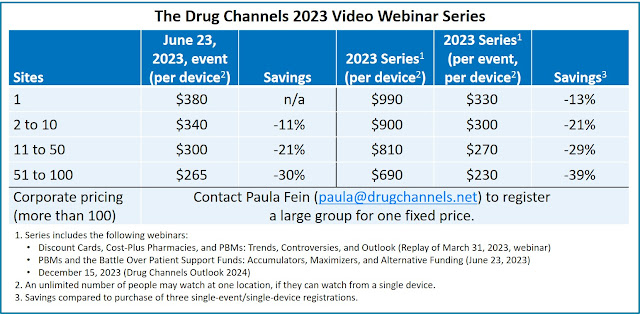
You can register for this unique educational opportunity for only $380 per viewing device. Within 24 hours of your purchase, you will receive an email from Zoom with a unique link to access the live event.

We are offering substantial discounts for multiple registrations from the same organization. We know that many of you may be working remotely, so rates for multiple registrations are as low as $265 per device—a 30% savings. An unlimited number of people may watch at one physical location if they can watch from a single device. Please note that a device at a single physical location may not stream, share, or project our webinar to other sites. Each device at a physical location requires its own registration.

Click here to order. All discounts will be automatically computed based on the number of registrations you enter in your cart. (You can reset the cart by entering 0 in the quantity field.)


Please contact Paula Fein (paula@drugchannels.net) if you have any questions. If you purchase access for multiple devices, we will contact you for a list of your participants and their email addresses. Or, download this spreadsheet and email your registrants’ information to Tamra Feldman (admin@drugchannels.net).

Click here to register for the full Drug Channels 2023 Video Webinar Series

Payment can be made with all major credit cards (Visa, MasterCard, American Express, and Discover) or via PayPal. Click here to email us if you would like to pay by corporate purchase order or check.

IMPORTANT THINGS TO KNOW
  • Watch and listen via any device with a web browser (computer, iPad, iPhone/Android, etc.) There is no access via telephone.
  • We use Zoom technology for this webinar. Every registrant will receive an email from Zoom with a link to watch the event. This link is unique to the registrant and can only be accessed once. We recommend that every registrant download the Zoom client software/app.
  • Within one day of purchasing a registration, each registrant will receive an email from Zoom with a link to access the event and add it to their calendar. Every registrant will also receive reminder emails from Zoom one week, one day, and one hour before the event.
  • This event is part of The Drug Channels 2023 Video Webinar Series. If you have already purchased the full series, then you should have received an email from no-reply@zoom.us with your unique link to access the June event.
  • Organizations that purchased corporate access for The Drug Channels 2023 Video Webinar Series will receive a custom, branded signup link so employees can easily register. We will automatically refund payments from anyone at a company with corporate access who purchases a single registration using their corporate email account.
  • Unfortunately, we are unable to offer refunds.


Wednesday, May 17, 2023

Employers Expand Use of Alternative Funding Programs—But Sustainability in Doubt as Loopholes Close

Last August, I warned you about alternative funding programs (AFPs)–the shady schemes by which commercial plan sponsors drop drug coverage in order to grab charity support intended for uninsured and indigent patients.

I’m sad to report that the manipulation of charitable patient assistance programs continues to expand. As you will see below, employers have significantly ramped up their adoption of AFPs, while health plans seem more skeptical. Meanwhile, a new AbbVie lawsuit sheds light on the alleged activities of a major AFP vendor.

Read on for our update on these suspect programs—and the growing risks to their sustainability. Caveat payer.

Tuesday, April 25, 2023

Drug Channels News Roundup, April 2023: OptumRx’s Biosimilar Nonsense, Accumulator Inequity, Amazon Redux, AFPs, and My Meeting with Mark Cuban

Baseball season is here! While we wait for the Phillies turnaround, let’s oil up our gloves, lace up our cleats, and run the bases around this month's biggest hits:
  • Foul ball: OptumRx prefers higher prices for the first Humira biosimilar (SEE UPDATE BELOW)
  • Strikeout: Copay accumulators hurt health equity
  • Bench warmer: Surprise? Amazon has still not disrupted healthcare
  • Spitting mad: Shady alternative funding programs (AFPs) face more scrutiny
Plus, I sit down with Mark Cuban—and take a selfie.

P.S. Join my nearly 41,000 (!) LinkedIn followers for daily links to neat stuff. You can also find my daily posts at @DrugChannels on Twitter, where I have more than 16,000 followers. (I recommend that you follow me on LinkedIn, because the quality of comments is much, much higher than they are on Twitter.)

Tuesday, March 21, 2023

Drug Channels News Roundup, March 2023: My $0.02 on Insulin Price Cuts, AbbVie vs. AFPs, Optum Expands, ASAP340B, and Hooray for Pharmacists

Spring is here in sunny downtown Philadelphia, worldwide headquarters of Drug Channels. The vernal equinox has brought us an unexpected bounty of noteworthy news:
  • Thoughts on the recent insulin price cuts by Lilly, Novo, and Sanofi
  • AbbVie gets tougher on alternative funding programs
  • Optum quietly adds a new drug channel role
  • A novel partnership emerges to modernize the 340B program
Plus, a celebration of pharmacists’ activities during the COVID-19 pandemic.

P.S. Join my more than 38,000 LinkedIn followers for daily links to neat stuff. You can also find my daily posts at @DrugChannels on Twitter, where I have more than 16,000 followers.

Join me for my new live video webinar, Discount Cards, Cost-Plus Pharmacies, and PBMs: Trends, Controversies, and Outlook, on March 31, 2023, from 12:00 p.m. to 1:30 p.m. ET. Click here to learn more and sign up.

Wednesday, February 22, 2023

Copay Accumulator and Maximizer Update: Adoption Plateaus as Insurers Battle Patients Over Copay Support

Is the gold rush in copay accumulators and maximizers slowing down?

Our latest update finds that for 2022, about 40% of commercial lives have adopted these benefit designs. Accumulator adoption has plateaued, while maximizer use has overtaken accumulators. Patients who take a single-source, brand-name specialty drug for autoimmune conditions, multiple sclerosis, and oncology increasingly face these benefit designs. Check out the plan and patient data below.

Patients are caught in the middle of a complex battle among insurers, PBMs, and drugmakers. They are rightfully unhappy that their plans are grabbing the copay support funds. That’s why legislation, lawsuits, and patient advocacy are growing. Manufacturers are also pushing back on plans’ copay games.

These reactions will slow the financial windfall for plans and PBMs—and raise the risk that plans will push the ethical boundaries even farther.

Tuesday, January 31, 2023

Drug Channels News Roundup, January 2023: My $0.02 on Amazon & OptumRx, PBMs vs. AFPs, WSJ on 340B, Accumulators & Maximizers, and Tipping Culture

Here at our worldwide headquarters in Philadelphia, Eagles Super Bowl fever has landed. The police are already getting extra Crisco for the light poles. (Yes, really.)

Before you start training to gorge at your game day party, tackle this month’s selection of notable news stories, intercepted for you from the Drug Channels gridiron:
  • Offsides: My $0.02 on the latest moves by Amazon and OptumRx
  • Trick play: OptumRx attacks alternative funding programs
  • Offensive line: Shocking Wall Street Journal expose of 340B abuses
  • Touchdown! Accumulators and maximizers go mainstream
Plus, tipping culture comes to healthcare.

P.S. Join the nearly 37,000 people who run after me on LinkedIn. You can also chase me at @DrugChannels on Twitter. Every day, I tackle links to neat stuff for you.

Wednesday, December 14, 2022

The Shady Business of Specialty Carve-Outs, a.k.a., Alternative Funding Programs (rerun)

This week, I’m rerunning some popular posts while I prepare for tomorrow's live video webinar: Drug Channels Outlook 2023.

In the four months since I published the article below, the issues with alternative funding programs have hit the mainstream press. Check out last week's article from Kaiser Health News: Employers Use Patient Assistance Programs to Offset Their Own Costs.

Click here to see the original post and comments from August 2022.


Watch out! Plan sponsors are getting even bolder in their attempts to grab financial support intended for patients. The latest scam is called a specialty carve-out.

Here’s the game: A commercial plan eliminates coverage for all specialty drugs. Beneficiaries are then shunted over to a charitable foundation, because they are now disguised as uninsured—at least for specialty drugs. Naturally, the vendor skims a healthy share of the charity’s money.

In addition to the ethical and compliance issues, some vendors raise safety risks by sourcing prescriptions from non-U.S. pharmacies as a backup.

The Orwellian euphemism for this “benefit” design: alternative funding program.

A new survey reveals that an astounding four out of 10 commercial plans are already using, or exploring the use of, these specialty carve-out programs. Yikes.

Read on for an overview of these shady programs—and the many problems they are creating.

Tuesday, August 02, 2022

The Shady Business of Specialty Carve-Outs, a.k.a., Alternative Funding Programs

Watch out! Plan sponsors are getting even bolder in their attempts to grab financial support intended for patients. The latest scam is called a specialty carve-out.

Here’s the game: A commercial plan eliminates coverage for all specialty drugs. Beneficiaries are then shunted over to a charitable foundation, because they are now disguised as uninsured—at least for specialty drugs. Naturally, the vendor skims a healthy share of the charity’s money.

In addition to the ethical and compliance issues, some vendors raise safety risks by sourcing prescriptions from non-U.S. pharmacies as a backup.

The Orwellian euphemism for this “benefit” design: alternative funding program.

A new survey reveals that an astounding four out of 10 commercial plans are already using, or exploring the use of, these specialty carve-out programs. Yikes.

Read on for an overview of these shady programs—and the many problems they are creating.

Friday, April 22, 2022

Four Reasons Why PBMs Gain As Maximizers Overtake Copay Accumulators (rerun)

This week, I’m rerunning some popular posts while I prepare for today’s live video webinar: PBM Industry Update: Trends, Controversies, and Outlook.

Click here to see the original post and comments from February 2022.


More than four years ago, I warned about the emerging trend of copay accumulators and outlined the costly consequences for patients.

The latest data reveal that copay accumulator adjustment programs are now in the word list for a growing share of pharmacy benefit designs. What’s more, adoption of copay maximizers now exceeds that of copay accumulators. Maximizers avoid the brutal patient adherence problems of accumulators, while allowing plan sponsors to extract even more patient support funds.

Despite this impressive growth, you may not yet have considered PBMs’ business model for these tools. Below, I outline why PBMs have incentives to prefer maximizer programs over accumulators and alternatives such as specialty carve-out programs.

I look forward to hearing your thoughts on these developments in the comments below or on social media: LinkedIn (preferred) or Twitter.

Tuesday, February 08, 2022

Four Reasons Why PBMs Gain As Maximizers Overtake Copay Accumulators

More than four years ago, I warned about the emerging trend of copay accumulators and outlined the costly consequences for patients.

The latest data reveal that copay accumulator adjustment programs are now in the word list for a growing share of pharmacy benefit designs. What’s more, adoption of copay maximizers now exceeds that of copay accumulators. Maximizers avoid the brutal patient adherence problems of accumulators, while allowing plan sponsors to extract even more patient support funds.

Despite this impressive growth, you may not yet have considered PBMs’ business model for these tools. Below, I outline why PBMs have incentives to prefer maximizer programs over accumulators and alternatives such as specialty carve-out programs.

I look forward to hearing your thoughts on these developments in the comments below or on social media: LinkedIn (preferred) or Twitter.