Drug Channels delivers timely analysis and provocative opinions from Adam J. Fein, Ph.D., the country's foremost expert on pharmaceutical economics and the drug distribution system. Drug Channels reaches an engaged, loyal and growing audience of more than 100,000 subscribers and followers. Learn more...
Showing posts with label Hospitals. Show all posts

Thursday, April 23, 2026

Minnesota’s 340B Hospitals Make One Billion More From 340B Than They Spend on Uncompensated Care

By Bryce Platt, PharmD

Minnesota’s new 340B data reveal a growing disconnect between the program’s size and the value Minnesotans receive in return.

In 2024, nonprofit hospitals generated more than $1.3 billion in 340B net profits—nearly a billion dollars more than they provided in uncompensated care. At the same time, these same institutions already benefit from substantial tax exemptions tied to their not-for-profit status and charitable mission.

The gap between 340B profits and charity care isn’t a rounding error or a one-off anomaly. The 340B Drug Pricing Program has evolved into a significant profit center for hospital systems. This is another layer on top of existing public subsidies, not a substitute for them.

As you’ll see below, our analysis describes a 340B program that generates financial gains far in excess of any contribution back to the people of the state. There is also no clear accountability for how those dollars are used.

Tuesday, April 21, 2026

The Top 15 Specialty Pharmacies of 2025: PBM-Affiliated Pharmacies Dominate While Health Systems and Independents Gain Ground

By Adam J. Fein, Ph.D.

Drug Channels Institute’s (DCI’s) latest analysis reveals that PBM-affiliated specialty pharmacies continue to dominate the dispensing of specialty drugs.

For 2025, DCI has identified more than 1,900 dispensing locations with specialty pharmacy accreditation from one or both of the two major independent accreditation organizations. The overall number of accredited locations grew by only 3% in 2025, but is more than five times larger than the 2015 figure.

However, market share for the dispensing of specialty drugs remains highly concentrated. For 2025, the three largest specialty pharmacies accounted for two-thirds of total prescription revenues from pharmacy-dispensed specialty drugs. These businesses are all owned by vertically integrated organizations that also own a PBM.

Below, we share DCI’s latest analysis of the top 15 specialty pharmacies, including updated market shares and revenue estimates, highlighting how vertical integration and channel control continue to reshape specialty dispensing. Despite growth in accredited locations, economic power remains concentrated among a small group of PBM-affiliated entities.

Next week, the DCI team will be attending Asembia’s AXS26 Summit in fabulous Las Vegas. Please say hello if you see us!

Tuesday, April 07, 2026

Drug Channels News Roundup, Mid-April 2026: Vertical Integration & MLR Games, Copay Maximizers, Hospital Price Chaos, and One Big Drug Channel Family

I’m pleased to introduce a new recurring feature from Bryce Platt, DCI’s new Director. Each month, Bryce will highlight some of his most notable LinkedIn posts—for those of you who don’t follow him or can’t keep up with his prolific stream of drug channel graphics.

Best,
Adam


Welcome to my first Drug Channels post! Yes, it may feel a bit strange to see an article here that isn’t written by Adam.

I post daily on LinkedIn, but some posts deserve a deeper look or a wider audience. This roundup highlights a few of my favorites from the past month, along with added context and takeaways.

Let me know what you think and how I can make these roundups even more useful.

In this issue: Extra: How did I end up at Drug Channels Institute?

P.S. Join my nearly 30,000 LinkedIn followers for valuable daily posts at 9 a.m. ET.
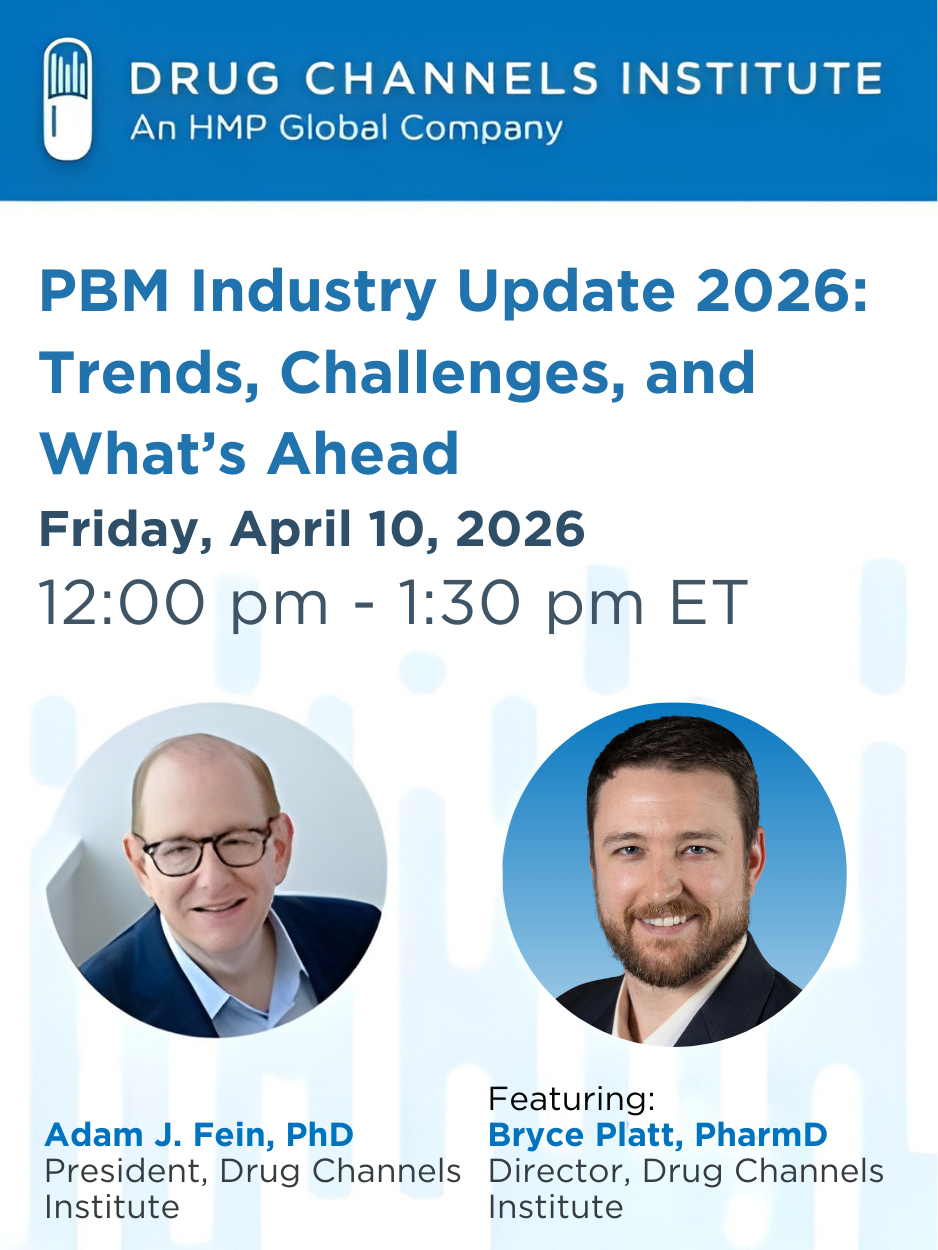
PBM Industry Update 2026: Trends, Challenges, and What's Ahead.

Don't miss DCI’s upcoming webinar on Friday, April 10, 2026, from 12:00 p.m. to 1:30 p.m. ET. Adam J. Fein and Bryce Platt will unpack the good, the bad, and the ugly of the PBM industry—and what it means for you. Click here to learn more and sign up.

Tuesday, January 27, 2026

Drug Channels News Roundup, January 2026: Cuban vs. Optum, McKesson’s Biosimilar Play, States vs. Accumulators, 340B Windfalls, and Ozempic Ads

Super Bowl LX is almost here! Time for some blowout beer and snack commercials, occasionally interrupted by an actual football game. DCI’s hometown Philadelphia Eagles will not be going to the big game, so the city’s light poles will remain Crisco-free and upright.

While you wait for kickoff, please enjoy this month’s playbook of articles, intercepted for you from the Drug Channels gridiron: Plus: Will Ozempic's new ad campaign make us nostalgic for 2006?

P.S. Join my more than 67,000 LinkedIn followers for daily links to neat stuff, along with sharp, thoughtful commentary from the DCI community.

Monday, December 15, 2025

340B Hit $81 Billion in 2024 (+23%): Why CMS and the IRA Are Poised to Cool the Program’s Runaway Growth

Whoa. The 340B Drug Pricing Program has once again given new meaning to the word “skyrocketing.”

For 2024, discounted purchases under the 340B program reached a record $81.4 billion—an astounding $15.1 billion (+23%) higher than 2023. The gross-to-net difference between list prices and discounted 340B purchases—a proxy for funds available to covered entities—also grew, to $66.4 billion (+$6.0 billion). Hospitals again accounted for 87% of 340B purchases.

How big is the program? 340B purchases are now more than 50% larger than Medicaid’s net prescription drug spending. The program now accounts for nearly one-fifth of the total U.S. gross-to-net bubble.

But thanks to the Inflation Reduction Act (IRA), 340B’s day of reckoning is coming soon. I expect 2026 to be the first year of structural 340B pressure as the Centers for Medicare & Medicaid Services (CMS) continues its regulatory takeover of the 340B program. What’s more, I expect the program’s out-of-control growth rate to slow and for some long-overdue transparency to enter this notoriously opaque program.

Read on for our full analysis—and why the 340B swell may finally be breaking.

Tuesday, December 09, 2025

Follow the 340B Dollar: Senator Cassidy Exposes How CVS Health and Walgreens Profit as 340B Contract Pharmacies (rerun)

This week, I’m rerunning some popular posts while I prepare for Friday’s live video webinar: Drug Channels Outlook 2026.

Today's rerun provides background for the webinar, when I will discuss the consequences of the Inflation Reduction Act for the 340B program and contract pharmacies. Click here to see the original post from May 2025.


Two weeks ago, Senator Bill Cassidy—now chair of the Senate Committee on Health, Education, Labor, and Pensions (HELP)—dropped a must-read, eyebrow-raising report on the out-of-control 340B Drug Pricing Program. (Link below.)

The report reveals previously confidential information showing how billions are funneled to health systems and pharmacies—with manufacturers unable to follow the flow.

Below, we use these new disclosures to illustrate the 340B program’s hidden prescription economics for 340B contract specialty pharmacies operated by CVS Health and Walgreens Boots Alliance.

As you can see, the program’s participants earn substantial margins, while plans and third-party payers foot the bill.

What do you think? Click here to share your thoughts with the Drug Channels LinkedIn community.  

Thursday, October 09, 2025

The 340B Contract Pharmacy Market in 2025: Big Chains and PBMs Tighten Their Grip (rerun)

This week, I’m rerunning some popular posts while I put the finishing touches on DCI’s 2025-26 Economic Report on Pharmaceutical Wholesalers and Specialty Distributors.

Click here to see the original post from June 2025.


The 340B Drug Pricing Program has emerged as a growing source of profits for pharmacies and pharmacy benefit managers (PBMs).

Drug Channels Institute’s latest exclusive analysis of the 2025 market reveals a highly concentrated market structure increasingly dominated by a handful of major players:
  • About 32,000 pharmacy locations—nearly 60% of the entire U.S. pharmacy industry—function as contract pharmacies for the hospitals and federal grantees that participate in the 340B program.
  • The 340B contract pharmacy has become increasingly concentrated with five multi-billion-dollar, for-profit, publicly traded pharmacy chains and pharmacy benefit managers (PBMs)—Cigna (via Express Scripts), CVS Health, UnitedHealth Group (via Optum Rx), Walgreens, and Walmart.
The 2025 market data below illustrate just how far the 340B program’s operations have diverged from its original intent. As Senator Bill Cassidy recently noted, the 340B program “was never meant to be part of an earnings call. It was meant to be part of patient care.”

Wednesday, September 17, 2025

Preorder Now: DCI’s 2025-26 Economic Report on Pharmaceutical Wholesalers and Specialty Distributors

2025-26 DCI Report Cover On October 14, 2025, Drug Channels Institute will release our 2025-26 Economic Report on Pharmaceutical Wholesalers and Specialty Distributors. This report—our sixteenth edition—is the most comprehensive, fact-based tool for understanding and analyzing the large and growing U.S. pharmaceutical distribution industry.

With 9 chapters, 400+ pages, 187 exhibits, and 850+ endnotes, this report is unmatched in scope and depth. There is no other resource like it.

Preorder today to secure this fully updated, revised, and expanded 2025-26 edition at special discounted prices. Preorders ensure early access. You’ll receive the report before its October 14 release date.
You can pay online with all major credit cards (Visa, MasterCard, American Express, and Discover). Click here to contact us if you would like to pay by corporate check or ACH.

Special preorder and launch pricing discounts will be valid through October 27, 2025. Act now to maximize savings.

The chart below highlights the three largest companies’ vertical alignment and diverse roles within the U.S. healthcare system. The numbers in the chart indicate the report chapter that corresponds to, explains, and analyzes each business.

[Click to Enlarge]

The 2025-26 Economic Report on Pharmaceutical Wholesalers and Specialty Distributors remains the most comprehensive, fact-based tool for understanding and analyzing the large and growing U.S. pharmaceutical distribution industry. Widely regarded as the industry standard, this encyclopedic resource offers a definitive guide to wholesale distribution’s role in the complex web of U.S. prescription drug channels.

Our 2025-26 edition contains the most current financial and industry data about the distribution of pharmaceuticals and the major companies that handle these products. As always, we have updated all market and industry data with the most current information available. The report also updates our annual analyses of the strategies, market positions, and executive compensation of the three largest companies: Cencora, Cardinal Health, and McKesson.

We review each wholesaler’s business segments and underlying business profitability, based upon our proprietary economic models. This information allows you to assess differences among the public wholesalers’ business organizations, strategies, and financial performance. Where appropriate, financial data have been restated based on updated disclosures.

See pages 9 and 10 of the free report overview for details on the notable new material in this latest edition.

Thank you for your continued interest in our research. Please email me (afein@drugchannels.net) with any questions before purchasing. We look forward to sharing this year’s insights with you.

Tuesday, August 05, 2025

Markup Madness 2025: Hospitals, Insurers, and the Broken Buy-and-Bill Market for Biosimilars

After multiple years of mandated disclosure of negotiated hospital-insurer rates, those of us who follow the buy-and-bill channel might have expected transparency to reduce drug price variability, lower hospital markups, and accelerate adoption of lower-cost biosimilars.

Alas, that’s not what the latest data reveal.

DCI’s analysis of four national commercial insurers—Aetna, Anthem, Cigna, and UnitedHealthcare—and 26 hospitals found that:
  • Hospitals still earn significant markups over average sale price (ASP). 340B hospitals earn even more.
  • Insurers pay wildly varying amounts for the same drug.
  • Some hospitals get paid significantly more than others for the same drug.
  • Insurers can pay more for a lower-cost biosimilar than for the higher-cost reference product.
While provider-administered biosimilars are significantly cheaper than their reference products, hospitals and insurers are still making them expensive for plan sponsors. Meanwhile, patients with coinsurance and deductibles are paying higher out-of-pocket costs.

Transparency was supposed to clean things up—but someone forgot to bring the mop.

Tuesday, June 10, 2025

The 340B Contract Pharmacy Market in 2025: Big Chains and PBMs Tighten Their Grip

The 340B Drug Pricing Program has emerged as a growing source of profits for pharmacies and pharmacy benefit managers (PBMs).

Drug Channels Institute’s latest exclusive analysis of the 2025 market reveals a highly concentrated market structure increasingly dominated by a handful of major players:
  • About 32,000 pharmacy locations—nearly 60% of the entire U.S. pharmacy industry—function as contract pharmacies for the hospitals and federal grantees that participate in the 340B program.
  • The 340B contract pharmacy has become increasingly concentrated with five multi-billion-dollar, for-profit, publicly traded pharmacy chains and pharmacy benefit managers (PBMs)—Cigna (via Express Scripts), CVS Health, UnitedHealth Group (via Optum Rx), Walgreens, and Walmart.
The 2025 market data below illustrate just how far the 340B program’s operations have diverged from its original intent. As Senator Bill Cassidy recently noted, the 340B program “was never meant to be part of an earnings call. It was meant to be part of patient care.”

For more on what the 340B program’s growth means for pharmacies, join Adam J. Fein, Ph.D., and Antonio Ciaccia on June 20 for a new live video webinar: What’s Next for Retail Pharmacy: Data, Debate, and Disruption.

Tuesday, June 03, 2025

Pharmacist Salaries and Employment in 2024: Retail Employment Collapse Offset by Hospital Boom

It’s time for Drug Channels’ annual look at pharmacist salaries and employment.

There was more bad news, as employment in retail pharmacies and drugstores dropped by 8,500 positions in 2024, following a drop of 4,800 positions in 2023. Employment in mass merchants and supermarkets with pharmacies increased. Meanwhile, employment at hospitals surged to a new high, growing by nearly 7,000 positions in 2024.

Average salaries hit $137,000, but varied widely across practice settings. However, salary growth did not keep pace with overall inflation.

Downsizing by the larger pharmacy chains, combined with Rite Aid’s liquidation, means that 2025 looks even grimmer for retail pharmacists. Full salary and employment data below for your enjoyment or sorrow. Click here to share your thoughts on the pharmacist job market with the Drug Channels LinkedIn community.

Jump to:
UPCOMING LIVE VIDEO WEBINAR!

Get ready for the future of pharmacy on June 20, 2025 (12:00–1:30 p.m. ET). Dr. Adam J. Fein and Antonio Ciaccia will unpack the good, the bad, and the ugly of the pharmacy industry—and explore what it means for you. This dynamic session will blend expert insights and real-time debate. Click here to register.

Tuesday, May 06, 2025

Follow the 340B Dollar: Senator Cassidy Exposes How CVS Health and Walgreens Profit as 340B Contract Pharmacies

Two weeks ago, Senator Bill Cassidy—now chair of the Senate Committee on Health, Education, Labor, and Pensions (HELP)—dropped a must-read, eyebrow-raising report on the out-of-control 340B Drug Pricing Program. (Link below.)

The report reveals previously confidential information showing how billions are funneled to health systems and pharmacies—with manufacturers unable to follow the flow.

Below, we use these new disclosures to illustrate the 340B program’s hidden prescription economics for 340B contract specialty pharmacies operated by CVS Health and Walgreens Boots Alliance.

As you can see, the program’s participants earn substantial margins, while plans and third-party payers foot the bill.

What do you think? Click here to share your thoughts with the Drug Channels LinkedIn community.  

Wednesday, April 02, 2025

Four Revelations from Minnesota’s First 340B Transparency Report (rerun)

This week, I’m rerunning some popular posts while I prepare for Friday’s live video webinar: PBM Industry Update: Trends, Challenges, and What’s Ahead.

Click here to see the original post from December 2024.


It’s time to pay attention to the money behind the 340B curtain.

Minnesota just released the industry‘s first ever mandated financial report on the 340B Drug Pricing Program. Below, I do a wicked deep dive into the data and highlight crucial implications about spending, profits, pharmacies, plans, patients, program integrity, and more.

There are important limitations to these data. But Minnesota’s report marks a valuable first step on the yellow brick road to the wonderful world of transparency. I suspect similar reports are gonna be popular.

Thursday, December 12, 2024

White Bagging Update 2024: Providers’ Pushback Preserves Buy-and-Bill (rerun)

This week, I’m rerunning some popular posts while I prepare for tomorrow’s Drug Channels Outlook 2025 live video webinar. During the webinar, I'll share some thoughts on how vertical integration will affect the buy-and-bill channel.

Click here to see the original post from September 2024.


Time for DCI’s annual update on the channels for provider-administered drugs. Below, I review the latest data on 2024 trends and compare them to the pre-pandemic figures.

For 2024, payers report that specialty pharmacies—via white and clear bagging—have displaced buy-and-bill for a meaningful share of commercial covered lives utilizing provider-administered oncology drugs. However, provider pushback has limited specialty pharmacies' share gains, so that buy-and-bill remains the most common channel for these products.

Payers’ adoption of white bagging—and provider’s push back—reflect the ongoing battle for oncology margin in U.S. drug channels. Let’s hope that patients don’t get caught in the crossfire.

P.S. Today’s article is adapted from Chapter 3 of DCI’s forthcoming 2024-25 Economic Report on Pharmaceutical Wholesalers and Specialty Distributors, which will be available to preorder next week at special introductory pricing.

Wednesday, December 11, 2024

Follow the 340B Prescription Dollar: How PBMs Profit from 340B Contract Pharmacies (rerun)

This week, I’m rerunning some popular posts while I prepare for Friday’s Drug Channels Outlook 2025 live video webinar. During the webinar, I'll provide an update the 340B program, which continues to defy gravity. Click here to see the original post.

In my recent The 340B Drug Pricing Program: Trends, Controversies, and Outlook video webinar, I provided an update on the economics of the 340B program, reviewed the multiple controversies surrounding the program’s operations, discussed state and federal legislation, and analyzed how the Inflation Reduction Act of 2022 (IRA) will alter the 340B market.

In the video excerpt below, I walk through a brief history of 340B contract pharmacies. I then document how five multi-billion-dollar, for-profit, publicly traded pharmacy chains and pharmacy benefit managers (PBMs)—Cigna (via Express Scripts), CVS Health, UnitedHealth Group (via OptumRx), and Walgreens, Walmart—continue to dominate the 340B contract pharmacy market. I conclude with a “follow the dollar” example of 340B prescription economics with contract pharmacies.

If this clip whets your appetite for more, register to watch a replay of the full 90-minute video webinar from June.

You can also check out our recent data deep dive: Hospitals Are Relying More on PBMs to Manage Manufacturers' 340B Contract Pharmacy Restrictions: DCI's 2024 Market Analysis.

Click here if you can’t see the video below.


Tuesday, December 03, 2024

Four Revelations from Minnesota’s First 340B Transparency Report

It’s time to pay attention to the money behind the 340B curtain.

Minnesota just released the industry‘s first ever mandated financial report on the 340B Drug Pricing Program. Below, I do a wicked deep dive into the data and highlight crucial implications about spending, profits, pharmacies, plans, patients, program integrity, and more.

There are important limitations to these data. But Minnesota’s report marks a valuable first step on the yellow brick road to the wonderful world of transparency. I suspect similar reports are gonna be popular.

And don't forget to put on your ruby slippers and hear from Doctor of Thinkology Adam J. Fein. During next week’s Drug Channels Outlook 2025 live video webinar, he'll tell you what's ahead for the program that continues to defy gravity.

Monday, November 04, 2024

Transparency Shocker: Biosimilars Are Getting Cheaper—But Hospitals and Insurers Can Make Them Expensive

Here on Drug Channels, we have long highlighted the boom in provider-administered biosimilars. In contrast to the pharmacy market, adoption of these biosimilars is growing, prices are dropping, and formulary barriers continue to fall.

Novel transparency information reveals that this good news doesn’t always translate into savings. Below, we rely on a unique data set from Turquoise Health to examine how much four national commercial health plans—Aetna, Anthem, Cigna, and UnitedHealthcare—paid hospitals for Avastin and its two most significant biosimilar competitors.

As we demonstrate, health plans pay hospitals far above acquisition costs for biosimilars. What’s more, plans can pay hospitals more for a biosimilar than for the higher-cost reference product. The U.S. drug channel system is warping hospitals’ incentives to adopt biosimilars, while simultaneously raising costs for commercial plans.

The namesake of my alma mater once said: “Sunlight is said to be the best of disinfectants.” What would happen if we disinfected the entire channel?

Tuesday, October 22, 2024

The 340B Program Reached $66 Billion in 2023—Up 23% vs. 2022: Analyzing the Numbers and HRSA’s Curious Actions

Reality has again failed to support the spin surrounding the 340B Drug Pricing Program.

For 2023, discounted purchases under the 340B program reached a record $66.3 billion—an astounding $12.6 billion (+23.4%) higher than its 2022 counterpart. The gross-to-net difference between list prices and discounted 340B purchases also grew, to $57.8 billion (+$5.5 billion). 340B purchases are now almost 40% larger than Medicaid’s prescription drug purchases.

Hospitals again accounted for 87% of 340B purchases for 2023. Purchases at every 340B covered entity type grew, despite drug prices that grew more slowly than overall inflation.

Lobbyists claim that manufacturers’ 340B contract pharmacy changes are “stripping billions of dollars from the healthcare safety net.” But every year, the data tell a very different story. Only in the U.S. healthcare system can billions more in payments and spreads be considered a cut.

Read on for full details and our analysis, along with fresh details of troubling behavior by the Health Resources and Services Administration (HRSA).