Drug Channels delivers timely analysis and provocative opinions on pharmaceutical economics and the drug distribution system. Drug Channels reaches an engaged, loyal and growing audience of more than 100,000 subscribers and followers. Learn more...
Showing posts with label Physicians. Show all posts

Tuesday, September 15, 2026

Preorder DCI’s New 2026-27 Economic Report on Pharmaceutical Wholesalers and Specialty Distributors

2026-27 DCI Report Cover On October 12, 2026, Drug Channels Institute will release our 2026-27 Economic Report on Pharmaceutical Wholesalers and Specialty Distributors.

The U.S. prescription drug market continues to expand, but the foundations of the drug channel are shifting. Legislative intervention, pricing realignment, vertical integration, and alternative payment models are accelerating a transition away from a rebate-driven system built on high list prices and toward a marketplace increasingly shaped by net prices.

DCI’s seventeenth annual report examines what these changes mean for the pharmaceutical wholesalers and specialty distributors at the center of the U.S. drug channel. With nine chapters, more than 400 pages, 193 exhibits, and more than 930 endnotes, this report is unmatched in scope and depth.

Preorder today to secure the fully updated, revised, and expanded 2026-27 edition at special discounted prices. Preorders also ensure early access. You will receive the report before its October 12 release date.
You can pay online with all major credit cards. Contact us if you prefer to pay by corporate check or ACH.

Special preorder and launch pricing discounts will be available through October 26, 2026. Act now to maximize your savings.

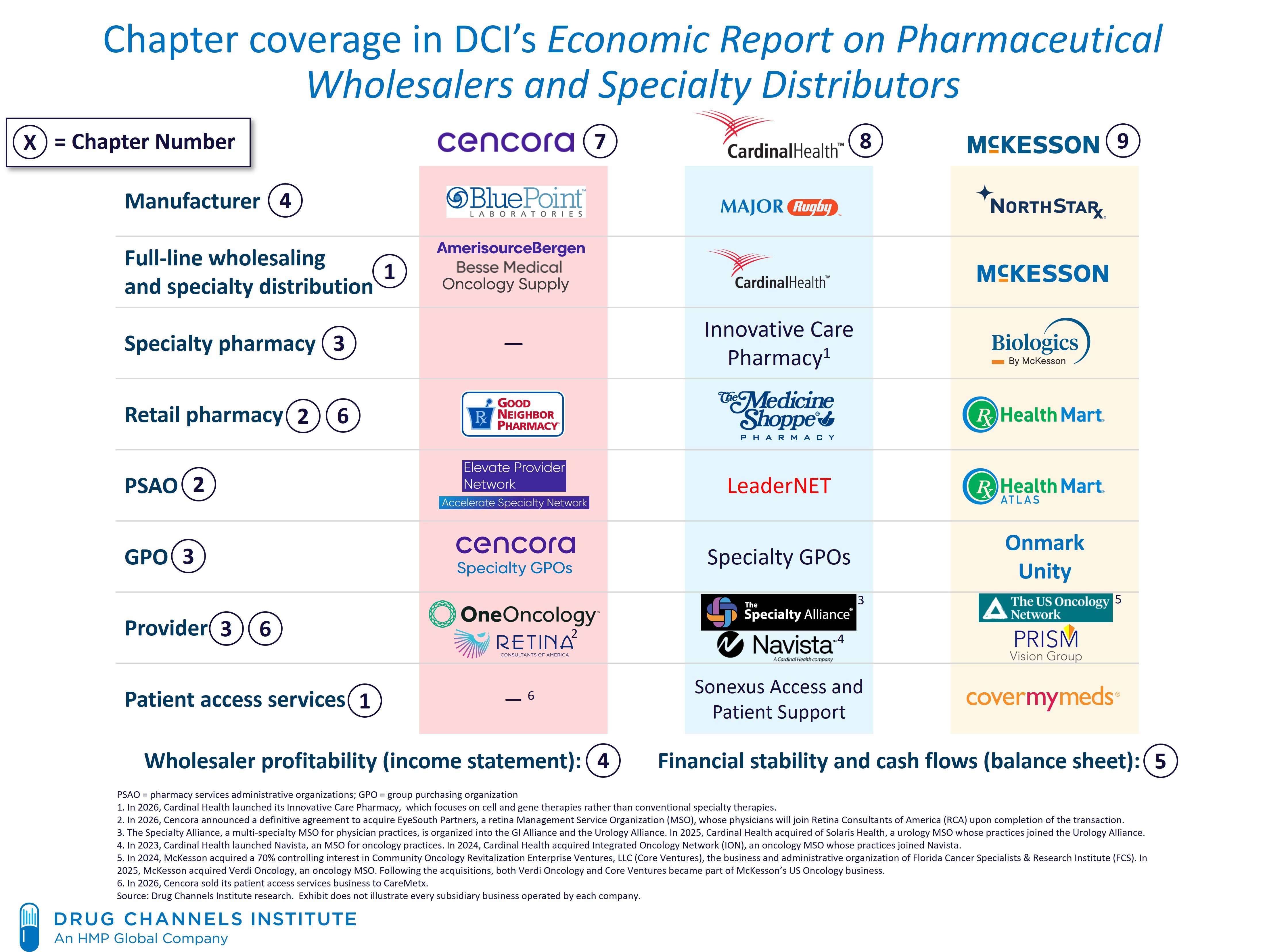
The chart below highlights the vertical alignment and diverse roles of Cencora, Cardinal Health, and McKesson within the U.S. healthcare system. The circled numbers identify the report chapters that explain and analyze each business.

[Click to enlarge]

The new edition provides the most current financial and industry data about pharmaceutical distribution. Among the major findings and expanded areas of coverage:
  • Drug distribution revenues for the Big Three public wholesalers are projected to reach $933 billion in 2026, although growth has slowed from double-digit to mid-single-digit rates.
  • The largest wholesalers have invested more than $20 billion in physician management services organizations, transforming their roles in buy-and-bill markets.
  • Changes in drug pricing, direct-to-patient models, and other emerging channels are accelerating the industry’s transition toward a Net Pricing Drug Channel.
  • The report examines the evolving economics of biosimilars, cell and gene therapies, the 340B Drug Pricing Program, and implementation of the Inflation Reduction Act.
  • DCI’s proprietary economic models reveal differences in the business strategies, market positions, financial performance, and underlying profitability of Cencora, Cardinal Health, and McKesson.
There are 193 exhibits in the 2026-27 edition, compared with 187 in last year’s report. Most are new or fully updated.


Thank you for your continued interest in our research. Please email us (dcisupport@hmpglobal.com) with any questions before purchasing. We look forward to sharing this year’s insights with you.

Tuesday, August 18, 2026

REMS Removed: Why CAR-T’s Expansion into Community Oncology Could Benefit the Big Three Wholesalers

By Greis Kapexhiu and Adam J. Fein, Ph.D.

In June 2025, the FDA announced that CAR-T therapies would no longer be subject to a REMS program.

The FDA’s removal of CAR-T REMS requirements eliminates one obstacle to expanding treatment beyond traditional academic medical centers. That change could disproportionately benefit the Big Three wholesalers, which have spent billions building positions in community oncology while simultaneously investing in cell-and-gene-therapy distribution and support infrastructure.

Read on for our review of this dynamic sector and ponder how wholesalers’ community oncology roll-up activities could interact with their cell and gene therapy (CGT) investments. Will wholesalers capture a growing share of CAR-T’s economics, or will hospitals continue to hold the upper hand?

Tuesday, May 05, 2026

Specialty Pharmacy Accreditation: DCI’s Exclusive Analysis Reveals a Market at an Inflection Point

By Adam J. Fein, Ph.D.

The Drug Channels Institute (DCI) team attended Asembia’s AXS26 Summit last week. Once again, the specialty pharmacy market delivered a classic paradox: a sprawling, fragmented landscape of participants paired with highly concentrated economics controlled by a handful of PBM-affiliated giants.

Below, we share our proprietary analyses of the specialty market’s participants. DCI identified more than 1,900 pharmacy locations that have achieved specialty pharmacy accreditation from one of the two major independent accreditation organizations.

Despite growing revenues from specialty drugs, overall growth in accredited pharmacies has plateaued. However, pharmacy locations owned by healthcare providers—hospitals, health systems, physician practices, and other healthcare providers—continue to expand and now account for nearly 40% of all accredited specialty pharmacy locations.

Read on for a bit of our arithmomania. Because in specialty pharmacy, what gets counted reveals who really counts.

Thursday, December 11, 2025

The Future of Buy-and-Bill Market Access: Five Drivers of Wholesalers’ Vertical Integration with Physician Practices (rerun)

This week, I’m rerunning some popular posts while I prepare for tomorrow's live video webinar: Drug Channels Outlook 2026 .

Click here to see the original post from October 2025.


Vertical integration continues to reshape U.S. healthcare, as detailed in DCI’s new 2025-26 Economic Report on Pharmaceutical Wholesalers and Specialty Distributors.

Our latest analysis shows how the Big Three companies—Cencora, Cardinal Health, and McKesson—are extending their reach far beyond drug distribution, building influence throughout the drug channel.

In recent years, these companies have spent more than $16 billion to acquire management service organizations (MSOs) that oversee physician practices in such specialties as gastroenterology, oncology, ophthalmology, and urology.

Below, we highlight the largest MSO transactions and explore five ways wholesalers benefit from ownership in their downstream physician customers. Ultimately, these strategies may allow wholesalers to exert unprecedented control over market access for provider-administered drugs—if they can figure out how to realize this power.

Today’s post is adapted from Section 6.3.2. in DCIs 2025-26 Economic Report on Pharmaceutical Wholesalers and Specialty Distributors.

Tuesday, October 21, 2025

The Future of Buy-and-Bill Market Access: Five Drivers of Wholesalers’ Vertical Integration with Physician Practices

By Adam J. Fein, Ph.D.

Vertical integration continues to reshape U.S. healthcare, as detailed in DCI’s new 2025-26 Economic Report on Pharmaceutical Wholesalers and Specialty Distributors.

Our latest analysis shows how the Big Three companies—Cencora, Cardinal Health, and McKesson—are extending their reach far beyond drug distribution, building influence throughout the drug channel.

In recent years, these companies have spent more than $16 billion to acquire management service organizations (MSOs) that oversee physician practices in such specialties as gastroenterology, oncology, ophthalmology, and urology.

Below, we highlight the largest MSO transactions and explore five ways wholesalers benefit from ownership in their downstream physician customers. Ultimately, these strategies may allow wholesalers to exert unprecedented control over market access for provider-administered drugs—if they can figure out how to realize this power.

Today’s post is adapted from Section 6.3.2. in DCIs 2025-26 Economic Report on Pharmaceutical Wholesalers and Specialty Distributors. Special launch pricing discounts are available through October 27, 2025.

Wednesday, September 17, 2025

Preorder Now: DCI’s 2025-26 Economic Report on Pharmaceutical Wholesalers and Specialty Distributors

2025-26 DCI Report Cover On October 14, 2025, Drug Channels Institute will release our 2025-26 Economic Report on Pharmaceutical Wholesalers and Specialty Distributors. This report—our sixteenth edition—is the most comprehensive, fact-based tool for understanding and analyzing the large and growing U.S. pharmaceutical distribution industry.

With 9 chapters, 400+ pages, 187 exhibits, and 850+ endnotes, this report is unmatched in scope and depth. There is no other resource like it.

Preorder today to secure this fully updated, revised, and expanded 2025-26 edition at special discounted prices. Preorders ensure early access. You’ll receive the report before its October 14 release date.
You can pay online with all major credit cards (Visa, MasterCard, American Express, and Discover). Click here to contact us if you would like to pay by corporate check or ACH.

Special preorder and launch pricing discounts will be valid through October 27, 2025. Act now to maximize savings.

The chart below highlights the three largest companies’ vertical alignment and diverse roles within the U.S. healthcare system. The numbers in the chart indicate the report chapter that corresponds to, explains, and analyzes each business.

[Click to Enlarge]

The 2025-26 Economic Report on Pharmaceutical Wholesalers and Specialty Distributors remains the most comprehensive, fact-based tool for understanding and analyzing the large and growing U.S. pharmaceutical distribution industry. Widely regarded as the industry standard, this encyclopedic resource offers a definitive guide to wholesale distribution’s role in the complex web of U.S. prescription drug channels.

Our 2025-26 edition contains the most current financial and industry data about the distribution of pharmaceuticals and the major companies that handle these products. As always, we have updated all market and industry data with the most current information available. The report also updates our annual analyses of the strategies, market positions, and executive compensation of the three largest companies: Cencora, Cardinal Health, and McKesson.

We review each wholesaler’s business segments and underlying business profitability, based upon our proprietary economic models. This information allows you to assess differences among the public wholesalers’ business organizations, strategies, and financial performance. Where appropriate, financial data have been restated based on updated disclosures.

See pages 9 and 10 of the free report overview for details on the notable new material in this latest edition.

Thank you for your continued interest in our research. Please email me (afein@drugchannels.net) with any questions before purchasing. We look forward to sharing this year’s insights with you.

Tuesday, April 15, 2025

Master the Hidden Economics of Pharmaceuticals—In Under an Hour—with DCI's New eLearning Modules

In today’s fast-moving pharmaceutical marketplace, insight is everything. Whether you're building trust with customers, launching new products, or guiding internal teams, understanding the economic forces that shape drug distribution, reimbursement, and pricing is essential.

At Drug Channels Institute (DCI), we know how critical this knowledge is—and how hard it can be to find credible, up-to-date training that fits into a busy professional’s schedule. That’s why we created our DCI eLearning Modules: a suite of six interactive, expertly narrated courses that deliver must-know insights in 45 minutes or less.


Why Professionals Choose DCI eLearning

These modules were built from the ground up for pharmaceutical professionals—from seasoned experts to newcomers looking to understand the industry's complex web of relationships. Each course distills our signature Drug Channels expertise into engaging, bite-sized lessons that are ideal for:
  • Sales and field teams: seeking clearer context for their customer conversations
  • Market access, training, and internal strategy groups: who need to understand payer and channel dynamics
  • Any professional: ready to level up their understanding of pharmaceutical economics
Each module features:
  • Interactive graphics and animations for improved retention
  • Expert voice-over narration to guide you through complex topics
  • References to key DCI reports for optional deep dives
  • iPad compatibility for learning on the go
The modules are available only via a site-wide license, giving your entire organization access through your internal learning platform. We also offer licenses to our secure hosted learning environment—no internal setup required! (Sorry, individual licenses are not currently available.)

What You’ll Learn: A Snapshot of Each Module

1. Follow the Dollar: How Funds Flow in the Distribution and Reimbursement Channels
This foundational course breaks down the financial and product flows in U.S. pharmaceutical distribution. You'll learn how money and medicines move between manufacturers, wholesalers, pharmacies, PBMs, and payers—and how each relationship affects costs and outcomes.

2. The Economics of Retail, Mail, and Specialty Pharmacies
Gain a clear-eyed view of how different pharmacy channels generate revenue and manage costs. Understand reimbursement dynamics, cost estimation methods, and how profitability varies across drug types and dispensing models.

3. The Business of Specialty Pharmacy
Specialty drugs are revolutionizing care—and reshaping the pharmacy business. This module explores how these products are distributed, covered by insurance, and supported through value-added services.

4. The Economics of Provider-Administered Specialty Drugs
Navigate the unique dynamics of provider-administered drugs, from buy-and-bill systems to ASP reimbursement. Understand how coverage types, care sites, and financial relationships affect access and profitability.

5. Understanding Pharmacy Benefit Managers
PBMs wield enormous influence—but many professionals may not fully understand their true impact. Learn how PBMs operate, where they make money, and how they interact with manufacturers, payers, and pharmacies.

6. Pharmaceutical Wholesalers: Business Strategies and Financial Economics
Take a deep dive into how wholesalers operate, generate profits, and provide critical services. You’ll come away understanding the difference between full-line wholesalers and specialty distributors—and why that matters for your strategy.


Bottom line: If you or your team work in any part of the pharmaceutical value chain, DCI’s eLearning modules will make you smarter, faster. They’re the shortest path to mastering the industry's most important (and most misunderstood) topics.

Visit our eLearning page to get started.

Click here if you can't see the video below.


Thursday, April 03, 2025

Vertical Integration Redux: How Pharmaceutical Wholesalers Are Transforming the Buy-and-Bill Market (rerun)

This week, I’m rerunning some popular posts while I prepare for tomorrow’s live video webinar: PBM Industry Update: Trends, Challenges, and What’s Ahead.

Click here to see the original post from February 2025.


ICYMI, the largest three pharmaceutical wholesalers—Cardinal Health, Cencora, and McKesson—are using vertical integration to build significant market positions in businesses beyond drug distribution.

In the video clip below, I review the vertical integration status of the largest three pharmaceutical wholesalers, illustrated in the chart below.

[Click to Enlarge]

I also:
  • Explain how wholesalers have strengthened their position in buy-and-bill channels for provider-administered drugs through vertical integration with their downstream customers.
  • Discuss how and why private equity roll-up activity has provided wholesalers with strategic opportunities to acquire ownership stakes in practice management companies.
  • Outline the market access implications for provider-administered biosimilars in the buy-and-bill market.
This video was excerpted from my recent Drug Channels Outlook 2025 webinar. Click here if you can’t see the video below.


For more on the forces of change affecting drug distribution and the buy-and-bill market, see Chapter 6 of DCI’s recent 2024-25 Economic Report on Pharmaceutical Wholesalers and Specialty Distributors.

Tuesday, February 25, 2025

Drug Channels News Roundup, February 2025: Part D vs. Pharmacies, Accumulator Madness, Wholesaler Vertical Integration, IRA vs. MDs, and a 340B Cartoon

Winter—or at least February—is almost over. Celebrate the imminent return of spring with our selection of noteworthy news from around the drug channel. In this issue:
  • How Part D plan sponsors responded to pharmacy DIR changes
  • Troubling new data on copay accumulators in marketplace plans
  • DCI’s latest vertical integration visualization
  • How the IRA will hurt physician practices
Plus, cartoon cats explain the 340B Drug Pricing Program.

P.S. Join my more than 60,000 LinkedIn followers for daily links to neat stuff along with thoughtful and provocative commentary from the DCI community.

Tuesday, February 04, 2025

Vertical Integration Redux: How Pharmaceutical Wholesalers Are Transforming the Buy-and-Bill Market (Video)

ICYMI, the largest three pharmaceutical wholesalers—Cardinal Health, Cencora, and McKesson—are using vertical integration to build significant market positions in businesses beyond drug distribution.

In the video clip below, I review the vertical integration status of the largest three pharmaceutical wholesalers, illustrated in the chart below.

[Click to Enlarge]

I also:
  • Explain how wholesalers have strengthened their position in buy-and-bill channels for provider-administered drugs through vertical integration with their downstream customers.
  • Discuss how and why private equity roll-up activity has provided wholesalers with strategic opportunities to acquire ownership stakes in practice management companies.
  • Outline the market access implications for provider-administered biosimilars in the buy-and-bill market.
This video was excerpted from my recent Drug Channels Outlook 2025 webinar. Click here if you can’t see the video below.


For more on the forces of change affecting drug distribution and the buy-and-bill market, see Chapter 6 of DCI’s recent 2024-25 Economic Report on Pharmaceutical Wholesalers and Specialty Distributors.

Thursday, December 12, 2024

White Bagging Update 2024: Providers’ Pushback Preserves Buy-and-Bill (rerun)

This week, I’m rerunning some popular posts while I prepare for tomorrow’s Drug Channels Outlook 2025 live video webinar. During the webinar, I'll share some thoughts on how vertical integration will affect the buy-and-bill channel.

Click here to see the original post from September 2024.


Time for DCI’s annual update on the channels for provider-administered drugs. Below, I review the latest data on 2024 trends and compare them to the pre-pandemic figures.

For 2024, payers report that specialty pharmacies—via white and clear bagging—have displaced buy-and-bill for a meaningful share of commercial covered lives utilizing provider-administered oncology drugs. However, provider pushback has limited specialty pharmacies' share gains, so that buy-and-bill remains the most common channel for these products.

Payers’ adoption of white bagging—and provider’s push back—reflect the ongoing battle for oncology margin in U.S. drug channels. Let’s hope that patients don’t get caught in the crossfire.

P.S. Today’s article is adapted from Chapter 3 of DCI’s forthcoming 2024-25 Economic Report on Pharmaceutical Wholesalers and Specialty Distributors, which will be available to preorder next week at special introductory pricing.

Tuesday, October 29, 2024

Drug Channels News Roundup, October 2024: Humira Price War Update, PA vs. Providers, IRA vs. Physicians, My AI Podcast, New DCI Jobs, and Dr. G on Copayments

Eeek! It's time for Drug Channels’ Halloween roundup of terrifying tales to share with your ghoulish fiends. This month’s tricks and treats:
  • Spooky! Blue Shield of California frightens away the gross-to-net bubble with its Humira biosimilar strategy
  • Vampiric! Prior authorization sinks its fangs into providers’ time
  • Wicked! How the IRA will put a stake through specialty physician practices
  • Eerie! Google’s monstrous AI podcasts leave me petrified
  • Zoinks! Join the vampire hunters at Drug Channels Institute
Plus, Dr. Glaucomflecken tells us a frightening tale of copayments.

P.S. Stretch out your arms and join the ever-growing zombie horde who shamble after me on LinkedIn. You’ll find my ghostly rantings along with commentary from the undead hordes in the DCI community.

Wednesday, October 09, 2024

Five Crucial Trends Facing U.S. Drug Wholesalers in 2024 and Beyond

As regular readers of Drug Channels know, U.S. distribution and dispensing channels for prescription drugs are undergoing significant evolution and consolidation as the changing economics of pharmaceuticals challenge conventional business models.

During this period of volatility, the core business model of the Big Three public pharmaceutical distribution companies—Cardinal Health, Cencora, and McKesson—remains intact. Put simply: Buy low, sell high, collect early, and pay late.

But as I explain below, wholesalers continue to position themselves as essential intermediaries by expanding their industry position and strengthening their economic fundamentals.

Read on for five key pricing, pharmacy, provider, and manufacturer trends that are driving the U.S. drug wholesaling industry.

For even more, check out DCI's new 2024-25 Economic Report on Pharmaceutical Wholesalers and Specialty Distributors, the fifteenth edition of our deep dive into wholesale distribution channels.Click here to download a free report overview (including key industry trends, the table of contents, and a list of exhibits)

Tuesday, September 17, 2024

Available for Preorder: The 2024-25 Economic Report on Pharmaceutical Wholesalers and Specialty Distributors

On October 8, 2024, Drug Channels Institute will release our 2024-25 Economic Report on Pharmaceutical Wholesalers and Specialty Distributors. This report—our fifteenth edition—remains the most comprehensive, fact-based tool for understanding and analyzing the large and growing U.S. pharmaceutical distribution industry.

9 chapters, 350+ pages, 178 exhibits, 750+ endnotes: There is nothing else available that comes close to this valuable resource.

We are providing you with the opportunity to preorder this thoroughly updated, revised, and expanded 2024-25 edition at special discounted prices. This means that you can be among the first to access our new report. Those who preorder will receive a download link before October 8.
You can pay online with all major credit cards (Visa, MasterCard, American Express, and Discover) or via PayPal. Click here to contact us if you would like to pay by corporate check or ACH.

Special preorder and launch pricing discounts will be valid through October 23, 2024.

Read on for more details.

Wednesday, September 11, 2024

White Bagging Update 2024: Providers’ Pushback Preserves Buy-and-Bill

Time for DCI’s annual update on the channels for provider-administered drugs. Below, I review the latest data on 2024 trends and compare them to the pre-pandemic figures.

For 2024, payers report that specialty pharmacies—via white and clear bagging—have displaced buy-and-bill for a meaningful share of commercial covered lives utilizing provider-administered oncology drugs. However, provider pushback has limited specialty pharmacies' share gains, so that buy-and-bill remains the most common channel for these products.

Payers’ adoption of white bagging—and provider’s push back—reflect the ongoing battle for oncology margin in U.S. drug channels. Let’s hope that patients don’t get caught in the crossfire.

P.S. Today’s article is adapted from Chapter 3 of DCI’s forthcoming 2024-25 Economic Report on Pharmaceutical Wholesalers and Specialty Distributors, which will be available to preorder next week at special introductory pricing.

Tuesday, March 26, 2024

Drug Channels News Roundup, March 2024: My $0.02 of CarelonRx/Kroger & CVS, Provider-Owned Pharmacies, Shady AFPs, 340B Deception, and Lilly’s GLP-1 Ad

It’s finally spring in Philadelphia, home of Drug Channels. Along with sunshine and fine weather, the vernal equinox has ushered in a crop of new and noteworthy stories:
  • What the CarelonRx/Kroger specialty pharmacy deal means for CVS Health
  • Provider-owned specialty pharmacies expand in Medicare
  • Payers are not keen on shady alternative funding programs (AFP)
  • Hospitals’ association spreads 340B misinformation
Plus, Lilly trolls our nation’s celebrities.

P.S. Join my nearly 54,000 LinkedIn followers for daily links to neat stuff.

What’s ahead for the drug channel? Find out during Drug Channel Implications of the Inflation Reduction Act, a new live video webinar with Adam J. Fein, PhD. Click here to learn more and reserve your spot at our April 5 webinar.

Tuesday, February 27, 2024

Drug Channels News Roundup, February 2024: Pharmacy Shakeout Update, High Drug Prices, 340B Realities, MDs vs. Pharmacists, and Foo Fighters

February is longer than usual this year, which means that you’ll have extra time to leap into our monthly curated selection of noteworthy news. In this issue:
  • An update on the retail pharmacy shakeout
  • Arguing for high drug prices
  • A leading researcher provides a 340B reality check
  • Physicians don’t want pharmacists getting uppity
Plus, Dave Grohl fights for your right to…have healthcare price transparency?

P.S. Join my nearly 53,000 LinkedIn followers for daily links to neat stuff. You can also find my daily posts at @DrugChannels on Twitter/X, where I have more than 17,400 followers. (I recommend that you follow me on LinkedIn, because the quality of comments and engagement is much higher than they are on Twitter. Sorry, no Threads.)

Thursday, December 14, 2023

The Battle for Oncology Margin: How Private Equity Enables Vertical Integration by Pharmaceutical Wholesalers (rerun)

This week, I’m rerunning some popular posts while I prepare for tomorrow’s Drug Channels Outlook 2024 live video webinar. Click here to see the original post from October 2023.

In case you haven’t noticed, private equity firms have displaced hospitals and health systems as the major acquirers of community oncology practices. These financial firms have assembled significant oncology practice management companies that are primed for purchase by drug channel participants.

Below, I review recent M&A trends and then examine the strategic objectives behind the acquisition of private-equity-backed OneOncology by AmerisourceBergen (Cencora) and another financial buyer. As I explain, AmerisourceBergen (Cencora) gains significant strategic advantage from this transaction, which echoes a historical McKesson deal.

The Federal Trade Commission’s (FTC) has a newfound interest in the roll-up transactions that are creating practice management companies. Nonetheless, I expect this consolidation activity to continue—enabling a new round of vertical integration in the drug channel.

FYI: Today’s article is adapted from Section 6.3. (Future Trends for Buy-and-Bill Channels) of our new our 2023-24 Economic Report on Pharmaceutical Wholesalers and Specialty Distributors, now available to download at special launch pricing.

Wednesday, December 13, 2023

White Bagging Update 2023: Saving Money or Shifting Costs? (rerun)

This week, I’m rerunning some popular posts while I prepare for Friday's Drug Channels Outlook 2024 live video webinar. Click here to see the original post from September 2023.

Time for our annual update on the channels for provider-administered drugs.

For 2023, specialty pharmacies—via white, brown, and clear bagging—retained a meaningful share of the distribution channels for provider-administered oncology drugs. Despite the concerted efforts of insurers such as UnitedHealthcare and Elevance Health, however, buy-and-bill remains the most common channel for these products. Below, I review the latest data on trends over the past five years.

Strategies for white and brown bagging reflect the broader battle over oncology margins—and plans’ attempts to shift costs to providers, patients, and manufacturers. The persistence of buy-and-bill reflects this channel’s legacy infrastructure as well as providers’ push back on white bagging mandates. But perhaps patients and manufacturers will start paying more attention to the higher costs from white bagging.

FYI: The material in today’s article is adapted from Chapter 3 of our forthcoming 2023-24 Economic Report on Pharmaceutical Wholesalers and Specialty Distributors, now available to preorder at special introductory pricing.

Tuesday, October 17, 2023

The Battle for Oncology Margin: How Private Equity Enables Vertical Integration by Pharmaceutical Wholesalers

In case you haven’t noticed, private equity firms have displaced hospitals and health systems as the major acquirers of community oncology practices. These financial firms have assembled significant oncology practice management companies that are primed for purchase by drug channel participants.

Below, I review recent M&A trends and then examine the strategic objectives behind the acquisition of private-equity-backed OneOncology by AmerisourceBergen (Cencora) and another financial buyer. As I explain, AmerisourceBergen (Cencora) gains significant strategic advantage from this transaction, which echoes a historical McKesson deal.

The Federal Trade Commission’s (FTC) has a newfound interest in the roll-up transactions that are creating practice management companies. Nonetheless, I expect this consolidation activity to continue—enabling a new round of vertical integration in the drug channel.

FYI: Today’s article is adapted from Section 6.3. (Future Trends for Buy-and-Bill Channels) of our new our 2023-24 Economic Report on Pharmaceutical Wholesalers and Specialty Distributors, now available to download at special launch pricing.