Drug Channels delivers timely analysis and provocative opinions on pharmaceutical economics and the drug distribution system. Drug Channels reaches an engaged, loyal and growing audience of more than 100,000 subscribers and followers. Learn more...
Football season is officially back. Personally, my signal is hearing my uncle curse about bad calls from 1,000 miles away, but you may have already seen a game.
This news roundup is short enough to fit into an ad break or two. *Caveat: may lead to rabbit holes that take much longer than an ad break.
Drug Channels Institute is proud to host the 2027 Drug Channels Leadership Forum, which will take place from March 15–17, 2027, in Miami. Request your invitation to this invite-only gathering of senior leaders from across the drug channel ecosystem. You must request an invitation to be considered for attendance. We will begin sending invitations in mid-October.
Today's guest post comes from Divya Iyer, SVP, Head of Revenue, Pharma Direct at GoodRx.
Divya examines how AI-powered search and conversational tools are reshaping the way patients research treatments and prescription costs before ever reaching a brand's website. She argues that pharmaceutical manufacturers must rethink their direct-to-consumer (DTC) strategies to ensure treatment information is discoverable, trusted, and connected to actionable next steps.
For more than a decade, the answer to “Where do drug wholesalers make their money?” has been generic drugs.
Although wholesaler revenues are linked most closely to sales of brand-name drugs, the majority of wholesalers’ gross profits comes from generic drugs. We estimate that in calendar year 2026, generic drugs will contribute 52% of total drug distribution gross profits of the Big Three wholesalers, but only 9% of drug distribution revenues.
Generic drugs are the long-running hit show that has carried wholesalers' profits for 15+ seasons. The show is still on the air, but a supporting character is starting a spinoff.
Generic drugs’ share of distribution gross profits has declined, from 68% in 2022 to 52% in 2026. This partially reflects the growth in profits from provider-administered biosimilars. Biosimilars now account for 6% of wholesalers’ drug distribution revenues, but 23% of total gross profits.
November 17-20, 2026 | Sheraton Downtown Philadelphia Exclusive Offer – Use promo code 26DC10 to save 10% on your registration*
Patient need is at an all-time high and the healthcare ecosystem is more complex than ever. With insurance changes, policy volatility, AI disruption and economic pressures reshaping patient programs, staying ahead is critical.
Join industry leaders at Patient Pathways 2026, where experts in copay, reimbursement and patient services will share actionable insights, innovative solutions and best practices. Unlock cutting-edge copay and reimbursement strategies, innovative patient solutions and robust compliance frameworks to elevate program performance, remove barriers and maximize affordability impact.
Can’t-Miss Highlights:
27+ hours of cutting-edge content featuring 6+ sessions on AI integration and automation, 10+ sessions on navigating regulatory changes and compliance frameworks, 20+ sessions on operational challenges and more.
Expert speakers from leading organizations such as Pfizer, BMS, Sanofi, Vertex, Boehringer Ingelheim, Teva, Novo Nordisk and more.
In-depth case studies on topics including patient cost-sharing burdens, balancing affordability with care and market saturation impacts.
Regulatory and policy updates to stay compliant and proactive in a rapidly evolving healthcare landscape.
15+ hours of networking opportunities to connect with industry leaders, build strategic partnerships and expand your professional network.
Why Attend?
Balancing patient services with business objectives is a delicate task. The Congress will address critical questions that access professionals face:
How can programs remain sustainable, innovative and profitable while supporting patients?
How will upcoming health policy changes impact affordability, commercialization and program strategies?
Is your program equipped to deploy AI strategically?
Join industry leaders, peers and solution providers for answers to these questions and more – Benchmark best practices, gain actionable insights, connect with industry trailblazers and drive patient support and affordability forward at Patient Pathways 2026.
“The event was exceptionally well-organized, the atmosphere was welcoming, and I left feeling more informed, empowered and excited to bring what I learned back to my team.”
*Cannot be combined with other offers, promotions, or applied to an existing registration. Other restrictions may apply.
The content of Sponsored Posts does not necessarily reflect the views of HMP Omnimedia, LLC, Drug Channels Institute, its parent company, or any of its employees. To find out how you can publish an event post on Drug Channels, please contact Marie Caldwell(mcaldwell@hmpglobal.com).
Today's guest post comes from Tom Traylor, Senior Vice President of Pharmacy Operations at CareMetx.
Tom examines how intake speed and time to therapy relate to each other in specialty pharmacy programs. He describes how bringing pharmacy connectivity to the front of the patient journey can support faster benefit verification, clearer affordability answers, and shorter time to therapy.
The U.S. prescription drug market continues to expand, but the foundations of the drug channel are shifting. Legislative intervention, pricing realignment, vertical integration, and alternative payment models are accelerating a transition away from a rebate-driven system built on high list prices and toward a marketplace increasingly shaped by net prices.
DCI’s seventeenth annual report examines what these changes mean for the pharmaceutical wholesalers and specialty distributors at the center of the U.S. drug channel. With nine chapters, more than 400 pages, 193 exhibits, and more than 930 endnotes, this report is unmatched in scope and depth.
Preorder today to secure the fully updated, revised, and expanded 2026-27 edition at special discounted prices. Preorders also ensure early access. You will receive the report before its October 12 release date.
Special preorder and launch pricing discounts will be available through October 26, 2026. Act now to maximize your savings.
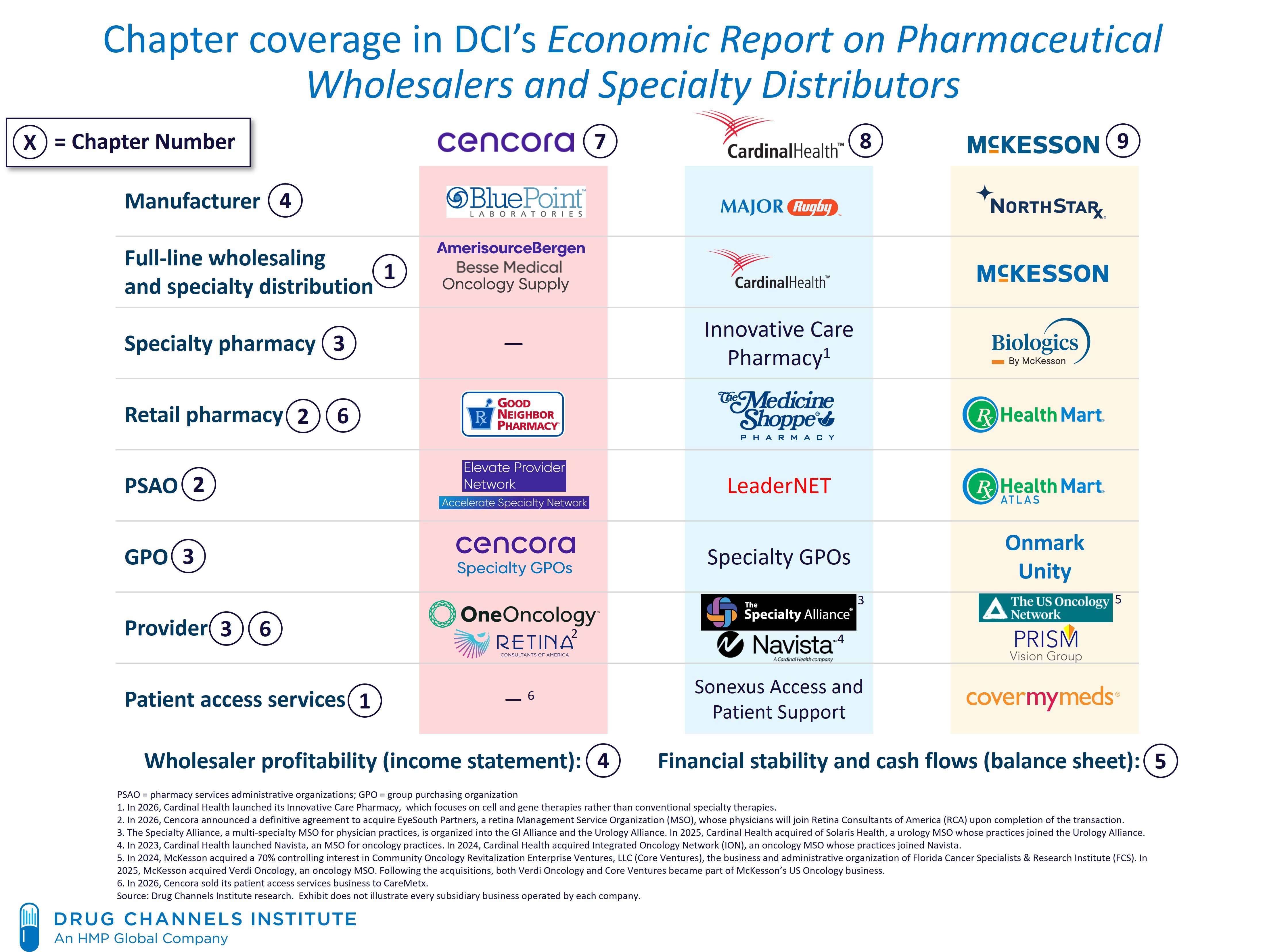
The chart below highlights the vertical alignment and diverse roles of Cencora, Cardinal Health, and McKesson within the U.S. healthcare system. The circled numbers identify the report chapters that explain and analyze each business.
[Click to enlarge]
The new edition provides the most current financial and industry data about pharmaceutical distribution. Among the major findings and expanded areas of coverage:
Drug distribution revenues for the Big Three public wholesalers are projected to reach $933 billion in 2026, although growth has slowed from double-digit to mid-single-digit rates.
The largest wholesalers have invested more than $20 billion in physician management services organizations, transforming their roles in buy-and-bill markets.
Changes in drug pricing, direct-to-patient models, and other emerging channels are accelerating the industry’s transition toward a Net Pricing Drug Channel.
The report examines the evolving economics of biosimilars, cell and gene therapies, the 340B Drug Pricing Program, and implementation of the Inflation Reduction Act.
DCI’s proprietary economic models reveal differences in the business strategies, market positions, financial performance, and underlying profitability of Cencora, Cardinal Health, and McKesson.
There are 193 exhibits in the 2026-27 edition, compared with 187 in last year’s report. Most are new or fully updated.
Thank you for your continued interest in our research. Please email us (dcisupport@hmpglobal.com) with any questions before purchasing. We look forward to sharing this year’s insights with you.
Informa’s Pharma/Biotech GTN Summit returns on November 16-18, 2026, in Philadelphia, PA, bringing together hundreds of senior finance, gross-to-net and accounting professionals from across the life sciences industry to navigate the evolving complexities of gross-to-net management in an era of unprecedented regulatory change.
This year’s CPE-accredited event (offering up to 16.0 CPE credits, plus 2.0 additional credits with the optional add-on, pre-conference training course) will deliver cutting-edge insights on AI integration, IRA implementation strategies, and advanced forecasting methodologies. With an intensive focus on regulatory adaptation, technology transformation, and cross-functional excellence, the agenda addresses the most pressing challenges facing GTN professionals today – from Maximum Fair Price (MFP) operationalization to AI-powered analytics and strategic organizational design.
Featured Thought Leaders Include:
Brett Nussbaum, Head of Gross to Net Accounting, Novartis
Matt Pellegrini, Senior Director Business Finance, NA, Teva Pharmaceuticals
*Offer exclusively for life sciences manufacturers only. Offer applies to the current rate and maybe not be applied to existing registrations; additional terms may apply, see website for full details.
The content of Sponsored Posts does not necessarily reflect the views of HMP Omnimedia, LLC, Drug Channels Institute, its parent company, or any of its employees. To find out how you can publish an event post on Drug Channels, please contact Marie Caldwell(mcaldwell@hmpglobal.com).
We’re excited to announce the return of the Drug Channels Leadership Forum (DCLF), taking place March 15–17, 2027, at the JW Marriott Miami Turnberry Resort & Spa in Miami. Drug Channels Institute (DCI) will once again host this invitation-only gathering of senior leaders and decision-makers from across the drug channel.
DCLF returns for its third year with the same focus that has defined the event from the start: candid, consequential conversations about the forces reshaping the U.S. pharmaceutical ecosystem.
Today's guest post comes from Geoffrey Chaiken and Matthew Chaiken, Co-founders of BlinkRx.
Geoffrey and Matthew examine how efforts to improve patient access have contributed to an increasingly fragmented prescription journey. They suggest that a more integrated approach can reduce complexity, improve visibility and control for manufacturers, and create a simpler path to therapy for patients.
PBM-affiliated private label biosimilars would seem to have a built-in formulary advantage. But for ustekinumab, that advantage has not carried over to Medicare Part D.
A recent JAMA Network Open study identified 12 ustekinumab products available for formulary coverage in early 2026. Yet the average Part D plan covered only 2.3 biosimilars. Even more surprising, PBM affiliated private label products were largely missing from formularies connected to their corporate siblings.
CVS Health’s Cordavis labeled Pyzchiva received no Part D coverage. Optum Rx’s Nuvaila labeled Wezlana appeared in just 0.4% of UnitedHealth plans.
The results run against the conventional logic of vertical integration. If a PBM can influence formulary placement, why not direct volume toward its own product like in commercial formularies? The answer lies in the Inflation Reduction Act’s (IRA) Part D redesign, which made the economics of an affiliated private label biosimilar potentially less attractive in Medicare than in the commercial market.
Below, we follow the incentives that help explain why PBM-affiliated biosimilars remain largely absent from Medicare Part D formularies.