Drug Channels delivers timely analysis and provocative opinions on pharmaceutical economics and the drug distribution system. Drug Channels reaches an engaged, loyal and growing audience of more than 100,000 subscribers and followers. Learn more...
As regular readers of Drug Channels know, U.S. distribution and dispensing channels for prescription drugs are undergoing significant evolution and consolidation as the changing economics of pharmaceuticals challenge conventional business models.
During this period of volatility, the core business model of the Big Three public pharmaceutical distribution companies—Cardinal Health, Cencora, and McKesson—remains intact. Put simply: Buy low, sell high, collect early, and pay late.
But as I explain below, wholesalers continue to position themselves as essential intermediaries by expanding their role across the drug channel and strengthening their economic fundamentals.
Read on for 10 key pricing, pharmacy, provider, and manufacturer trends that are driving the U.S. drug wholesaling industry.
The U.S. prescription drug market continues to expand, even as the foundations of the drug channel are shifting. Legislative intervention, pricing realignment, vertical integration, and alternative payment models are accelerating a transition away from a rebate-driven system built on high list prices and toward a marketplace increasingly shaped by net prices.
DCI’s seventeenth annual report examines what these changes mean for the pharmaceutical wholesalers and specialty distributors at the center of the U.S. drug channel. With nine chapters, more than 430 pages, 193 exhibits, and more than 940 endnotes, this report is unmatched in scope and depth.
Order today to download the fully updated, revised, and expanded 2026-27 edition at special launch prices. Special launch prices will be available through October 26, 2026. Act now to maximize your savings.
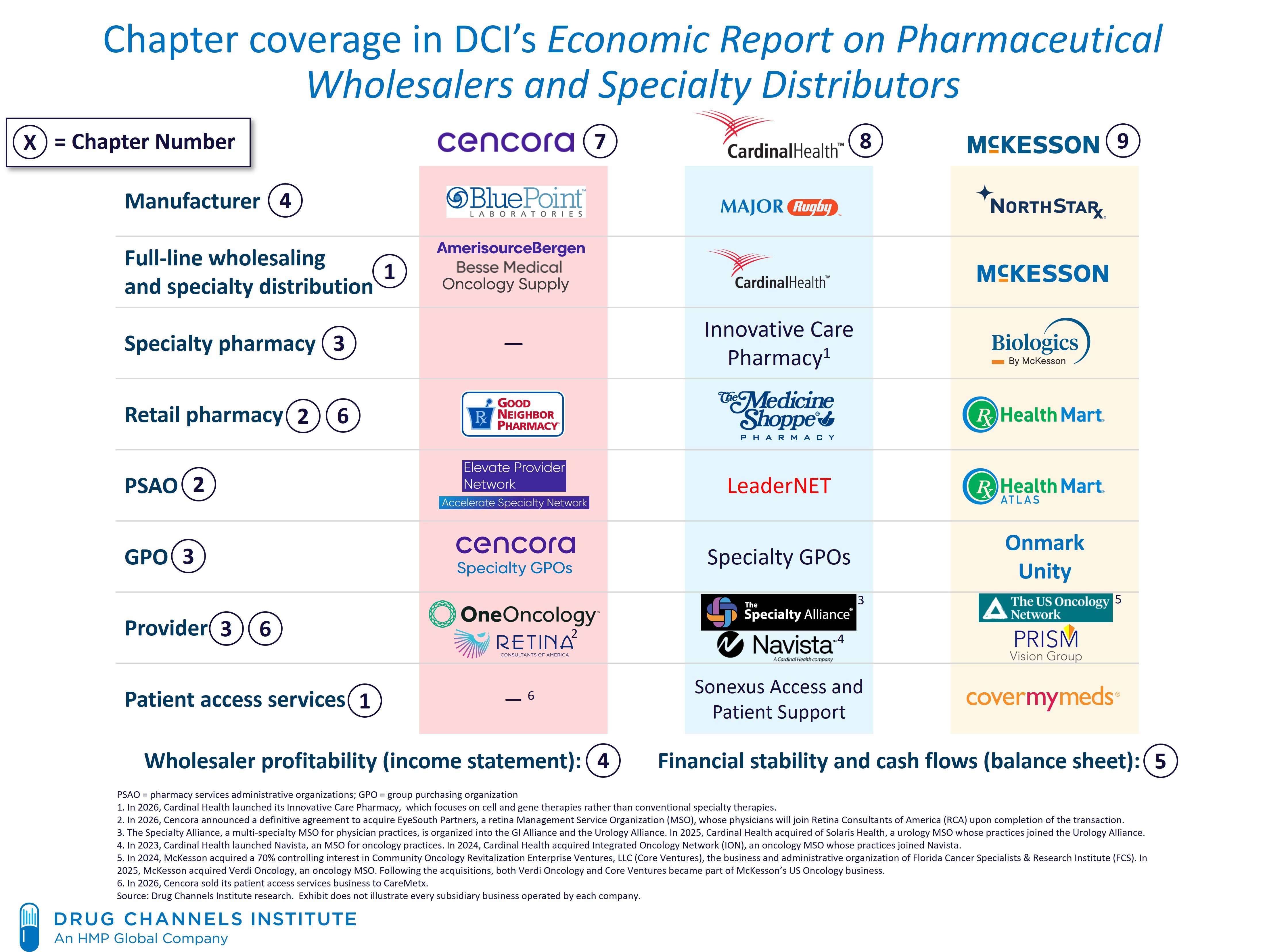
The chart below highlights the vertical alignment and diverse roles of Cencora, Cardinal Health, and McKesson within the U.S. healthcare system. The circled numbers identify the report chapters that explain and analyze each business.
[Click to enlarge]
The new edition provides the most current financial and industry data about pharmaceutical distribution. Among the major findings and expanded areas of coverage:
Drug distribution revenues for the Big Three public wholesalers are projected to reach $933 billion in 2026, although revenue growth has slowed from double-digit to mid-single-digit rates.
The largest wholesalers have invested more than $20 billion in physician management services organizations, transforming their roles in buy-and-bill markets.
Changes in drug pricing, direct-to-patient models, and other emerging channels are accelerating the industry’s transition toward a Net Pricing Drug Channel.
The report examines the evolving economics of biosimilars, cell and gene therapies, the 340B Drug Pricing Program, and implementation of the Inflation Reduction Act.
DCI’s proprietary economic models reveal differences in the business strategies, market positions, financial performance, and underlying profitability of Cencora, Cardinal Health, and McKesson.
There are 193 exhibits in the 2026-27 edition, compared with 187 in last year’s report. Most are new or fully updated.
Thank you for your continued interest in our research. Please email us (dcisupport@hmpglobal.com) with any questions before purchasing. We look forward to helping you succeed in the evolving U.S. drug channel.
Today's guest post comes from Meghal Patel, Chief Product Officer for Truzo at Model N.
Meghal examines why claims-level transparency has become increasingly important as manufacturers navigate the growing complexity of 340B and other drug pricing programs. He argues that greater visibility into pricing, discounts, and utilization can help manufacturers move beyond compliance to improve gross-to-net (GTN) management, revenue forecasting, and strategic decision-making.
For years, Medicare Part D plans often preferred high-list/high-rebate branded multiple sclerosis (MS) drugs over lower-cost generics. That was rational behavior inside an irrational system.
The Inflation Reduction Act (IRA) offers one example of how incentives can change behavior in the system. New research in JAMA Health Forum reveals a significant reversal in Medicare Part D formulary coverage for MS drugs. After years of plans favoring brand-name drugs over generics, 2025 formularies shifted to near-universal generic coverage.
However, in return patients got narrower formularies, higher upfront costs, and way more taxpayer dollars spent than expected.
While this wasn’t the case for all drug classes, in MS, the IRA Part D redesign has forced plans to care more about net drug spending. Below, we analyze the formulary data and explain why the coverage patterns changed so abruptly—and what new tradeoffs have emerged.
Every year, Drug Channels reviews drug pricing trends at the largest pharmaceutical manufacturers. This year's disclosures provide early evidence that the economics of the U.S. drug channel—and the strategies manufacturers use to secure market access—are beginning to change.
We review the following eight companies: Bristol Myers Squibb, Eli Lilly and Company, Genentech, GlaxoSmithKline, Sanofi, Takeda, Teva, and UCB. You can find links to each company’s data in the appendix.
Our review found:
Brand-name drug list prices continued to rise modestly, while mandatory and voluntary rebates, discounts, and fees reduced net prices at seven of the eight manufacturers.
The average gross-to-net price difference was –5.5%, reflecting an average list price increase of 3.7% and an average net price decline of 1.8%.
For the three manufacturers that disclosed these data, rebates, discounts, and other fees reduced the selling prices of brand-name drugs to less than half of their list prices.
Sanofi's latest and historical disclosures provide one of the clearest illustrations yet of the drug channel's changing economics. Since 2020, the company's estimated U.S. biopharmaceutical sales have grown far faster than rebate payments. As a result, the share of its gross sales returned to payers as rebates declined from 51% to 39%.
Taken together, this year's manufacturer disclosures suggest that the gross-to-net bubble is growing more slowly—and even deflating in parts of the market. Meanwhile, the Net Pricing Drug Channel (NPDC) is becoming visible in manufacturers’ pricing disclosures and financial statements.
It’s time for Drug Channels’ annual look at pharmacist salaries and employment. The latest data might be a tough pill to swallow.
As we predicted, the situation was grim for retail pharmacists. Employment in retail outpatient pharmacies fell by 8,200 positions in 2025, following a drop of 11,700 positions over 2023 and 2024 combined.
Meanwhile, pharmacist employment at hospitals grew by 3,000 positions, after hospitals added more than 11,000 pharmacist jobs in 2023 and 2024. Nearly half of all pharmacists now work outside a traditional retail setting.
Overall pharmacist salaries averaged $140,920, but varied widely across practice settings. Salary growth in many settings, however, did not keep pace with overall inflation.
Our 2026 Economic Report on U.S. Pharmacies and Pharmacy Benefit Managers documents how and why retail pharmacy economics are under sustained pressure. Since 2018, the two remaining national drugstore chains have collectively closed nearly 3,000 locations, reflecting margin compression and weaker front-end economics.
Informa’s PBM Contracting Summit
December 8-9, 2026 | Chicago, IL Drug Channels readers save 10% with code 26DRCH10*
The PBM Contracting Summit returns to Chicago this December! Join the industry as expert speakers navigate the complex PBM landscape, gaining unparalleled strategies to enhance patient care and effectively manage costs.
Key topics covered:
Employer and Broker Priorities: Understand what drives PBM selection, where traditional models fall short, and how to demonstrate measurable value.
Federal Regulatory Reform: Explore how evolving policy and enforcement affect your contracts through interactive roundtables.
GLP-1 Cost Management: Balance growing demand with access, affordability, and long-term sustainability.
Alternative PBM Models: Examine how emerging models address employer demands for transparency and control.
Manufacturer Direct-to-Consumer Strategies: Assess how direct channels and patient support programs are reshaping the PBM’s role.
The PBM Contracting Summit remains essential to tackle rising drug costs head-on, spotlighting bold innovations in contracting, GLP-1 strategy, AI-powered solutions, and federal and state-driven regulatory change.
View the agenda for PBM Contracting 2026 to see the complete picture—the program, speakers, and more. Visit www.informaconnect.com/pbm-contracting for further details and to register.
Drug Channels readers will save 10% off when they use code 26DRCH10 and register prior to November 6, 2026.*
*Cannot be combined with other offers or used towards a current registration. Cannot be combined with special category rates or other offers. Other restrictions may apply.
The content of Sponsored Posts does not necessarily reflect the views of HMP Omnimedia, LLC, Drug Channels Institute, its parent company, or any of its employees. To find out how you can publish an event post on Drug Channels, please contact Marie Caldwell(mcaldwell@hmpglobal.com)
Today's guest post comes from Kristen Magee, Vice President of Methodology & Enablement at AssistRx.
Kristen explains why patient support programs (PSPs) need to evolve as products move from launch through growth, maturity, and loss of exclusivity. She outlines how manufacturers can recalibrate the balance of technology, automation, and human support at each stage to improve efficiency while maintaining strong patient and healthcare provider experiences.
Football season is officially back. Personally, my signal is hearing my uncle curse about bad calls from 1,000 miles away, but you may have already seen a game.
This news roundup is short enough to fit into an ad break or two. *Caveat: may lead to rabbit holes that take much longer than an ad break.
Drug Channels Institute is proud to host the 2027 Drug Channels Leadership Forum, which will take place from March 15–17, 2027, in Miami. Request your invitation to this invite-only gathering of senior leaders from across the drug channel ecosystem. You must request an invitation to be considered for attendance. We will begin sending invitations in mid-October.
Today's guest post comes from Divya Iyer, SVP, Head of Revenue, Pharma Direct at GoodRx.
Divya examines how AI-powered search and conversational tools are reshaping the way patients research treatments and prescription costs before ever reaching a brand's website. She argues that pharmaceutical manufacturers must rethink their direct-to-consumer (DTC) strategies to ensure treatment information is discoverable, trusted, and connected to actionable next steps.
For more than a decade, the answer to “Where do drug wholesalers make their money?” has been generic drugs.
Although wholesaler revenues are linked most closely to sales of brand-name drugs, the majority of wholesalers’ gross profits comes from generic drugs. We estimate that in calendar year 2026, generic drugs will contribute 52% of total drug distribution gross profits of the Big Three wholesalers, but only 9% of drug distribution revenues.
Generic drugs are the long-running hit show that has carried wholesalers' profits for 15+ seasons. The show is still on the air, but a supporting character is starting a spinoff.
Generic drugs’ share of distribution gross profits has declined, from 68% in 2022 to 52% in 2026. This partially reflects the growth in profits from provider-administered biosimilars. Biosimilars now account for 6% of wholesalers’ drug distribution revenues, but 23% of total gross profits.
November 17-20, 2026 | Sheraton Downtown Philadelphia Exclusive Offer – Use promo code 26DC10 to save 10% on your registration*
Patient need is at an all-time high and the healthcare ecosystem is more complex than ever. With insurance changes, policy volatility, AI disruption and economic pressures reshaping patient programs, staying ahead is critical.
Join industry leaders at Patient Pathways 2026, where experts in copay, reimbursement and patient services will share actionable insights, innovative solutions and best practices. Unlock cutting-edge copay and reimbursement strategies, innovative patient solutions and robust compliance frameworks to elevate program performance, remove barriers and maximize affordability impact.
Can’t-Miss Highlights:
27+ hours of cutting-edge content featuring 6+ sessions on AI integration and automation, 10+ sessions on navigating regulatory changes and compliance frameworks, 20+ sessions on operational challenges and more.
Expert speakers from leading organizations such as Pfizer, BMS, Sanofi, Vertex, Boehringer Ingelheim, Teva, Novo Nordisk and more.
In-depth case studies on topics including patient cost-sharing burdens, balancing affordability with care and market saturation impacts.
Regulatory and policy updates to stay compliant and proactive in a rapidly evolving healthcare landscape.
15+ hours of networking opportunities to connect with industry leaders, build strategic partnerships and expand your professional network.
Why Attend?
Balancing patient services with business objectives is a delicate task. The Congress will address critical questions that access professionals face:
How can programs remain sustainable, innovative and profitable while supporting patients?
How will upcoming health policy changes impact affordability, commercialization and program strategies?
Is your program equipped to deploy AI strategically?
Join industry leaders, peers and solution providers for answers to these questions and more – Benchmark best practices, gain actionable insights, connect with industry trailblazers and drive patient support and affordability forward at Patient Pathways 2026.
“The event was exceptionally well-organized, the atmosphere was welcoming, and I left feeling more informed, empowered and excited to bring what I learned back to my team.”
*Cannot be combined with other offers, promotions, or applied to an existing registration. Other restrictions may apply.
The content of Sponsored Posts does not necessarily reflect the views of HMP Omnimedia, LLC, Drug Channels Institute, its parent company, or any of its employees. To find out how you can publish an event post on Drug Channels, please contact Marie Caldwell(mcaldwell@hmpglobal.com).