

But don’t worry—I’ve gathered some high-impact information over the last month from my LinkedIn posts that you can quickly read between your sets at the gym.
I recommend reading BETWEEN your sets, but some may be brave enough to read during the set itself.
In this issue: Extra: What If Specialty Pharmacy Worked Like a Luxury Hotel? A Surprising Reimagining
P.S. Join my more than 33,000 LinkedIn followers for valuable daily posts at 9 a.m. ET.
340B in 2026: Market Shifts, Policy Battles, and What They Mean for Stakeholders.
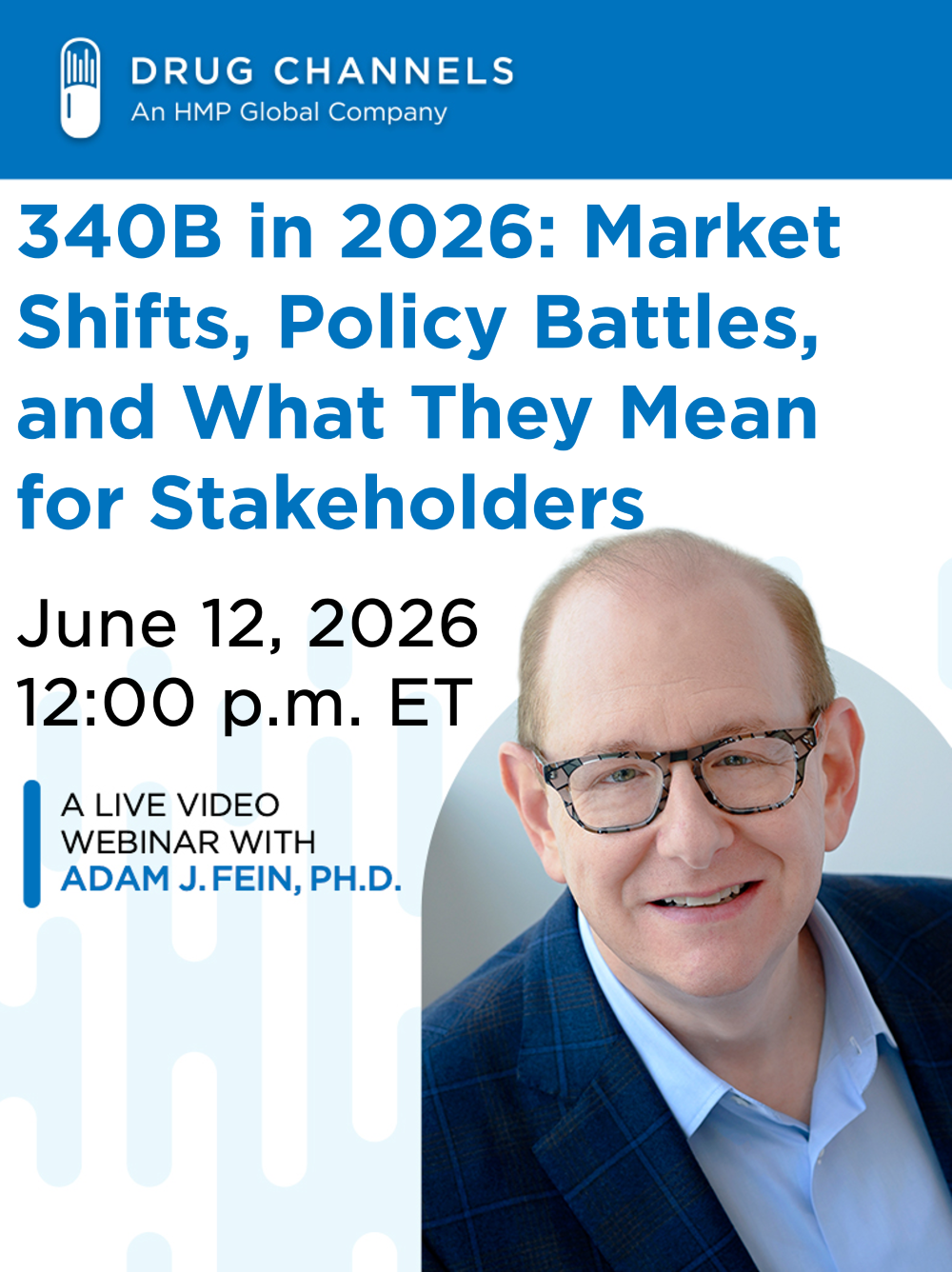
Don't miss DCI’s upcoming webinar on Friday, June 12, 2026, from 12:00 p.m. to 1:30 p.m. ET. Adam J. Fein and Tyler Novotny will unpack the good, the bad, and the ugly of the 340B program—and what it means for you. Click here to learn more and sign up.
The Health, Education, Labor and Pensions (HELP) Committee Drug Pricing Report, United States Senate
When looking at drug launch prices, the unweighted average tells you almost nothing.
This Senate HELP report makes the same mistake as a 2022 JAMA study that we covered here: A New JAMA Study Misleads About Drug Prices—And Launches a New Attack on Patients with Ultra-Rare Diseases.
As you can see below, a banana, a TV, and a Rolls Royce technically have an “average” price, but the average price is meaningless unless you weight the numbers with actual utilization.

If more rare disease drugs, a.k.a. a Rolls Royce, launch in a given year—which is what has happened the last several years—the average rises. Not necessarily because launch prices for similar drugs changed, but because the types of drugs approved did.
Payers don’t buy averages. What really matters is drug mix, utilization, and net prices—not a single, misleading average.
This Senate HELP report makes the same mistake as a 2022 JAMA study that we covered here: A New JAMA Study Misleads About Drug Prices—And Launches a New Attack on Patients with Ultra-Rare Diseases.
As you can see below, a banana, a TV, and a Rolls Royce technically have an “average” price, but the average price is meaningless unless you weight the numbers with actual utilization.
[Click to Enlarge]

If more rare disease drugs, a.k.a. a Rolls Royce, launch in a given year—which is what has happened the last several years—the average rises. Not necessarily because launch prices for similar drugs changed, but because the types of drugs approved did.
Payers don’t buy averages. What really matters is drug mix, utilization, and net prices—not a single, misleading average.
Preferred Networks and pharmacy access in Part D, MedPAC
Pharmacy closures are increasing, but the impact is more about where they’re closing than which pharmacies are closing.
Sixty-two percent of pharmacy closures in 2025 were from chain pharmacies. That sounds alarming.
However, chains are mostly closing underperforming stores in markets that have other pharmacies available. The chain companies overall still had significant increases in revenues in 2025. Independents are closing where they’re often the only option.

What we really care about is if patients can still access a pharmacy. Focusing on total closures misses that access problem.
Sixty-two percent of pharmacy closures in 2025 were from chain pharmacies. That sounds alarming.
However, chains are mostly closing underperforming stores in markets that have other pharmacies available. The chain companies overall still had significant increases in revenues in 2025. Independents are closing where they’re often the only option.
[Click to Enlarge]

What we really care about is if patients can still access a pharmacy. Focusing on total closures misses that access problem.
Hospitals & Their Fake Prices, Off Label Ideas
Hospitals often reference low reimbursement from government payers like Medicare and Medicaid as one reason for charging higher rates to commercial payers.
If you look at the reimbursement data closer, you’ll see hospitals are funded through multiple overlapping streams.
Many of these streams are covered in the Off Label Ideas article, as well in more mathematical detail in Minnesota’s 340B Hospitals Make One Billion More From 340B Than They Spend on Uncompensated Care.

After taxes, tax exemptions, DSH payments, supplemental payments for uncompensated care, 340B revenue, market pricing power, and more, what’s left that wasn’t sufficiently reimbursed?
A little more accounting proof of the underpayment would be helpful.
If you look at the reimbursement data closer, you’ll see hospitals are funded through multiple overlapping streams.
Many of these streams are covered in the Off Label Ideas article, as well in more mathematical detail in Minnesota’s 340B Hospitals Make One Billion More From 340B Than They Spend on Uncompensated Care.
[Click to Enlarge]

After taxes, tax exemptions, DSH payments, supplemental payments for uncompensated care, 340B revenue, market pricing power, and more, what’s left that wasn’t sufficiently reimbursed?
A little more accounting proof of the underpayment would be helpful.
340B Hospitals versus Federal Grantees, LinkedIn
Many 340B discussions treat hospitals and federal grantees as interchangeable when they’re actually very different in practice.
They operate under the same statute, but the incentives produce separate outcomes.
This graphic summarizes some of the major contrasts between these 340B covered entities.

For a deep dive into this controversial and complex portion of the U.S. pharmaceutical market, register for our upcomign webinar: 340B in 2026: Market Shifts, Policy Battles, and What They Mean for Stakeholders.
They operate under the same statute, but the incentives produce separate outcomes.
This graphic summarizes some of the major contrasts between these 340B covered entities.
[Click to Enlarge]

For a deep dive into this controversial and complex portion of the U.S. pharmaceutical market, register for our upcomign webinar: 340B in 2026: Market Shifts, Policy Battles, and What They Mean for Stakeholders.
If Specialty Pharmacy was a Luxury Hotel, LinkedIn
Last month, I attended the Asembia AXS26 Summit for the first time, so I kicked off the week with this analogy between specialty pharmacy and luxury hotels.

One piece of the drug channel I didn’t explicitly call out in the image is the drug manufacturer. You can think of the manufacturer as the general contractor that built the luxury hotel. Without the general contractor, there wouldn’t be a hotel for patients to stay in at all!
[Click to Enlarge]

One piece of the drug channel I didn’t explicitly call out in the image is the drug manufacturer. You can think of the manufacturer as the general contractor that built the luxury hotel. Without the general contractor, there wouldn’t be a hotel for patients to stay in at all!
No comments:
Post a Comment