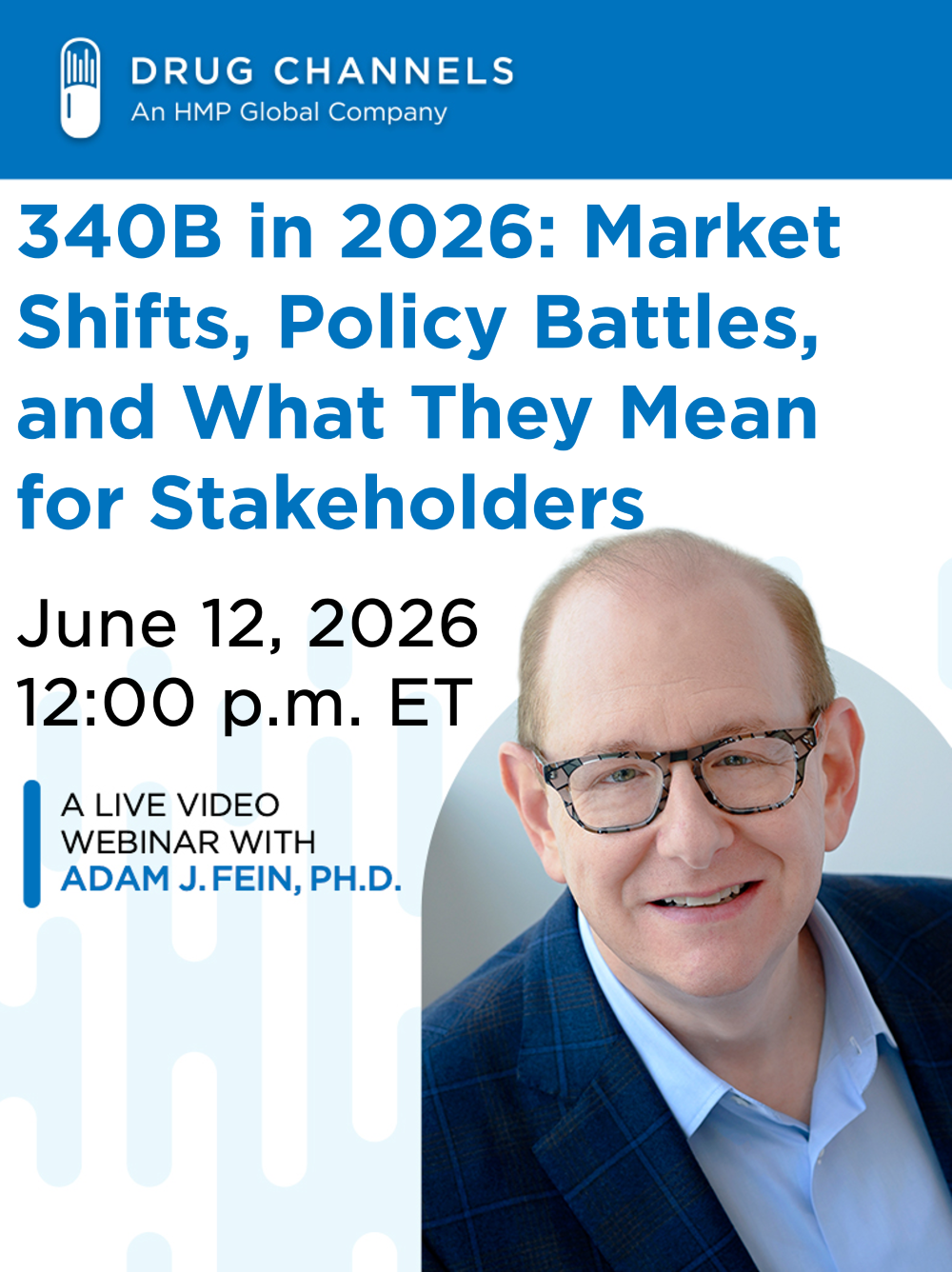
This week, we’re rerunning some popular posts while we prepare for today’s live video webinar: 340B in 2026: Market Shifts, Policy Battles, and What They Mean for Stakeholders.
Click here to see the original post from April 2026.
By Bryce Platt, PharmD
Minnesota’s new 340B data reveal a growing disconnect between the program’s size and the value Minnesotans receive in return.
In 2024, nonprofit hospitals generated more than $1.3 billion in 340B net profits—nearly a billion dollars more than they provided in uncompensated care. At the same time, these same institutions already benefit from substantial tax exemptions tied to their not-for-profit status and charitable mission.
The gap between 340B profits and charity care isn’t a rounding error or a one-off anomaly. The 340B Drug Pricing Program has evolved into a significant profit center for hospital systems. This is another layer on top of existing public subsidies, not a substitute for them.
As you’ll see below, our analysis describes a 340B program that generates financial gains far in excess of any contribution back to the people of the state. There is also no clear accountability for how those dollars are used.
Drug Channels delivers timely analysis and provocative opinions from Adam J. Fein, Ph.D., the country's foremost expert on pharmaceutical economics and the drug distribution system. Drug Channels reaches an engaged, loyal and growing audience of more than 100,000 subscribers and followers. Learn more...
Friday, June 12, 2026
Thursday, June 11, 2026
The Top 15 Specialty Pharmacies of 2025: PBM-Affiliated Pharmacies Dominate While Health Systems and Independents Gain Ground (rerun)
This week, we’re rerunning some popular posts while we prepare for tomorrow’s live video webinar: 340B in 2026: Market Shifts, Policy Battles, and What They Mean for Stakeholders.
Click here to see the original post from April 2026.
By Adam J. Fein, Ph.D.
Drug Channels Institute’s (DCI’s) latest analysis reveals that PBM-affiliated specialty pharmacies continue to dominate the dispensing of specialty drugs.
For 2025, DCI has identified more than 1,900 dispensing locations with specialty pharmacy accreditation from one or both of the two major independent accreditation organizations. The overall number of accredited locations grew by only 3% in 2025, but is more than five times larger than the 2015 figure.
However, market share for the dispensing of specialty drugs remains highly concentrated. For 2025, the three largest specialty pharmacies accounted for two-thirds of total prescription revenues from pharmacy-dispensed specialty drugs. These businesses are all owned by vertically integrated organizations that also own a PBM.
Below, we share DCI’s latest analysis of the top 15 specialty pharmacies, including updated market shares and revenue estimates, highlighting how vertical integration and channel control continue to reshape specialty dispensing. Despite growth in accredited locations, economic power remains concentrated among a small group of PBM-affiliated entities.
Click here to see the original post from April 2026.
By Adam J. Fein, Ph.D.
Drug Channels Institute’s (DCI’s) latest analysis reveals that PBM-affiliated specialty pharmacies continue to dominate the dispensing of specialty drugs.
For 2025, DCI has identified more than 1,900 dispensing locations with specialty pharmacy accreditation from one or both of the two major independent accreditation organizations. The overall number of accredited locations grew by only 3% in 2025, but is more than five times larger than the 2015 figure.
However, market share for the dispensing of specialty drugs remains highly concentrated. For 2025, the three largest specialty pharmacies accounted for two-thirds of total prescription revenues from pharmacy-dispensed specialty drugs. These businesses are all owned by vertically integrated organizations that also own a PBM.
Below, we share DCI’s latest analysis of the top 15 specialty pharmacies, including updated market shares and revenue estimates, highlighting how vertical integration and channel control continue to reshape specialty dispensing. Despite growth in accredited locations, economic power remains concentrated among a small group of PBM-affiliated entities.
Labels:
Hospitals,
PBMs,
Specialty Drugs
Wednesday, June 10, 2026
Mapping the Vertical Integration of Insurers, PBMs, GPOs, Specialty Pharmacies, and Healthcare Services: DCI’s 2026 Update (rerun)
This week, we’re rerunning some popular posts while we prepare for Friday’s live video webinar: 340B in 2026: Market Shifts, Policy Battles, and What They Mean for Stakeholders.
Click here to see the original post from April 2026.
By Adam J. Fein, Ph.D.
It's time for Drug Channels Institute’s (DCI) annual update of vertical integration among insurers, PBMs, specialty pharmacies, and healthcare services within U.S. drug channels. As you can see below, we have updated and revised our infamous illustration of the major vertical business relationships within the largest companies.
These organizations continue to exert greater control over patient access, sites of care/dispensing, and pricing, although some have started to unwind their vertical integration strategies. Scrutiny of these companies’ actions continues to grow.
For all the details behind these companies’ operations, check out DCI’s new 2026 Economic Report on U.S. Pharmacies and Pharmacy Benefit Managers.
Click here to see the original post from April 2026.
By Adam J. Fein, Ph.D.
It's time for Drug Channels Institute’s (DCI) annual update of vertical integration among insurers, PBMs, specialty pharmacies, and healthcare services within U.S. drug channels. As you can see below, we have updated and revised our infamous illustration of the major vertical business relationships within the largest companies.
These organizations continue to exert greater control over patient access, sites of care/dispensing, and pricing, although some have started to unwind their vertical integration strategies. Scrutiny of these companies’ actions continues to grow.
For all the details behind these companies’ operations, check out DCI’s new 2026 Economic Report on U.S. Pharmacies and Pharmacy Benefit Managers.
Tuesday, June 09, 2026
The Top Pharmacy Benefit Managers of 2025: Market Share and Key Industry Developments (rerun)
This week, we’re rerunning some popular posts while we prepare for Friday’s live video webinar: 340B in 2026: Market Shifts, Policy Battles, and What They Mean for Stakeholders.
Click here to see the original post from March 2026.
By Adam J. Fein, Ph.D.
Three is still the magic number for pharmacy benefit managers (PBMs).
For 2025, 80% of all equivalent prescription claims were processed by three companies: the CVS Caremark business of CVS Health, the Express Scripts business of Cigna, and the Optum Rx business of UnitedHealth Group. Express Scripts continued to pull ahead of its peers, while CVS Caremark’s claim volume declined for the second year.
Independent PBMs continued to gain business from these larger PBMs, showing fragmentation at the margins. Many smaller PBMs still rely on their larger competitors for claims processing, network management, and rebate negotiation. So even if a plan sponsor chooses an alternative PBM, the Big Three can still win with behind-the scenes economics.
Below, we draw on DCI's new 2026 Economic Report on U.S. Pharmacies and Pharmacy Benefit Managers to break down the latest market share data for the largest companies.
The Big Three PBMs’ dominance persists, but they face growing regulatory and competitive constraints. The largest PBMs are restructuring their businesses in response to client demands, legislative changes, and legal pressures. The emerging Net Pricing Drug Channel will accelerate these shifts, forcing changes in how PBMs generate profits, structure contracts, and justify their role in the drug channel.
Click here to see the original post from March 2026.
By Adam J. Fein, Ph.D.
Three is still the magic number for pharmacy benefit managers (PBMs).
For 2025, 80% of all equivalent prescription claims were processed by three companies: the CVS Caremark business of CVS Health, the Express Scripts business of Cigna, and the Optum Rx business of UnitedHealth Group. Express Scripts continued to pull ahead of its peers, while CVS Caremark’s claim volume declined for the second year.
Independent PBMs continued to gain business from these larger PBMs, showing fragmentation at the margins. Many smaller PBMs still rely on their larger competitors for claims processing, network management, and rebate negotiation. So even if a plan sponsor chooses an alternative PBM, the Big Three can still win with behind-the scenes economics.
Below, we draw on DCI's new 2026 Economic Report on U.S. Pharmacies and Pharmacy Benefit Managers to break down the latest market share data for the largest companies.
The Big Three PBMs’ dominance persists, but they face growing regulatory and competitive constraints. The largest PBMs are restructuring their businesses in response to client demands, legislative changes, and legal pressures. The emerging Net Pricing Drug Channel will accelerate these shifts, forcing changes in how PBMs generate profits, structure contracts, and justify their role in the drug channel.
Monday, June 08, 2026
The Top 15 U.S. Pharmacies of 2025: Market Shares and Revenues at the Biggest Chains, PBMs, and Specialty Pharmacies (rerun)
This week, we’re rerunning some popular posts while we prepare for Friday’s live video webinar: 340B in 2026: Market Shifts, Policy Battles, and What They Mean for Stakeholders.
Click here to see the original post from March 2026.
By Adam J. Fein, Ph.D.
Next week, the Drug Channels Institute (DCI) will release our 2026 Economic Report on U.S. Pharmacies and Pharmacy Benefit Managers. This 17th edition provides our most comprehensive and up-to-date examination of the U.S. drug pricing, reimbursement, and dispensing system.
For 2025, DCI estimates that total prescription dispensing revenues at retail, mail, long-term care, and specialty pharmacies reached $751 billion in 2025, up 10% from the 2024 figure.
GLP-1 agonist drugs have become the dominant driver of revenue growth. Over the past five years, increases in dispensing revenues from GLP-1 products accounted for about 60% of retail pharmacies’ total revenue growth.
The table below—one of 270 in our new report—racks up DCI's first look at the 15 largest organizations that competed for a share of those dollars. For a sneak peek at the complete report, click here to download our free 32-page report overview (including key industry trends, What's New in this edition, the Table of Contents, and a List of Exhibits).
Click here to see the original post from March 2026.
By Adam J. Fein, Ph.D.
Next week, the Drug Channels Institute (DCI) will release our 2026 Economic Report on U.S. Pharmacies and Pharmacy Benefit Managers. This 17th edition provides our most comprehensive and up-to-date examination of the U.S. drug pricing, reimbursement, and dispensing system.
For 2025, DCI estimates that total prescription dispensing revenues at retail, mail, long-term care, and specialty pharmacies reached $751 billion in 2025, up 10% from the 2024 figure.
GLP-1 agonist drugs have become the dominant driver of revenue growth. Over the past five years, increases in dispensing revenues from GLP-1 products accounted for about 60% of retail pharmacies’ total revenue growth.
The table below—one of 270 in our new report—racks up DCI's first look at the 15 largest organizations that competed for a share of those dollars. For a sneak peek at the complete report, click here to download our free 32-page report overview (including key industry trends, What's New in this edition, the Table of Contents, and a List of Exhibits).
Labels:
PBMs,
Pharmacy,
Specialty Drugs,
Trends
Friday, June 05, 2026
Pharmacy Copay Misuse: The Multi-Billion Dollar Issue Hiding In Plain Sight
Today’s guest post comes from Stephen Hom, Co-Founder, EVP & Chief Operating Officer of RIS Rx.
Drawing on RIS Rx’s proprietary data and case studies, Stephen highlights patterns that can undermine patient support program effectiveness. He argues that a more data-driven approach can help manufacturers identify hidden risks, improve program performance, and ensure that affordability resources reach the patients they are intended to support.
Request a complimentary analysis from RIS Rx.
Read on for Stephen’s insights.
Drawing on RIS Rx’s proprietary data and case studies, Stephen highlights patterns that can undermine patient support program effectiveness. He argues that a more data-driven approach can help manufacturers identify hidden risks, improve program performance, and ensure that affordability resources reach the patients they are intended to support.
Request a complimentary analysis from RIS Rx.
Read on for Stephen’s insights.
Labels:
Guest Post,
Sponsored Post
Tuesday, June 02, 2026
The 340B Contract Pharmacy Market in 2026: A Maturing Industry Dominated by Big Chains and PBMs
By Adam J. Fein, Ph.D. and Greis Kapexhiu
It’s time for Drug Channels Institute’s latest exclusive analysis of the 340B contract pharmacy market, which continues to boom along with the overall program’s expansion.
However, our 2026 analysis finds that the contract pharmacy market is now entering a more mature phase characterized by consolidation, slower growth, and increasing dominance by the industry’s largest participants.
Below, we characterize the state of the marketplace:
Read on for our latest analysis of this ever-expanding profit pool for pharmacies and PBMs. For a deep dive on what the 340B program’s growth means for drug channel participants, join Adam J. Fein, Ph.D., and Tyler Novotny on June 12 for a new live video webinar: 340B in 2026: Market Shifts, Policy Battles, and What They Mean for Stakeholders.
It’s time for Drug Channels Institute’s latest exclusive analysis of the 340B contract pharmacy market, which continues to boom along with the overall program’s expansion.
However, our 2026 analysis finds that the contract pharmacy market is now entering a more mature phase characterized by consolidation, slower growth, and increasing dominance by the industry’s largest participants.
Below, we characterize the state of the marketplace:
- Nearly two-thirds of the entire U.S. pharmacy industry participates as contract pharmacies for the 340B hospitals and federal grantees.
- The number of 340B pharmacy locations declined for the third year, due largely to the retail pharmacy shakeout and manufacturers’ 340B policies.
- Meanwhile, the total number of unique contract pharmacy/covered entity relationships continues to expand. Five multi-billion-dollar, for-profit, publicly traded pharmacy chains and pharmacy benefit managers (PBMs)—Cigna, CVS Health, UnitedHealth Group, Walgreens, and Walmart—now account for a record 77% of all relationships.
Read on for our latest analysis of this ever-expanding profit pool for pharmacies and PBMs. For a deep dive on what the 340B program’s growth means for drug channel participants, join Adam J. Fein, Ph.D., and Tyler Novotny on June 12 for a new live video webinar: 340B in 2026: Market Shifts, Policy Battles, and What They Mean for Stakeholders.
Labels:
340B,
Channel Management,
Hospitals,
PBMs,
Pharmacy
Friday, May 29, 2026
Drugs, Discounts and Data: Crafting Sustainability in an Imperfect System
Today’s guest post comes from Angie Franks, Chief Executive Officer at Kalderos.
As Angie explains, the industry still lacks the transparency needed to effectively manage where discounts occur and how funds move across stakeholders. She argues that improving visibility and coordination across the ecosystem is essential to building a more sustainable and accountable model for both innovation and patient support.
To learn more, register for Kalderos’ free webinar on June 23, 2026:
GTN Oversight: A New Standard of Transparency Is Here.
Read on for Angie’s insights.
As Angie explains, the industry still lacks the transparency needed to effectively manage where discounts occur and how funds move across stakeholders. She argues that improving visibility and coordination across the ecosystem is essential to building a more sustainable and accountable model for both innovation and patient support.
To learn more, register for Kalderos’ free webinar on June 23, 2026:
GTN Oversight: A New Standard of Transparency Is Here.
Read on for Angie’s insights.
Labels:
Guest Post,
Sponsored Post
Wednesday, May 27, 2026
Drug Channels News Roundup, May 2026: My $0.02 on Optum Rx’s Transparency, Must-Read 340B History, PBM Unbundling Update, PA Delays, and Vegas Fun
By Adam J. Fein, Ph.D.
Summer unofficially kicked off last weekend. So fire up the grill and enjoy these noteworthy delicacies, seared to perfection on the Drug Channels barbeque: Plus: The Drug Channels Institute team takes on Las Vegas—with stickers!
P.S. Join my 70,000+ LinkedIn followers for links to interesting industry news, along with unfiltered commentary from the DCI community.
Summer unofficially kicked off last weekend. So fire up the grill and enjoy these noteworthy delicacies, seared to perfection on the Drug Channels barbeque: Plus: The Drug Channels Institute team takes on Las Vegas—with stickers!
P.S. Join my 70,000+ LinkedIn followers for links to interesting industry news, along with unfiltered commentary from the DCI community.
340B in 2026: Market Shifts, Policy Battles, and What They Mean for Stakeholders.
Don't miss DCI’s upcoming webinar on Friday, June 12, 2026, from 12:00 p.m. to 1:30 p.m. ET. Adam J. Fein and Tyler Novotny will unpack the good, the bad, and the ugly of the 340B program—and what it means for you. Click here to learn more and sign up.
Labels:
340B,
Benefit Design,
PBMs
Wednesday, May 20, 2026
PBM Shakeout: How Vertical Integration Is Reshaping What’s Next (VIDEO)
Here at Drug Channels, we’ve been closely tracking the evolution of the pharmacy benefit management (PBM) industry for many years.
The short video below—excerpted from DCI’s recent PBM Industry Update 2026: Trends, Challenges, and What’s Ahead video webinar—reviews the shifting market positions of the largest PBMs and explains why vertical integration continues to reshape the industry’s competitive dynamics.
I also discuss the proliferation of smaller PBMs, many of which still depend on the largest PBMs for claims processing, pharmacy networks, rebate negotiation, and other core services. However, the market is entering what we believe will be a significant shakeout phase.
The growing administrative complexity of state and federal regulation will disproportionately burden smaller PBMs that lack the scale, capital, and integrated infrastructure of the largest organizations. Over the next five years, we expect many smaller PBMs to disappear through acquisition, consolidation, or business failure.
Meanwhile, vertical integration will continue to create strategic and financial advantages for the largest healthcare organizations—along with new opportunities to shift profits, manage risk, and coordinate services across multiple parts of the healthcare system.
What do you think?
Can’t see the video? Click here to watch the PBM clip.
ADDITIONAL BACKGROUND AND ANALYSIS
For more on the PBM industry, see these articles and reports: Cathy Kelly at The Pink Sheet also wrote an article about the webinar: PBM Regulation May Bolster Big Three Market Position Versus Smaller Competitors.
The short video below—excerpted from DCI’s recent PBM Industry Update 2026: Trends, Challenges, and What’s Ahead video webinar—reviews the shifting market positions of the largest PBMs and explains why vertical integration continues to reshape the industry’s competitive dynamics.
I also discuss the proliferation of smaller PBMs, many of which still depend on the largest PBMs for claims processing, pharmacy networks, rebate negotiation, and other core services. However, the market is entering what we believe will be a significant shakeout phase.
The growing administrative complexity of state and federal regulation will disproportionately burden smaller PBMs that lack the scale, capital, and integrated infrastructure of the largest organizations. Over the next five years, we expect many smaller PBMs to disappear through acquisition, consolidation, or business failure.
Meanwhile, vertical integration will continue to create strategic and financial advantages for the largest healthcare organizations—along with new opportunities to shift profits, manage risk, and coordinate services across multiple parts of the healthcare system.
What do you think?
Can’t see the video? Click here to watch the PBM clip.
ADDITIONAL BACKGROUND AND ANALYSIS
For more on the PBM industry, see these articles and reports: Cathy Kelly at The Pink Sheet also wrote an article about the webinar: PBM Regulation May Bolster Big Three Market Position Versus Smaller Competitors.
340B in 2026: Market Shifts, Policy Battles, and What They Mean for Stakeholders.
Don't miss DCI’s next live video webinar on Friday, June 12, 2026, from 12:00 p.m. to 1:30 p.m. ET. Adam J. Fein and Tyler Novotny will unpack the good, the bad, and the ugly of the 340B program—and what it means for you. Click here to learn more and sign up.
Labels:
Industry Trends,
Mergers and Acquisitions,
PBMs,
Video
Friday, May 15, 2026
Protecting Gross-to-Net Performance Through Single-Channel Ecosystems
Today’s guest post comes from Peter Darch, SVP of Strategy and Operations at PHIL Inc.
Peter explains that growing pressure on drug pricing is exposing structural inefficiencies in gross-to-net (GTN) across traditional distribution channels. He argues that single-channel ecosystems can better coordinate affordability, coverage, and dispensing, improving both patient outcomes and brand performance.
Click here to learn more about PHIL’s technology solution for brands.
Read on for Peter’s insights.
Peter explains that growing pressure on drug pricing is exposing structural inefficiencies in gross-to-net (GTN) across traditional distribution channels. He argues that single-channel ecosystems can better coordinate affordability, coverage, and dispensing, improving both patient outcomes and brand performance.
Click here to learn more about PHIL’s technology solution for brands.
Read on for Peter’s insights.
Labels:
Guest Post,
Sponsored Post
Wednesday, May 13, 2026
Drug Channels News Roundup, Mid-May 2026: Flawed Launch Price Math, Rising Pharmacy Closures, Hospital Pay Realities, 340B Hospitals vs. Grantees, and a Luxury Take on Specialty Pharmacy
By Bryce Platt, PharmD
The onslaught of pharmacy-related news doesn’t end. It may even be increasing in volume due to AI.
But don’t worry—I’ve gathered some high-impact information over the last month from my LinkedIn posts that you can quickly read between your sets at the gym.
I recommend reading BETWEEN your sets, but some may be brave enough to read during the set itself.
In this issue: Extra: What If Specialty Pharmacy Worked Like a Luxury Hotel? A Surprising Reimagining
P.S. Join my more than 33,000 LinkedIn followers for valuable daily posts at 9 a.m. ET.
The onslaught of pharmacy-related news doesn’t end. It may even be increasing in volume due to AI.
But don’t worry—I’ve gathered some high-impact information over the last month from my LinkedIn posts that you can quickly read between your sets at the gym.
I recommend reading BETWEEN your sets, but some may be brave enough to read during the set itself.
In this issue: Extra: What If Specialty Pharmacy Worked Like a Luxury Hotel? A Surprising Reimagining
P.S. Join my more than 33,000 LinkedIn followers for valuable daily posts at 9 a.m. ET.
340B in 2026: Market Shifts, Policy Battles, and What They Mean for Stakeholders.
Don't miss DCI’s upcoming webinar on Friday, June 12, 2026, from 12:00 p.m. to 1:30 p.m. ET. Adam J. Fein and Tyler Novotny will unpack the good, the bad, and the ugly of the 340B program—and what it means for you. Click here to learn more and sign up.
Labels:
340B,
Hospitals,
Pharmacy,
Specialty Drugs
Tuesday, May 12, 2026
340B in 2026: Market Shifts, Policy Battles, and What They Mean for Stakeholders (NEW Live Video Webinar)
Join Dr. Adam J. Fein, president of Drug Channels Institute (DCI) and the editor of Drug Channels, for his latest exclusive video webinar:
The webinar will be broadcast live from the Drug Channels studio in beautiful downtown Philadelphia. It is part of The Drug Channels 2026 Video Webinar Series.
Join industry expert Adam J. Fein, Ph.D., and his colleague Tyler Novotny, MBA, for an exclusive deep dive into the 340B Drug Pricing Program—one of the most complex and controversial segments of the U.S. pharmaceutical market.
In this all-new webinar, Adam and Tyler will deliver a fact-based, data-driven analysis of the 340B program’s structure, economics, and rapid evolution. He’ll unpack the key controversies reshaping the program, explain what’s really happening behind the headlines, and provide a clear, actionable outlook for stakeholders across the drug channel.
Whether you’re in pharma, provider organizations, pharmacy, or policy, you’ll gain the insights needed to understand where 340B is headed—and what it means for your business.
Key topics include:
As always, they will clearly distinguish their opinions and interpretations from the objective facts and data.
This 90-minute video webinar will feature a dedicated Q&A session, where attendees can unmute and engage directly with Tyler and Adam.
Register now to stay informed and get ahead of the curve on 340B!
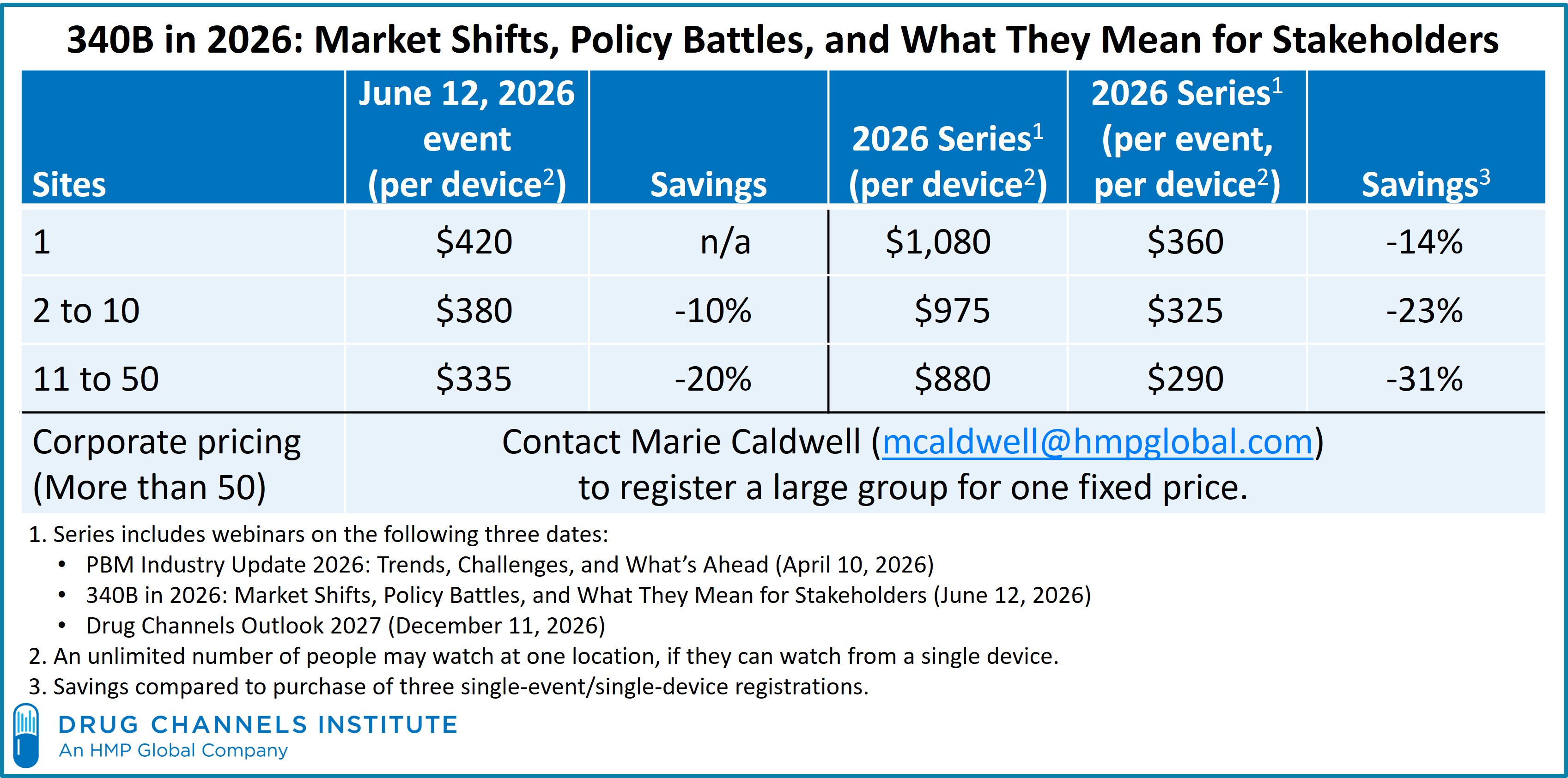
Take advantage of this exclusive educational opportunity for just $420 per viewing device. Once you register, you'll receive a unique Zoom access link within 24 hours—making it easy to add the event to your calendar and ensure you don’t miss out.
Special Discounts For Teams!
We understand that many professionals are working remotely, so we’re offering substantial savings for multiple registrations from the same organization. What's more, an unlimited number of attendees can watch together at a single physical location with one registered device.
Important Reminder: Each device at a single physical location must have its own registration. The webinar may not be recorded, streamed, broadcast, or shared across different locations, devices, or sites.
Click here to register. All discounts will be automatically computed based on the number of registrations you enter in your cart. (You can reset the cart by entering 0 in the quantity field.)
Questions about corporate pricing? Please contact Marie Caldwell (mcaldwell@hmpglobal.com).
Purchasing access for multiple sites? We'll contact you for your participant list. Or, download this spreadsheet and email your registrants’ information to dcisupport@hmpglobal.com.
Payment can be made with all major credit cards (Visa, MasterCard, American Express, and Discover). Prefer check or ACH? Click here to request an invoice.
340B in 2026: Market Shifts, Policy Battles,
and What They Mean for Stakeholders
This event will be broadcast live on:
Friday, June 12, 2026
12:00 p.m. to 1:30 p.m. ET
The webinar will be broadcast live from the Drug Channels studio in beautiful downtown Philadelphia. It is part of The Drug Channels 2026 Video Webinar Series.
WHAT YOU WILL LEARN
Join industry expert Adam J. Fein, Ph.D., and his colleague Tyler Novotny, MBA, for an exclusive deep dive into the 340B Drug Pricing Program—one of the most complex and controversial segments of the U.S. pharmaceutical market.
In this all-new webinar, Adam and Tyler will deliver a fact-based, data-driven analysis of the 340B program’s structure, economics, and rapid evolution. He’ll unpack the key controversies reshaping the program, explain what’s really happening behind the headlines, and provide a clear, actionable outlook for stakeholders across the drug channel.
Whether you’re in pharma, provider organizations, pharmacy, or policy, you’ll gain the insights needed to understand where 340B is headed—and what it means for your business.
Key topics include:
- The structure and economics of the 340B program
- Growth trends among covered entities and their partners
- 340B’s expanding role in pharmacy—and its impact on PBMs and retail
- DCI’s latest data on the contract pharmacy marketplace and the leading participants
- The role of third-party administrators and vendors in the 340B ecosystem
- What’s behind the growing controversy over the definition of an eligible patient
- Why diversion and duplicate discounts have become flashpoints
- The implications of the Net Pricing Drug Channel for 340B pricing dynamics
- How 340B funds are generated and distributed across participating entities
- How employers and plan sponsors could reshape the program’s future
- Manufacturers’ evolving distribution strategies for 340B contract pharmacies
- Recent legal developments affecting manufacturer policies and contract pharmacy arrangements
- The expanding influence of state legislation
- The impact of the Inflation Reduction Act on program operations and oversight
- The HRSA vs. CMS oversight crisis
- The outlook for a potential 340B rebate model
- What’s ahead for state and federal policy
- Emerging risks, challenges, and threats to watch
As always, they will clearly distinguish their opinions and interpretations from the objective facts and data.
This 90-minute video webinar will feature a dedicated Q&A session, where attendees can unmute and engage directly with Tyler and Adam.
Register now to stay informed and get ahead of the curve on 340B!
PRICING OPTIONS
Take advantage of this exclusive educational opportunity for just $420 per viewing device. Once you register, you'll receive a unique Zoom access link within 24 hours—making it easy to add the event to your calendar and ensure you don’t miss out.
Special Discounts For Teams!
We understand that many professionals are working remotely, so we’re offering substantial savings for multiple registrations from the same organization. What's more, an unlimited number of attendees can watch together at a single physical location with one registered device.
Important Reminder: Each device at a single physical location must have its own registration. The webinar may not be recorded, streamed, broadcast, or shared across different locations, devices, or sites.
Click here to register. All discounts will be automatically computed based on the number of registrations you enter in your cart. (You can reset the cart by entering 0 in the quantity field.)
340B in 2026: Market Shifts, Policy Battles, and What They Mean for Stakeholders
Questions about corporate pricing? Please contact Marie Caldwell (mcaldwell@hmpglobal.com).
Purchasing access for multiple sites? We'll contact you for your participant list. Or, download this spreadsheet and email your registrants’ information to dcisupport@hmpglobal.com.
Payment can be made with all major credit cards (Visa, MasterCard, American Express, and Discover). Prefer check or ACH? Click here to request an invoice.
IMPORTANT THINGS TO KNOW
- Watch and listen via any modern browser via computer, tablet, or mobile. (No telephone access.)
- Each registrant will receive an email with a link to watch the event. This link is unique to the registrant and can only be accessed once.
- Every registrant will also receive a link to download Dr. Fein's slides.
- This event is part of The Drug Channels 2026 Video Webinar Series. If you already purchased access to the 2026 Drug Channels Video Webinar Series, then you already should have received an email from Zoom with a link to access the June 12, 2026, event.
- Organizations that purchased corporate access for The Drug Channels 2026 Video Webinar Series will receive a custom, branded signup link so employees can easily register. We will automatically refund payments from anyone at a company with corporate access who purchases a single registration using their corporate email account.
- Each registration for a DCI webinar is valid for a single device at a single physical location. Each device at a physical location requires its own registration. Attendees are not permitted to record, stream, share, or project a DCI webinar to other sites or locations. Purchasers who violate this limitation by recording, streaming, sharing, or projecting a DCI webinar to other sites, devices, or locations will be liable for the full cost of all locations that viewed the webinar. DCI reserves the right to prohibit purchasers who violate our terms from attending future DCI webinars.
- Unfortunately, we are unable to offer refunds.
Labels:
340B,
Industry Trends,
Video
Friday, May 08, 2026
The Hidden Costs of Over-Customizing Your Hub Technology Stack
Today’s guest post comes from George Moore, Chief Product and Technology Officer at CareMetx.
George argues that customer relationship management (CRM) program customization delivers short-term workflow gains at the expense of long-term scalability, integration simplicity, and upgradeability. He highlights three common pitfalls and offers an approach on how to avoid them.
To learn more, download CareMetx’s Guide to Building an Agile, Scalable Hub Architecture.
Read on for George’s insights.
George argues that customer relationship management (CRM) program customization delivers short-term workflow gains at the expense of long-term scalability, integration simplicity, and upgradeability. He highlights three common pitfalls and offers an approach on how to avoid them.
To learn more, download CareMetx’s Guide to Building an Agile, Scalable Hub Architecture.
Read on for George’s insights.
Labels:
Guest Post,
Sponsored Post
Tuesday, May 05, 2026
Specialty Pharmacy Accreditation: DCI’s Exclusive Analysis Reveals a Market at an Inflection Point
By Adam J. Fein, Ph.D.
The Drug Channels Institute (DCI) team attended Asembia’s AXS26 Summit last week. Once again, the specialty pharmacy market delivered a classic paradox: a sprawling, fragmented landscape of participants paired with highly concentrated economics controlled by a handful of PBM-affiliated giants.
Below, we share our proprietary analyses of the specialty market’s participants. DCI identified more than 1,900 pharmacy locations that have achieved specialty pharmacy accreditation from one of the two major independent accreditation organizations.
Despite growing revenues from specialty drugs, overall growth in accredited pharmacies has plateaued. However, pharmacy locations owned by healthcare providers—hospitals, health systems, physician practices, and other healthcare providers—continue to expand and now account for nearly 40% of all accredited specialty pharmacy locations.
Read on for a bit of our arithmomania. Because in specialty pharmacy, what gets counted reveals who really counts.
The Drug Channels Institute (DCI) team attended Asembia’s AXS26 Summit last week. Once again, the specialty pharmacy market delivered a classic paradox: a sprawling, fragmented landscape of participants paired with highly concentrated economics controlled by a handful of PBM-affiliated giants.
Below, we share our proprietary analyses of the specialty market’s participants. DCI identified more than 1,900 pharmacy locations that have achieved specialty pharmacy accreditation from one of the two major independent accreditation organizations.
Despite growing revenues from specialty drugs, overall growth in accredited pharmacies has plateaued. However, pharmacy locations owned by healthcare providers—hospitals, health systems, physician practices, and other healthcare providers—continue to expand and now account for nearly 40% of all accredited specialty pharmacy locations.
Read on for a bit of our arithmomania. Because in specialty pharmacy, what gets counted reveals who really counts.
Labels:
Channel Management,
Hospitals,
Industry Trends,
PBMs,
Physicians,
Specialty Drugs
Friday, May 01, 2026
Where Gross-to-net Pressure Actually Lives After Launch
Today’s guest post comes from Cindy Baksh, Chief Product Officer at ConnectiveRx.
Cindy explains that many gross-to-net (GTN) exposures now occur at the claim level, where evolving payer tactics, pharmacy economics, and copay complexity create unpredictable leakage. She argues that manufacturers must augment downstream review with real-time visibility and intervention to protect both revenue and patient access.
To learn more, register for ConnectiveRx’s free webinar on June 17: Gross-To-Net FOMO: What GTN Dangers Are You Missing Post-Launch?
Read on for Cindy’s insights.
Cindy explains that many gross-to-net (GTN) exposures now occur at the claim level, where evolving payer tactics, pharmacy economics, and copay complexity create unpredictable leakage. She argues that manufacturers must augment downstream review with real-time visibility and intervention to protect both revenue and patient access.
To learn more, register for ConnectiveRx’s free webinar on June 17: Gross-To-Net FOMO: What GTN Dangers Are You Missing Post-Launch?
Read on for Cindy’s insights.
Labels:
Guest Post,
Sponsored Post
Tuesday, April 28, 2026
Drug Channels News Roundup, April 2026: PBM Specialty Pharmacy Steering, MLR Profit Shifting, Hospitals’ Fake Prices, and a Peek Behind the Scenes at DCI
By Adam J. Fein, Ph.D.
Spring has officially arrived at Drug Channels' worldwide headquarters in beautiful downtown Philadelphia. (Photo proof at right.) So, dive into this month’s curated crop of noteworthy news: Plus: Behind-the-scenes at DCI
P.S. Join my nearly 70,000 LinkedIn followers for links to neat stuff, along with unfiltered commentary from the DCI community.
Spring has officially arrived at Drug Channels' worldwide headquarters in beautiful downtown Philadelphia. (Photo proof at right.) So, dive into this month’s curated crop of noteworthy news: Plus: Behind-the-scenes at DCI
P.S. Join my nearly 70,000 LinkedIn followers for links to neat stuff, along with unfiltered commentary from the DCI community.
Labels:
340B,
Costs/Reimbursement,
Hospitals,
Medicare Part D,
PBMs,
Specialty Drugs
Friday, April 24, 2026
Beyond Formulary Access: Building a Scalable Pharmaceutical Manufacturer Commercial Platform for Direct-to-Consumer and Employer Channels
Today’s guest post comes from Laura Jensen, Chief Commercial Officer and President, Pharma Direct at GoodRx.
Laura suggests that manufacturers must move beyond payer-centric models toward integrated, direct-to-consumer and employer channel strategies that connect pricing, demand, and fulfillment. She argues that this approach will help manufacturers convert patient intent into therapy initiation while expanding access at scale.
To learn more about GoodRx’s pharma solutions, visit GoodRx Pharma Direct.
Read on for Laura’s insights.
Laura suggests that manufacturers must move beyond payer-centric models toward integrated, direct-to-consumer and employer channel strategies that connect pricing, demand, and fulfillment. She argues that this approach will help manufacturers convert patient intent into therapy initiation while expanding access at scale.
To learn more about GoodRx’s pharma solutions, visit GoodRx Pharma Direct.
Read on for Laura’s insights.
Labels:
Guest Post,
Sponsored Post
Thursday, April 23, 2026
Minnesota’s 340B Hospitals Make One Billion More From 340B Than They Spend on Uncompensated Care
By Bryce Platt, PharmD
Minnesota’s new 340B data reveal a growing disconnect between the program’s size and the value Minnesotans receive in return.
In 2024, nonprofit hospitals generated more than $1.3 billion in 340B net profits—nearly a billion dollars more than they provided in uncompensated care. At the same time, these same institutions already benefit from substantial tax exemptions tied to their not-for-profit status and charitable mission.
The gap between 340B profits and charity care isn’t a rounding error or a one-off anomaly. The 340B Drug Pricing Program has evolved into a significant profit center for hospital systems. This is another layer on top of existing public subsidies, not a substitute for them.
As you’ll see below, our analysis describes a 340B program that generates financial gains far in excess of any contribution back to the people of the state. There is also no clear accountability for how those dollars are used.
Minnesota’s new 340B data reveal a growing disconnect between the program’s size and the value Minnesotans receive in return.
In 2024, nonprofit hospitals generated more than $1.3 billion in 340B net profits—nearly a billion dollars more than they provided in uncompensated care. At the same time, these same institutions already benefit from substantial tax exemptions tied to their not-for-profit status and charitable mission.
The gap between 340B profits and charity care isn’t a rounding error or a one-off anomaly. The 340B Drug Pricing Program has evolved into a significant profit center for hospital systems. This is another layer on top of existing public subsidies, not a substitute for them.
As you’ll see below, our analysis describes a 340B program that generates financial gains far in excess of any contribution back to the people of the state. There is also no clear accountability for how those dollars are used.
Labels:
340B,
Costs/Reimbursement,
Hospitals
Tuesday, April 21, 2026
The Top 15 Specialty Pharmacies of 2025: PBM-Affiliated Pharmacies Dominate While Health Systems and Independents Gain Ground
By Adam J. Fein, Ph.D.
Drug Channels Institute’s (DCI’s) latest analysis reveals that PBM-affiliated specialty pharmacies continue to dominate the dispensing of specialty drugs.
For 2025, DCI has identified more than 1,900 dispensing locations with specialty pharmacy accreditation from one or both of the two major independent accreditation organizations. The overall number of accredited locations grew by only 3% in 2025, but is more than five times larger than the 2015 figure.
However, market share for the dispensing of specialty drugs remains highly concentrated. For 2025, the three largest specialty pharmacies accounted for two-thirds of total prescription revenues from pharmacy-dispensed specialty drugs. These businesses are all owned by vertically integrated organizations that also own a PBM.
Below, we share DCI’s latest analysis of the top 15 specialty pharmacies, including updated market shares and revenue estimates, highlighting how vertical integration and channel control continue to reshape specialty dispensing. Despite growth in accredited locations, economic power remains concentrated among a small group of PBM-affiliated entities.
Next week, the DCI team will be attending Asembia’s AXS26 Summit in fabulous Las Vegas. Please say hello if you see us!
Drug Channels Institute’s (DCI’s) latest analysis reveals that PBM-affiliated specialty pharmacies continue to dominate the dispensing of specialty drugs.
For 2025, DCI has identified more than 1,900 dispensing locations with specialty pharmacy accreditation from one or both of the two major independent accreditation organizations. The overall number of accredited locations grew by only 3% in 2025, but is more than five times larger than the 2015 figure.
However, market share for the dispensing of specialty drugs remains highly concentrated. For 2025, the three largest specialty pharmacies accounted for two-thirds of total prescription revenues from pharmacy-dispensed specialty drugs. These businesses are all owned by vertically integrated organizations that also own a PBM.
Below, we share DCI’s latest analysis of the top 15 specialty pharmacies, including updated market shares and revenue estimates, highlighting how vertical integration and channel control continue to reshape specialty dispensing. Despite growth in accredited locations, economic power remains concentrated among a small group of PBM-affiliated entities.
Next week, the DCI team will be attending Asembia’s AXS26 Summit in fabulous Las Vegas. Please say hello if you see us!
Labels:
Hospitals,
PBMs,
Specialty Drugs
Monday, April 20, 2026
The Omnichannel Gap: Building the CRM of the Future for Patient Services
Today’s guest post comes from Karishma Desai, Associate Director of Data Strategy at Claritas Rx.
Karishma explains how the complexities of specialty therapies require a customer relationship management (CRM) system that unifies consent management. She goes on to explain that by embedding AI into the patient journey, automating workflows at scale, and enhancing collaboration among stakeholders, organizations can reduce delays, improve adherence, and deliver better patient outcomes.
To learn more, download Claritas Rx’s white paper: The Omnichannel Gap: Building the CRM of the Future for Patient Services.
Read on for Karishma's insights.
Karishma explains how the complexities of specialty therapies require a customer relationship management (CRM) system that unifies consent management. She goes on to explain that by embedding AI into the patient journey, automating workflows at scale, and enhancing collaboration among stakeholders, organizations can reduce delays, improve adherence, and deliver better patient outcomes.
To learn more, download Claritas Rx’s white paper: The Omnichannel Gap: Building the CRM of the Future for Patient Services.
Read on for Karishma's insights.
Labels:
Guest Post,
Sponsored Post
Friday, April 17, 2026
The Hidden Pitfalls of Hub Transitions—and How to Navigate Them
Today’s guest post comes from Brok Vandersteen, Vice President of Business Development at AssistRx.
Brok explains how missteps during patient support program transitions—ranging from service disruptions to data misalignment—can undermine access, adherence, and brand trust. He describes best practices organizations can use to ensure a smooth transition while protecting patients, providers, and program outcomes.
To learn more, download AssistRx’s Hub Transition Process Checklist. You can also schedule a meeting with the AssistRx team at the Asembia Summit in Las Vegas.
Read on for Brok’s insights.
Brok explains how missteps during patient support program transitions—ranging from service disruptions to data misalignment—can undermine access, adherence, and brand trust. He describes best practices organizations can use to ensure a smooth transition while protecting patients, providers, and program outcomes.
To learn more, download AssistRx’s Hub Transition Process Checklist. You can also schedule a meeting with the AssistRx team at the Asembia Summit in Las Vegas.
Read on for Brok’s insights.
Labels:
Guest Post,
Sponsored Post
Tuesday, April 14, 2026
Mapping the Vertical Integration of Insurers, PBMs, GPOs, Specialty Pharmacies, and Healthcare Services: DCI’s 2026 Update
By Adam J. Fein, Ph.D.
It's time for Drug Channels Institute’s (DCI) annual update of vertical integration among insurers, PBMs, specialty pharmacies, and healthcare services within U.S. drug channels. As you can see below, we have updated and revised our infamous illustration of the major vertical business relationships within the largest companies.
These organizations continue to exert greater control over patient access, sites of care/dispensing, and pricing, although some have started to unwind their vertical integration strategies. Scrutiny of these companies’ actions continues to grow.
For all the details behind these companies’ operations, check out DCI’s new 2026 Economic Report on U.S. Pharmacies and Pharmacy Benefit Managers.
It's time for Drug Channels Institute’s (DCI) annual update of vertical integration among insurers, PBMs, specialty pharmacies, and healthcare services within U.S. drug channels. As you can see below, we have updated and revised our infamous illustration of the major vertical business relationships within the largest companies.
These organizations continue to exert greater control over patient access, sites of care/dispensing, and pricing, although some have started to unwind their vertical integration strategies. Scrutiny of these companies’ actions continues to grow.
For all the details behind these companies’ operations, check out DCI’s new 2026 Economic Report on U.S. Pharmacies and Pharmacy Benefit Managers.
Monday, April 13, 2026
Informa Connect’s Life Sciences Pricing & Contracting USA
May 18-20, 2026 | Philadelphia, PA
Drug Channels readers save 10% with code 26DRCH10*
Pricing & Contracting USA arrives at an important moment for our industry. As you work to navigate the evolving healthcare landscape, this annual event brings together 70+ expert speakers to lead the critical discussions that will drive comprehensive market strategy, uniting Medicaid, Policy, Pricing, Contracting & Reporting thought leaders.
Event features include:
Join us where Medicaid, Commercial & Government Teams will collaborate to drive a successful market strategy! View the agenda for Pricing & Contracting USA to see the complete picture – the program, speakers, and more, and visit www.informaconnect.com/pricing-contracting-usa for further details and to register.
*Cannot be combined with other offers or used towards a current registration. Cannot be combined with special category rates or other offers. Other restrictions may apply.
The content of Sponsored Posts does not necessarily reflect the views of HMP Omnimedia, LLC, Drug Channels Institute, its parent company, or any of its employees. To find out how you can publish an event post on Drug Channels, please contact Paula Fein (paula@DrugChannels.net).
May 18-20, 2026 | Philadelphia, PA
Drug Channels readers save 10% with code 26DRCH10*
Pricing & Contracting USA arrives at an important moment for our industry. As you work to navigate the evolving healthcare landscape, this annual event brings together 70+ expert speakers to lead the critical discussions that will drive comprehensive market strategy, uniting Medicaid, Policy, Pricing, Contracting & Reporting thought leaders.
Event features include:
- Wholesaler/Manufacturer Team-to-Team Meet-and-Greets: Direct industry collaboration led by McKesson and Cencora.
- Executive Programming: Fireside Chats with External Counsel, Closed Door Executive Strategy Summit and Luncheon.
- Interactive Sessions: Speed Networking, AI Lunch and Learn
- Strategic Working Groups: Medicaid Working Group Report, 80 Minute Industry Strategy Working Group.
- The Hottest Topics: Get ready for coverage on Most Favored Nation (MFN) Pricing Implementation, Medicare Part B Drug Negotiations (2028 Launch), 340B Rebate Model from all stakeholder perspectives, State Medicaid Revenue Transparency Sessions, Cell & Gene Therapy Outcomes-Based Contracting, AI-Powered Pricing Scenario Planning, Direct-to-Consumer Pharma Initiatives, Chargeback Data Accuracy Impact on Rebates, What's new with GTN, GPOs, PBMs, PDABs and SPTR, Government Shutdown Policy Timeline Disruption, and so much more.
Join us where Medicaid, Commercial & Government Teams will collaborate to drive a successful market strategy! View the agenda for Pricing & Contracting USA to see the complete picture – the program, speakers, and more, and visit www.informaconnect.com/pricing-contracting-usa for further details and to register.
*Cannot be combined with other offers or used towards a current registration. Cannot be combined with special category rates or other offers. Other restrictions may apply.
The content of Sponsored Posts does not necessarily reflect the views of HMP Omnimedia, LLC, Drug Channels Institute, its parent company, or any of its employees. To find out how you can publish an event post on Drug Channels, please contact Paula Fein (paula@DrugChannels.net).
Friday, April 10, 2026
The Net Pricing Revolution in the Drug Channel: What’s Deflating the Gross-to-Net Bubble (rerun)
This week, I’m rerunning some popular posts while we prepare for today’s live video webinar: PBM Industry Update 2026: Trends, Challenges, and What’s Ahead.
Click here to see the original post from January 2026.
As I highlighted last week, we are entering the Net Pricing Drug Channel (NPDC) era—a market environment in which net prices, not list prices, determine access, economics, and competitive strategy. This shift represents a structural change in how value is created and captured across the U.S. drug channel.
The NPDC will:
It walks through the key forces now deflating the gross-to-net bubble and explains how manufacturers and other channel participants are responding.
Can’t see the video? Click here to watch the NPDC clip.
For a deeper, data-driven look at the trends, market forces, and policy developments shaping the U.S. drug channel in 2026 and beyond, watch the full webinar replay and download the complete slide deck.
ADDITIONAL BACKGROUND AND ANALYSIS
For more context on the emergence of the Net Pricing Drug Channel and the slowdown in the gross-to-net bubble’s growth, see these Drug Channels articles:
Click here to see the original post from January 2026.
As I highlighted last week, we are entering the Net Pricing Drug Channel (NPDC) era—a market environment in which net prices, not list prices, determine access, economics, and competitive strategy. This shift represents a structural change in how value is created and captured across the U.S. drug channel.
The NPDC will:
- Reward simpler pricing models
- Penalize rebate-heavy strategies
- Expose business models built on gross-to-net arbitrage
- Force channel participants to rethink how they add value when money flows more transparently through the system
It walks through the key forces now deflating the gross-to-net bubble and explains how manufacturers and other channel participants are responding.
Can’t see the video? Click here to watch the NPDC clip.
For a deeper, data-driven look at the trends, market forces, and policy developments shaping the U.S. drug channel in 2026 and beyond, watch the full webinar replay and download the complete slide deck.
ADDITIONAL BACKGROUND AND ANALYSIS
For more context on the emergence of the Net Pricing Drug Channel and the slowdown in the gross-to-net bubble’s growth, see these Drug Channels articles:
Labels:
Gross-to-Net Bubble,
Net Pricing Drug Channel,
Video
Thursday, April 09, 2026
The FTC Blows Up Express Scripts’ PBM Model—and Launches the Net Pricing Drug Channel (rerun)
This week, I’m rerunning some popular posts while we prepare for tomorrow’s live video webinar: PBM Industry Update 2026: Trends, Challenges, and What’s Ahead.
In February, I posted a few follow-up comments reflecting on Mark Cuban's reaction to the settlement.
Click here to see the original post from February 2026.
Earlier today, the Federal Trade Commission (FTC) announced an extraordinary settlement with Express Scripts that fundamentally reshapes its pharmacy benefit management (PBM) business—and by extension, the entire drug channel.
The settlement addresses virtually every warped incentive that we have been covering on Drug Channels for the past 20 years. I summarize them below, but it’s worth reading the full document (links below) to appreciate just how completely the FTC has dismantled the existing PBM business model.
One small caveat: Plan sponsors could provide a loophole for business-as-usual. (See Section XI.)
But as I predicted in the Drug Channels Outlook 2026 webinar, we are entering the Net Pricing Drug Channel (NPDC) era.
William Gibson once said: “The future is already here–it's just not evenly distributed.” That future just arrived for one of the biggest PBMs. Get ready.
In February, I posted a few follow-up comments reflecting on Mark Cuban's reaction to the settlement.
Click here to see the original post from February 2026.
Earlier today, the Federal Trade Commission (FTC) announced an extraordinary settlement with Express Scripts that fundamentally reshapes its pharmacy benefit management (PBM) business—and by extension, the entire drug channel.
The settlement addresses virtually every warped incentive that we have been covering on Drug Channels for the past 20 years. I summarize them below, but it’s worth reading the full document (links below) to appreciate just how completely the FTC has dismantled the existing PBM business model.
One small caveat: Plan sponsors could provide a loophole for business-as-usual. (See Section XI.)
But as I predicted in the Drug Channels Outlook 2026 webinar, we are entering the Net Pricing Drug Channel (NPDC) era.
William Gibson once said: “The future is already here–it's just not evenly distributed.” That future just arrived for one of the biggest PBMs. Get ready.
Wednesday, April 08, 2026
List Price Reductions Will Deflate the Gross-to-Net Bubble–and Threaten Pharmacy and 340B Profits from IRA-Negotiated Drugs (rerun)
This week, I’m rerunning some popular posts while we prepare for Friday’s live video webinar: PBM Industry Update 2026: Trends, Challenges, and What’s Ahead.
Since this article was published last December, Net Pricing Drug Channel developments have accelerated. Manufacturers reduced the list prices for 6 of the 10 products with an MFP for 2026. They have also preemptively reduced list prices for three products that will have MFPs in 2027 and 2028. For more on these trends, see Section 12.1.1. of our new 2026 Economic Report on U.S. Pharmacies and Pharmacy Benefit Managers.
Click here to see the original post from December 2025.
Contrary to popular belief, the Inflation Reduction Act’s (IRA) maximum fair prices (MFPs) could temporarily boost profits for retail pharmacies serving Medicare Part D patients.
The bad news? The IRA is also one of the five key forces deflating the gross-to-net bubble.
That’s why any IRA-related pharmacy profits will vanish if manufacturers lower list prices to be closer to net prices. At least 13 brand-name drugs—five of which have MFPs—reportedly plan to reduce list prices within the next two months.
As I show below, retail pharmacies risk becoming collateral damage from significant deflation in the gross-to-net bubble for drugs subject to an MFP. Welcome to our bonkers healthcare system—where everyone wants lower prices, until they actually get them.
What’s more, list price cuts will reduce profits from 340B contract pharmacy operations, while weakening covered entities’ main objections to a 340B rebate model. Get ready for a 340B slowdown.
Since this article was published last December, Net Pricing Drug Channel developments have accelerated. Manufacturers reduced the list prices for 6 of the 10 products with an MFP for 2026. They have also preemptively reduced list prices for three products that will have MFPs in 2027 and 2028. For more on these trends, see Section 12.1.1. of our new 2026 Economic Report on U.S. Pharmacies and Pharmacy Benefit Managers.
Click here to see the original post from December 2025.
Contrary to popular belief, the Inflation Reduction Act’s (IRA) maximum fair prices (MFPs) could temporarily boost profits for retail pharmacies serving Medicare Part D patients.
The bad news? The IRA is also one of the five key forces deflating the gross-to-net bubble.
That’s why any IRA-related pharmacy profits will vanish if manufacturers lower list prices to be closer to net prices. At least 13 brand-name drugs—five of which have MFPs—reportedly plan to reduce list prices within the next two months.
As I show below, retail pharmacies risk becoming collateral damage from significant deflation in the gross-to-net bubble for drugs subject to an MFP. Welcome to our bonkers healthcare system—where everyone wants lower prices, until they actually get them.
What’s more, list price cuts will reduce profits from 340B contract pharmacy operations, while weakening covered entities’ main objections to a 340B rebate model. Get ready for a 340B slowdown.
Tuesday, April 07, 2026
Drug Channels News Roundup, Mid-April 2026: Vertical Integration & MLR Games, Copay Maximizers, Hospital Price Chaos, and One Big Drug Channel Family
I’m pleased to introduce a new recurring feature from Bryce Platt, DCI’s new Director. Each month, Bryce will highlight some of his most notable LinkedIn posts—for those of you who don’t follow him or can’t keep up with his prolific stream of drug channel graphics.
Best,
Adam
Welcome to my first Drug Channels post! Yes, it may feel a bit strange to see an article here that isn’t written by Adam.
I post daily on LinkedIn, but some posts deserve a deeper look or a wider audience. This roundup highlights a few of my favorites from the past month, along with added context and takeaways.
Let me know what you think and how I can make these roundups even more useful.
In this issue: Extra: How did I end up at Drug Channels Institute?
P.S. Join my nearly 30,000 LinkedIn followers for valuable daily posts at 9 a.m. ET.
Best,
Adam
Welcome to my first Drug Channels post! Yes, it may feel a bit strange to see an article here that isn’t written by Adam.
I post daily on LinkedIn, but some posts deserve a deeper look or a wider audience. This roundup highlights a few of my favorites from the past month, along with added context and takeaways.
Let me know what you think and how I can make these roundups even more useful.
In this issue: Extra: How did I end up at Drug Channels Institute?
P.S. Join my nearly 30,000 LinkedIn followers for valuable daily posts at 9 a.m. ET.
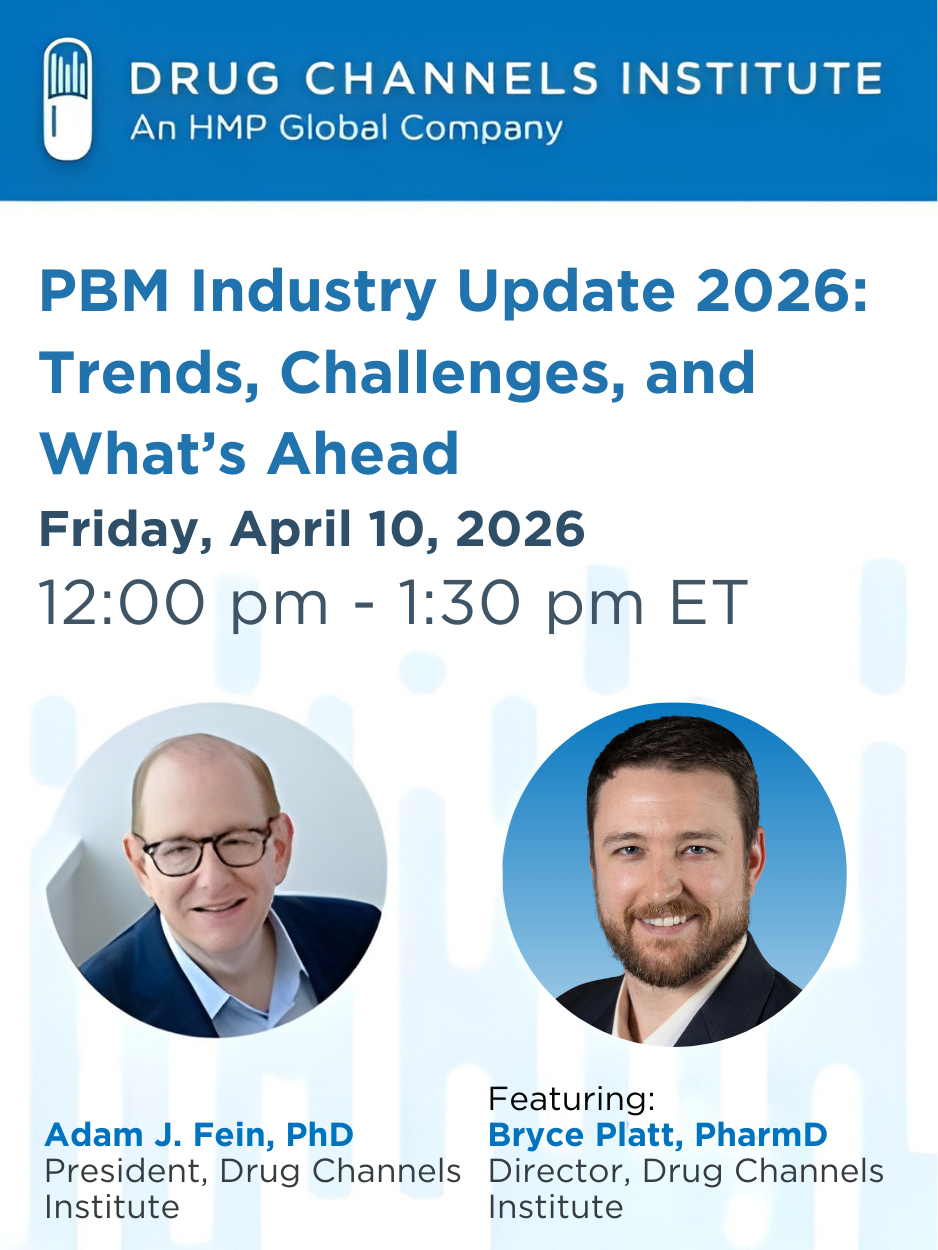
PBM Industry Update 2026: Trends, Challenges, and What's Ahead.
Don't miss DCI’s upcoming webinar on Friday, April 10, 2026, from 12:00 p.m. to 1:30 p.m. ET. Adam J. Fein and Bryce Platt will unpack the good, the bad, and the ugly of the PBM industry—and what it means for you. Click here to learn more and sign up.
Monday, April 06, 2026
The Big Three PBMs’ 2026 Formulary Exclusions: MFP, Private Label Biosimilars, and Direct-to-Patient Threats for PBMs (rerun)
This week, we're rerunning some popular posts while we prepare for Friday’s live video webinar: PBM Industry Update 2026: Trends, Challenges, and What’s Ahead.
Click here to see the original post from January 2026.
For 2026, the three largest pharmacy benefit managers (PBMs)—Caremark (CVS Health), Express Scripts (Cigna), and Optum Rx (United Health Group)—have once again excluded hundreds of drugs from their standard formularies. Our updated counts appear below.
The 2026 lists highlight how formulary preferences for Humira and Stelara are dominated by private-label biosimilars affiliated with the same parent companies that operate the three largest PBMs. Many of the preferred products feature lower list prices, signaling growing tension between traditional rebate-driven formularies and emerging net-price-based competition.
These developments matter because the pricing system that underpins PBMs’ formulary leverage is weakening. The gross-to-net bubble is deflating and the industry is moving toward what we call the Net Pricing Drug Channel (NPDC).
As low list prices, direct-to-patient distribution, and cost-plus reimbursement models gain traction, formulary exclusions will no longer deliver the economic power they once did. These changes threaten PBMs’ leverage—and profits.
As usual, Mark Cuban is leading the way. AbbVie itself now appears to be following. Consider this year’s formulary review a preview of what market access looks like when the rebate game starts to unwind.
Click here to see the original post from January 2026.
For 2026, the three largest pharmacy benefit managers (PBMs)—Caremark (CVS Health), Express Scripts (Cigna), and Optum Rx (United Health Group)—have once again excluded hundreds of drugs from their standard formularies. Our updated counts appear below.
The 2026 lists highlight how formulary preferences for Humira and Stelara are dominated by private-label biosimilars affiliated with the same parent companies that operate the three largest PBMs. Many of the preferred products feature lower list prices, signaling growing tension between traditional rebate-driven formularies and emerging net-price-based competition.
These developments matter because the pricing system that underpins PBMs’ formulary leverage is weakening. The gross-to-net bubble is deflating and the industry is moving toward what we call the Net Pricing Drug Channel (NPDC).
As low list prices, direct-to-patient distribution, and cost-plus reimbursement models gain traction, formulary exclusions will no longer deliver the economic power they once did. These changes threaten PBMs’ leverage—and profits.
As usual, Mark Cuban is leading the way. AbbVie itself now appears to be following. Consider this year’s formulary review a preview of what market access looks like when the rebate game starts to unwind.
Thursday, April 02, 2026
Building What’s Next: Join Industry Leaders to Shape Access and Affordability Trends Ahead of Asembia AXS26
Today’s guest post comes from Chrissy Hand, Chief Product and Commercial Officer at CoverMyMeds.
Chrissy highlights key themes in the future of patient access. She argues that policy changes, complex benefit designs, and affordability challenges require patient support services to be faster, more connected, and better aligned with real-world patient and provider needs.
Join CoverMyMeds’ April 23 AXS26 Innovation Roundtable.
Read on for Chrissy’s insights.
Chrissy highlights key themes in the future of patient access. She argues that policy changes, complex benefit designs, and affordability challenges require patient support services to be faster, more connected, and better aligned with real-world patient and provider needs.
Join CoverMyMeds’ April 23 AXS26 Innovation Roundtable.
Read on for Chrissy’s insights.
Labels:
Guest Post,
Sponsored Post
Tuesday, March 31, 2026
Drug Channels News Roundup, March 2026: Cigna’s 340B Workaround, Merck’s ARPA Surprise, Walgreens’ Automation Bet, Why Rebates Hurt Patients, and a DCI Team Photo
By Adam J. Fein, Ph.D.
Spring is here in always-sunny Philadelphia. The vernal equinox has brought us an unexpected bounty of noteworthy news: Plus: A bonus photo from the Drug Channels Leadership Forum
P.S. Join my nearly 69,000 LinkedIn followers for links to neat stuff, along with unfiltered commentary from the DCI community.
Spring is here in always-sunny Philadelphia. The vernal equinox has brought us an unexpected bounty of noteworthy news: Plus: A bonus photo from the Drug Channels Leadership Forum
P.S. Join my nearly 69,000 LinkedIn followers for links to neat stuff, along with unfiltered commentary from the DCI community.
PBM Industry Update 2026: Trends, Challenges, and What's Ahead.
Don't forget to register for DCI’s next webinar on Friday, April 10, 2026, from 12:00 p.m. to 1:30 p.m. ET. Adam J. Fein and Bryce Platt will unpack the good, the bad, and the ugly of the PBM industry—and explore what it means for you. Click here to learn more and sign up.

Labels:
340B,
Benefit Design,
Health Care Policy,
Mergers and Acquisitions,
PBMs,
Pharmacy