Best,
Adam

I post daily on LinkedIn, but some posts deserve a deeper look or a wider audience. This roundup highlights a few of my favorites from the past month, along with added context and takeaways.
Let me know what you think and how I can make these roundups even more useful.
In this issue: Extra: How did I end up at Drug Channels Institute?
P.S. Join my nearly 30,000 LinkedIn followers for valuable daily posts at 9 a.m. ET.
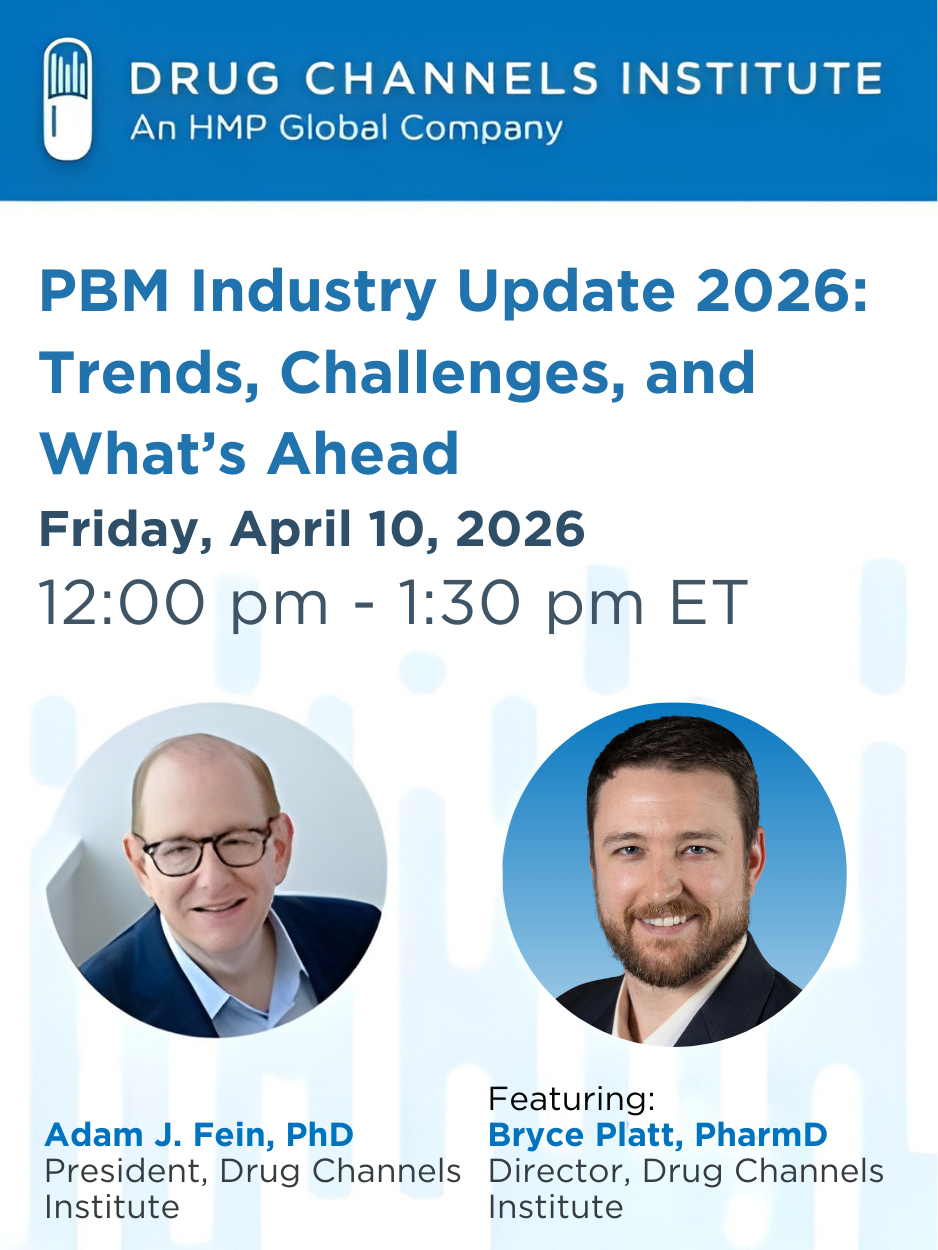
PBM Industry Update 2026: Trends, Challenges, and What's Ahead.
Don't miss DCI’s upcoming webinar on Friday, April 10, 2026, from 12:00 p.m. to 1:30 p.m. ET. Adam J. Fein and Bryce Platt will unpack the good, the bad, and the ugly of the PBM industry—and what it means for you. Click here to learn more and sign up.
Medical loss ratio requirements: Challenges posed by vertical integration, Milliman
Medical Loss Ratio (MLR) regulation requires insurers to spend 80% to 85% of premiums on medical care, not administrative costs or profit. The system was designed to limit insurer profit margins and ensure value for patients. However, vertical integration changes the outcome.
This recent Milliman paper (commissioned by PhRMA) explains how vertically integrated organizations can reshape MLR calculations through intercompany eliminations.
Two pharmacy-relevant tactics stand out: overpaying affiliated providers and retaining rebates within the corporate structure.

The net effect: profits can be shifted away from the regulated insurance entity to affiliated businesses that are not subject to MLR limits. As the authors write:
Notably, the analysis echoes finding from Health Affairs that DCI highlighted in last October’s news roundup.
This recent Milliman paper (commissioned by PhRMA) explains how vertically integrated organizations can reshape MLR calculations through intercompany eliminations.
Two pharmacy-relevant tactics stand out: overpaying affiliated providers and retaining rebates within the corporate structure.
[Click to Enlarge]

The net effect: profits can be shifted away from the regulated insurance entity to affiliated businesses that are not subject to MLR limits. As the authors write:
“When the parent company is able to create additional cost efficiencies, they have discretion as to how these savings flow through the various business segments. These savings may be reflected in lower overall premiums and passed through directly to members, as is the general economic rationale used to justify vertical integration. Alternatively, the parent company may elect to recapture some of that efficiency in the form of higher profits.”In theory, efficiencies could lower premiums. In practice, it’s not clear that patients are seeing much of that benefit.
Notably, the analysis echoes finding from Health Affairs that DCI highlighted in last October’s news roundup.
Copay Accumulators and Maximizers in 2025: Popular, Profitable, and Problematic, Drug Channels
In February, Drug Channels updated our analysis of plan sponsors’ use of copay accumulators and maximizers—the benefit designs that divert manufacturers’ copay support away from patients and toward plans and PBMs.
Below, you’ll see my summary infographic on copay maximizers. In 2025, nearly 40% of commercially insured members were enrolled in plans that had implemented copay maximizers.

If you’re managing pharmacy benefits, these designs can meaningfully reduce plan costs, but they also shift complexity and financial risk onto patients. That tradeoff will continue to attract scrutiny from regulators and policymakers.
Below, you’ll see my summary infographic on copay maximizers. In 2025, nearly 40% of commercially insured members were enrolled in plans that had implemented copay maximizers.
[Click to Enlarge]

If you’re managing pharmacy benefits, these designs can meaningfully reduce plan costs, but they also shift complexity and financial risk onto patients. That tradeoff will continue to attract scrutiny from regulators and policymakers.
Analysis of Prescription Drug Prices in Hospitals, 3 Axis Advisors
Antonio Ciaccia and the 3 Axis Advisors team published a fascinating new paper on the charges and rates that hospitals negotiated with third-party payers. They also launched a cool free dashboard here: hospitaldrugprices.org. The data come from CMS’ Hospital Price Transparency rule, which requires hospitals to report previously non-public details about their third-party contracts with commercial health plans.
The results were shocking. The same drug at the same hospital can cost 268,000 times more depending on different payers’ negotiated rates.
Even the average variation of 2,347 times between the highest and lowest rates makes no sense.
Here’s my visual summary of the results:

It's no secret that hospitals with dominant market positions can demand higher payments from plan sponsors and face little pressure to reduce prices. One or two health systems control the entire market for inpatient hospital care in nearly half of metropolitan areas. Site-of-care management can help drive patients to lower cost hospitals, but plans should still be pressuring the insurers who are negotiating their rates. In some cases, medical travel may be worthwhile.
ICYMI, DCI analyzed a subset of these data in Markup Madness 2025: Hospitals, Insurers, and the Broken Buy-and-Bill Market for Biosimilars.
The results were shocking. The same drug at the same hospital can cost 268,000 times more depending on different payers’ negotiated rates.
Even the average variation of 2,347 times between the highest and lowest rates makes no sense.
Here’s my visual summary of the results:
[Click to Enlarge]

It's no secret that hospitals with dominant market positions can demand higher payments from plan sponsors and face little pressure to reduce prices. One or two health systems control the entire market for inpatient hospital care in nearly half of metropolitan areas. Site-of-care management can help drive patients to lower cost hospitals, but plans should still be pressuring the insurers who are negotiating their rates. In some cases, medical travel may be worthwhile.
ICYMI, DCI analyzed a subset of these data in Markup Madness 2025: Hospitals, Insurers, and the Broken Buy-and-Bill Market for Biosimilars.
If the Drug Channel Were a Family, LinkedIn
Ever wonder how the drug channel would look as a dysfunctional family?
Wonder no more! Here’s how I see it. Feel free to share at your next family gathering or work conference.

Wonder no more! Here’s how I see it. Feel free to share at your next family gathering or work conference.
[Click to Enlarge]

My Path to DCI, LinkedIn
You may recognize this team photo from our March 20206 news roundup.
I took the liberty of making my joyous aura visible in the picture so you can easily spot me.

For those interested, I also shared how I came to work at Drug Channels Institute, along with my generally reproducible framework for increasing your “luck surface area.”
I took the liberty of making my joyous aura visible in the picture so you can easily spot me.
[Click to Enlarge]

For those interested, I also shared how I came to work at Drug Channels Institute, along with my generally reproducible framework for increasing your “luck surface area.”
No comments:
Post a Comment