
For 2025, DCI estimates that total prescription dispensing revenues at retail, mail, long-term care, and specialty pharmacies reached $751 billion in 2025, up 10% from the 2024 figure.
GLP-1 agonist drugs have become the dominant driver of revenue growth. Over the past five years, increases in dispensing revenues from GLP-1 products accounted for about 60% of retail pharmacies’ total revenue growth.
The table below—one of 270 in our new report—racks up DCI's first look at the 15 largest organizations that competed for a share of those dollars. For a sneak peek at the complete report, click here to download our free 32-page report overview (including key industry trends, What's New in this edition, the Table of Contents, and a List of Exhibits). We’re offering special discounted pricing if you order before April 6, 2026.
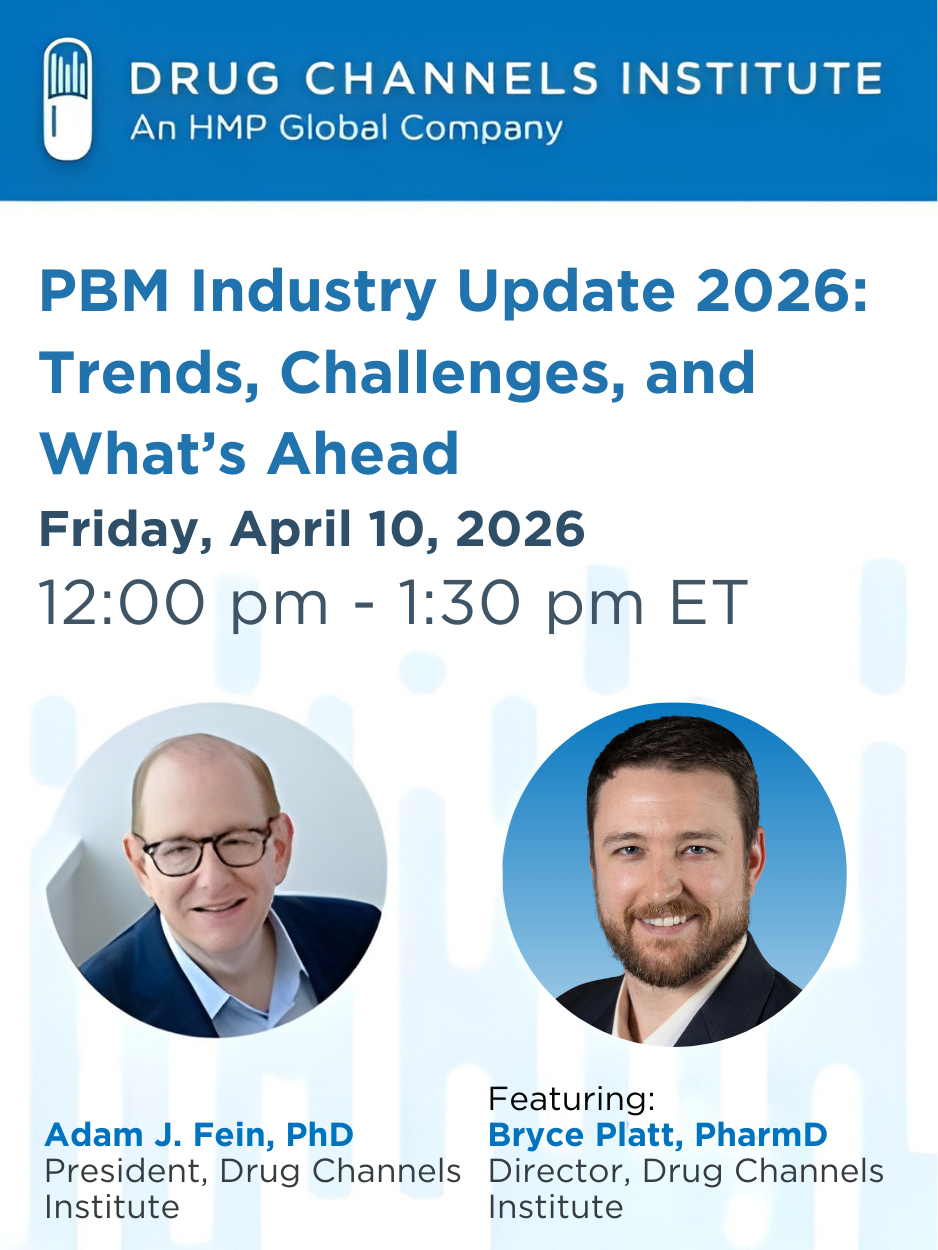
PBM Industry Update 2026: Trends, Challenges, and What's Ahead.
Don’t miss DCI’s next webinar on April 10, 2026, from 12:00 p.m. to 1:30 p.m. ET. Dr. Adam J. Fein and Bryce Platt will unpack the good, the bad, and the ugly of the PBM industry—and explore what it means for you. Click here to learn more and sign up.
RACK 'EM UP: THE TOP 15
The table below shows DCI’s estimates of the largest pharmacies ranked by total prescription dispensing revenues for 2025. For important information about these figures, please see the table’s footnotes and the Notes for Nerds section below.
[Click to Enlarge]

Observations on these figures:
- For 2025, the top 15 companies accounted for nearly three-quarters of total dispensing revenues from retail, mail, long-term care, and specialty pharmacies. The largest four companies operating pharmacies—CVS Health, Walgreens, Cigna, and UnitedHealth Group—together accounted for more than half of total U.S. prescription dispensing revenues in 2025.
- The total share of the largest 15 companies declined slightly versus 2024, reflecting revenue losses at Walgreens and the liquidation of Rite Aid. For the first time, Centene joins our top 15, driven by its operation of two specialty pharmacies.
We review the market changes and acquisitions that affected the 2025 revenues and growth rates for the largest retail chains in the following sections of DCI’s new report: Section 2.3.3., for the largest specialty pharmacies in Section 3.3.2., and for the largest PBMs in Section 5.2.2.
- Six of the largest pharmacies operate central fill mail and specialty pharmacies that are part of vertically integrated organizations that also own an insurer and a PBM: Acaria Health/Foundation Care (Centene), CarelonRx (Elevance Health), CVS Caremark (CVS Health), Express Scripts (Cigna), CenterWell (Humana), and Optum Rx (UnitedHealth Group). Two companies—BrightSpring and PANTHERx Rare Pharmacy—operate primarily as specialty pharmacies unaffiliated with a PBM. These developments reflect the growing role of specialty drugs in the pharmacy industry, as we discuss in Chapter 3 of our new report.
- In the report’s Section 12.3.1., we update our analysis of vertical integration among insurers, PBMs, specialty pharmacies, and providers within U.S. drug channels. Exhibit 267 provides a fully revised and updated version of DCI’s infamous vertical integration chart.
The revenue figures in the chart above reflect combined dispensing revenues from all entities within these organizations. Page ix of the 2026 report overview provides a handy matrix summarizing the current roles that the largest companies play in the drug channel.
So, the rack still holds 15 balls, but the lineup keeps changing. Stay tuned to Drug Channels to see who lines up the next big shot—and who scratches under pressure.
NOTES FOR NERDS
Our estimated prescription revenue data may not correspond with figures from other public sources for the following reasons:
- We have computed or estimated the figures on a calendar-year basis. The fiscal years for many public retail companies do not correspond to calendar years.
- Many companies do not report prescription revenues. We have therefore used various methods and sources to estimate the data. Where relevant, we have adjusted previously reported figures based on new disclosures of prescription revenues.
- As noted in the footnotes to the table above, we have made various adjustments to account for the pro forma impact of mergers and acquisitions. Year-over-year growth rates were also computed based on the prior year’s pro forma revenues. Pro forma revenues are computed based on the year in which an acquisition was completed.
- To permit comparability with previous years’ figures, the table above excludes revenues from the administration of COVID-19 vaccines.
- Prescription dispensing revenues are not equivalent to net spending on outpatient prescription drugs (reported by the Centers for Medicare & Medicaid Services’ National Health Expenditures data) or to “non-discounted spending” and “invoice-price spending” (reported by IQVIA).
No comments:
Post a Comment